EU budget 2028-2034

A decisive moment for the next EU budget (2028–2034)

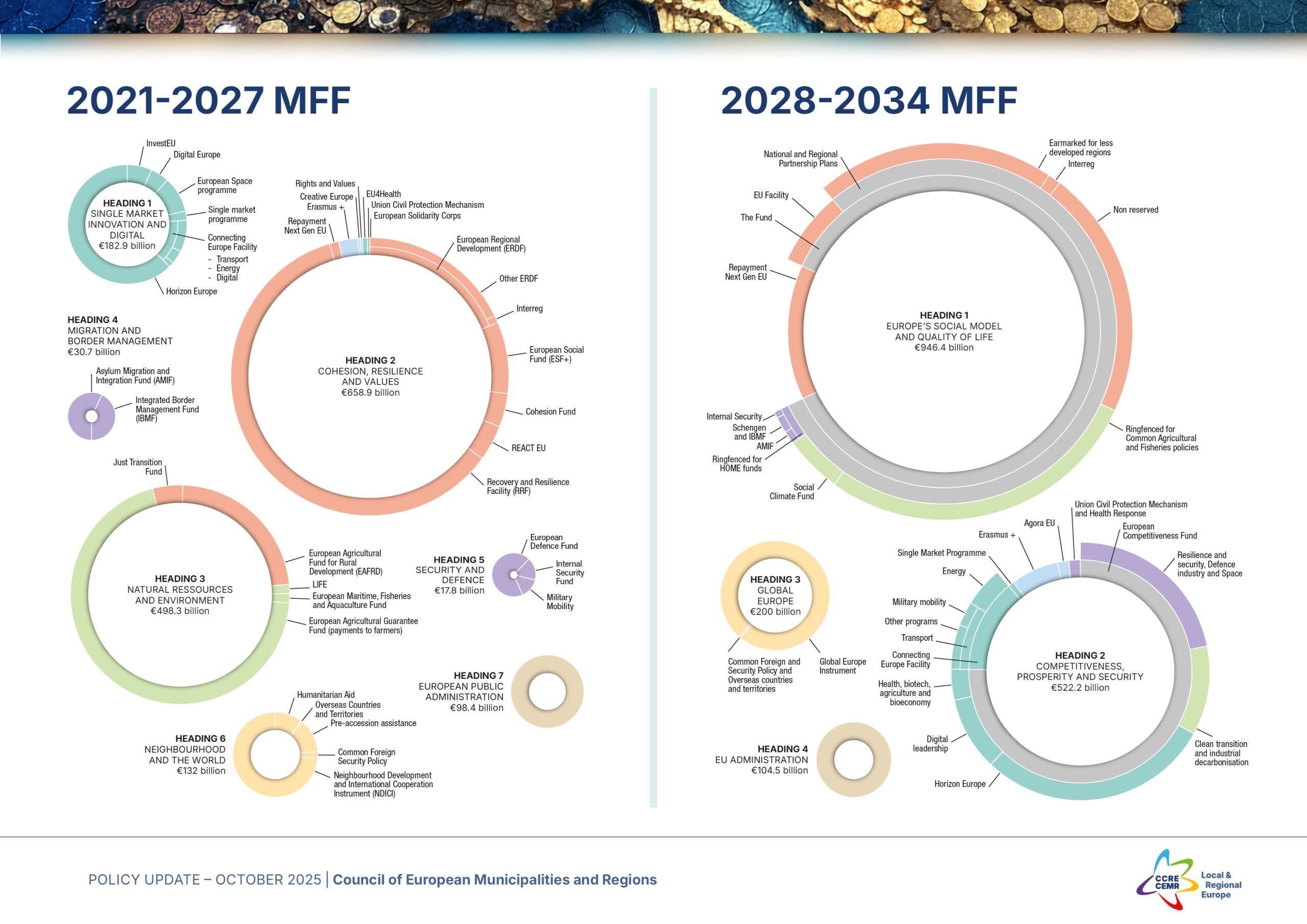
The European Commission presented its proposal in July 2025 for the EU’s next long-term budget (MFF) 2028–2034almost €2 trillion in total. Negotiations are now underway between Member States and the European Parliament, and the decisions taken in this phase will shape Europe’s capacity to invest in people and places for the next decade.

The proposal brings major changes for towns, cities and regions: more flexibility in how funds are organised through National and Regional Partnership Plans, and a stronger focus on competitiveness and security. But flexibility without clear safeguards risks recentralising decisions and weakening the place-based investments that towns, cities and regions deliver every day.

MFF - image banner

The Commission proposal would restructure shared management funds (including Cohesion Policy and the EU’s common agricultural policy) under the new Partnership Plans, giving Member States wider discretion in setting priorities — with a real risk of centralisation and less predictability for long-term territorial investment.

Key concerns for local and regional governments include:

  • A weaker “cohesion guarantee” in practice: the new setup merges multiple objectives and instruments, diluting funding explicitly dedicated to economic, social and territorial cohesion.
  • A potential drop in Cohesion Policy’s weight: CEMR estimates Cohesion Policy could shrink to around one-fifth of the total EU budget, compared to nearly one-third today.
  • Governance risk: without strong partnership rules, local and regional governments can be sidelined in the design of national plans, despite being the actors delivering investments on the ground.
  • No effective safeguarding mechanism: local access to funds should not depend on whether national-level conditions are met, when cities and regions are still expected to deliver results.

What are local and regional governments asking to be more involved in the negotiations?

CEMR calls on EU decision-makers to improve the Commission proposal so that Europe’s priorities are delivered in territories.

CEMR’s key asks include:

  • Make multilevel governance non-negotiable across the EU budget — especially in the National and Regional Partnership Plans.
  • Keep cohesion and territorial balance at the core of the next EU budget (cohesion is a treaty-based objective).
  • Require mandatory regional/territorial chapters in all Partnership Plans, co-designed with local and regional governments.
  • Protect territorial development through clear earmarking: CEMR calls for a mandatory 30% earmark for sustainable territorial development, including 15% for urban development.
  • Create a safeguarding mechanism so local governments’ access to funds is protected if national governments fail to meet conditionalities.
  • Ensure fair access to EU funding across programmes for municipalities of all sizes (simplification that works for small and mid-sized authorities, not only for big players).
  • Strengthen support for local governments in enlargement and external action, building on the proposal’s recognition of local governments in the “Global Europe” pillar.
  • Develop a dedicated EU programme to reinforce local democracy, at a time of growing intimidation and pressure on local elected representatives.

Europe’s future depends on strong, resilient territories.
The next EU budget must empower local and regional governments to deliver climate neutrality, inclusion, preparedness, and citizens’ trust. We call on the European Parliament and the European Council to ensure that cohesion and competitiveness go hand in hand for the benefit of all Europeans.

Local governments must be at the core of negotiations between the Parliament and the Council. We are not stakeholders to be consulted after the fact: we are the level of governance that knows how territories grow, innovate and create a future for people.

Christoph Schnaudigel, CEMR Co-President

Related content

Contact information