Sustainable Development Goals – European local leaders at the UN table
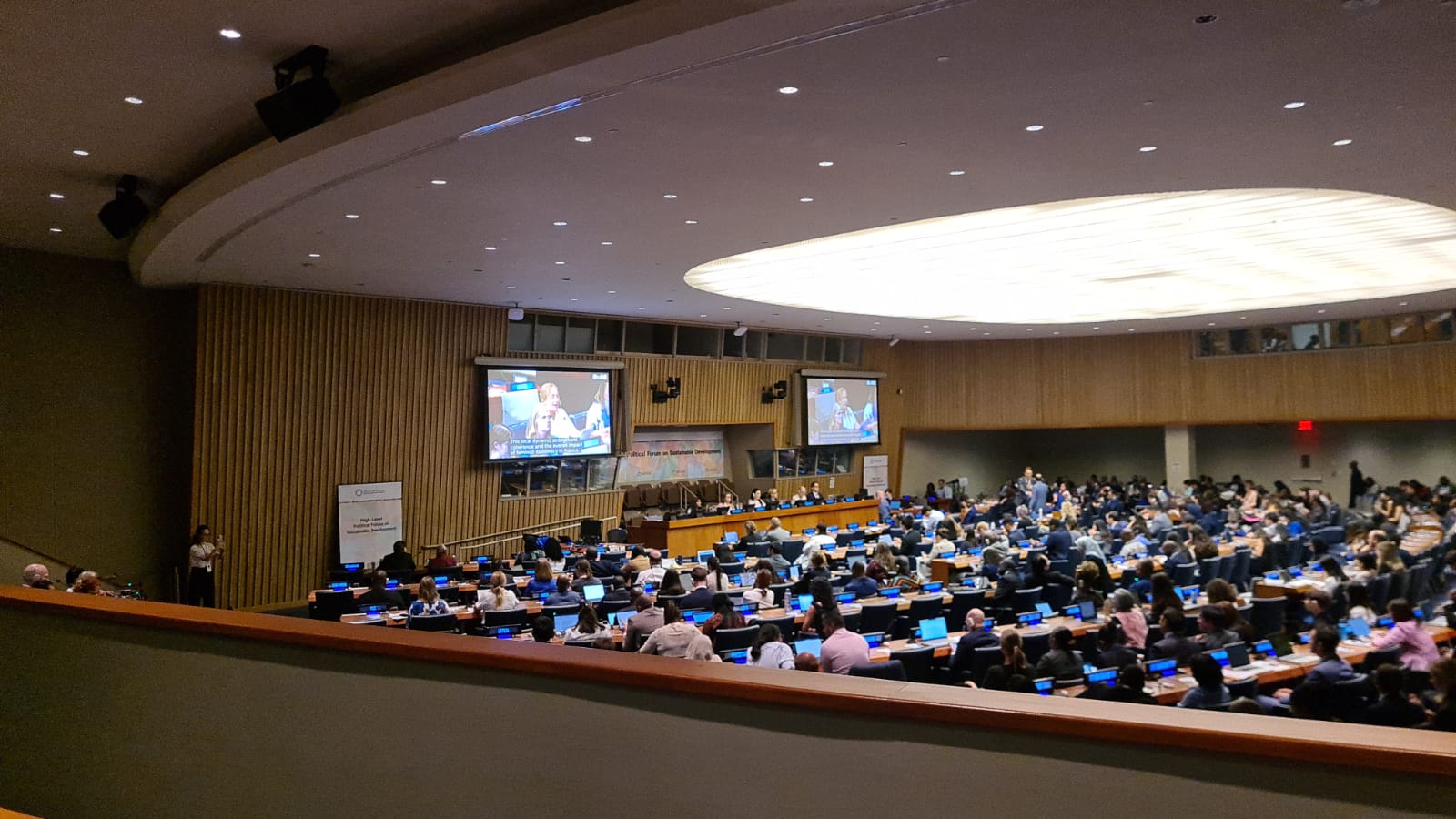
A delegation of more than 15 European local leaders is heading to New York next week for the High-Level Political Forum on Sustainable Development (HLPF) organised by the United Nations. There, they will take the floor at several high-level events to defend the key role of towns, cities and regions in localising the 2030 Agenda, but also designing its future shape. This includes, among others, the UN Habitat and Local2030 coalition annual event (14 July), UCLG Local and Regional Government Day (15 July) and CEMR-PLATFORMA breakfast meeting at the EU Delegation (16 July).
Under the theme “Transformative, equitable, innovative and coordinated actions for the 2030 Agenda for Sustainable Development and its Sustainable Development Goals (SDGs) for a sustainable future for all”, this year HLPF will concentrate on the review of a crucial goal for local and regional governments: SDG 11 (Sustainable Cities and Communities). It will also focus on SDG 6 (Clean Water and Sanitation), SDG 7 (Affordable and Clean Energy), SDG 9 (Industry, Innovation, and Infrastructure), and SDG 17 (Partnerships for the Goals), where local and regional governments play a key role.
Mayors and councillors will present the CEMR-PLATFORMA annual study: European Territories Localise the SDGs |Cities at the core of the implementation. With examples from 23 associations of local and regional governments, the report highlights concrete local actions supporting the SDGs under review in 2026, while stressing the need for stronger multilevel governance, financing and partnerships to accelerate progress towards the 2030 Agenda.
A special focus on housing and territorial inequalities underlines that achieving sustainable development requires empowering towns, cities and regions, sharing good practices, and ensuring that no community is left behind.
A large delegation of European local leaders
Among CEMR members and PLATFORMA partners’ local leaders attending HLPF this year are:
Rosa del Amo, Third Deputy Mayor of the City of Badalona (Spain), Spanish Federation of Municipalities and Provinces (FEMP)
María del Mar Vázquez Agüero, Mayor of the City of Almeria (Spain), Andalusian Fund of Municipalities for International Solidarity (FAMSI)
Óscar Bleda, Councilor of the City of Almeria (Spain), Andalusian Fund of Municipalities for International Solidarity (FAMSI)
Wim Dries, Mayor of the City of Genk (Belgium), President of the Association of Flemish Cities and Municipalities (VVSG)
Xavier García Albiol, Mayor of the City of Badalona (Spain), Spanish Federation of Municipalities and Provinces (FEMP)
Clare Hart, Vice-President of Montpellier Méditerranée Métropole and President of the Crisis Group of Cités Unies France (CUF)
Gunn Marit Helgesen, President of the Council of Europe’s Congress of Local and Regional Authorities and President of the Norwegian Association of Local and Regional Authorities (KS)
Marek Hudak, Member of the City of Bardejov and Member of Presov Regional Council (Slovakia), Member of CEMR Young Elected Officials Committee (YEOC), Association of Towns and Communities of Slovakia (ZMOS)
Eider Inuntziaga, Councillor for Citizen Attention and Participation, the 2030 Agenda and International Relations and Euskara of the City of Bilbao (Spain), CEMR Spokesperson on Local Democracy, Relations and Euskera
Antoine Le Solleuz, Deputy Mayor of the City of Nancy, President of the Lebanon Country Group of Cités Unies France (CUF)
Michael Maas, Mayor of the City of Pirmasens, German Association of Cities (DST)
Barbara Meyer, Mayor of the City of Saarbrücken, German Association of Cities (DST)
Giorgos Papanastasiou, Mayor, City of Agrinio (Greece) and second Vice President of the Central Union of Municipalities of Greece (KEDE)
André Viola, President of the Aude Departmental Council (France), Cités Unies France (CUF)
Dirk Wurm, Mayor of the City of Augsburg, German Association of Cities (DST)
Eckart Würzner, Mayor of the City of Heidelberg, German Association of Cities (DST)
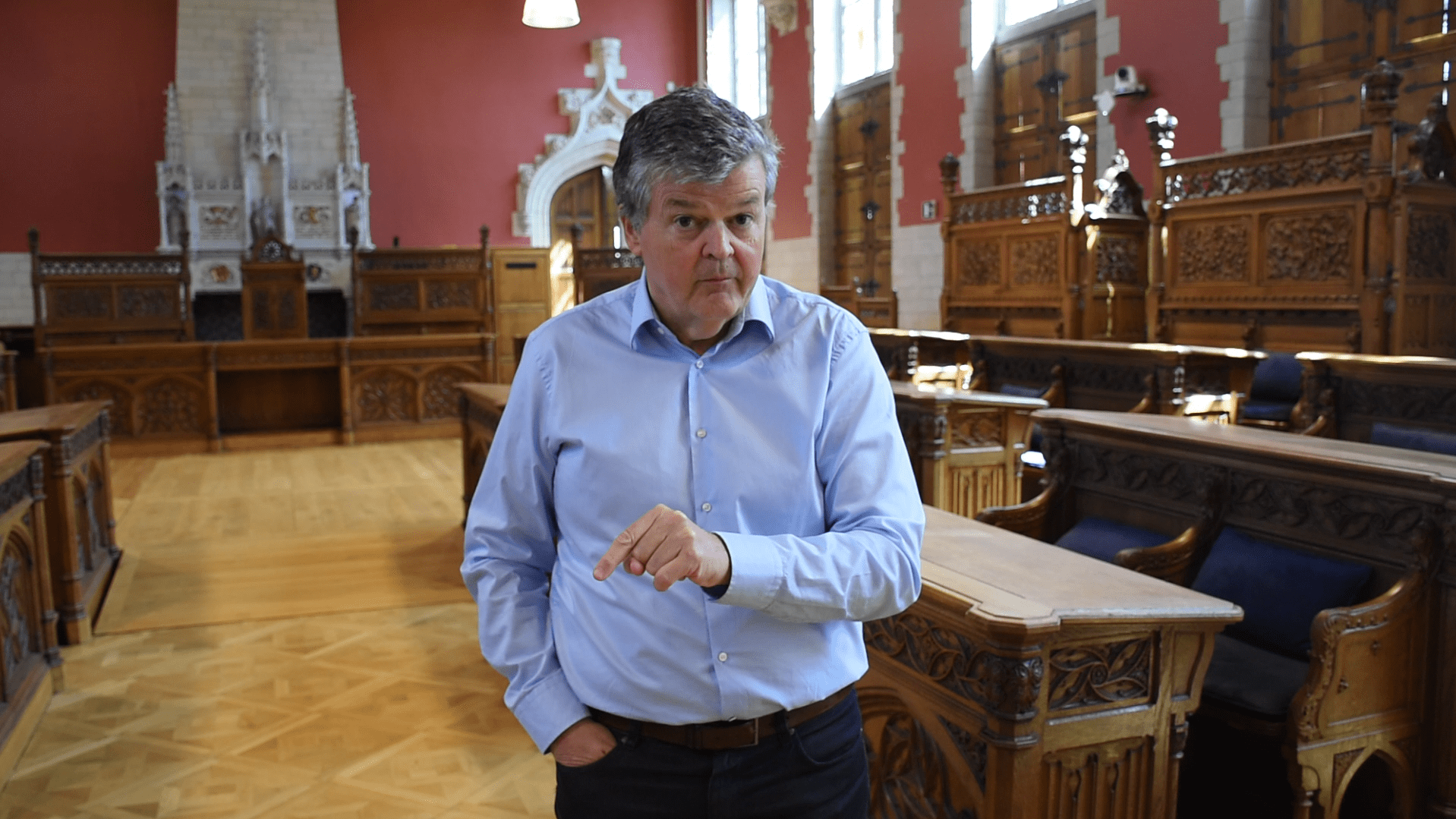
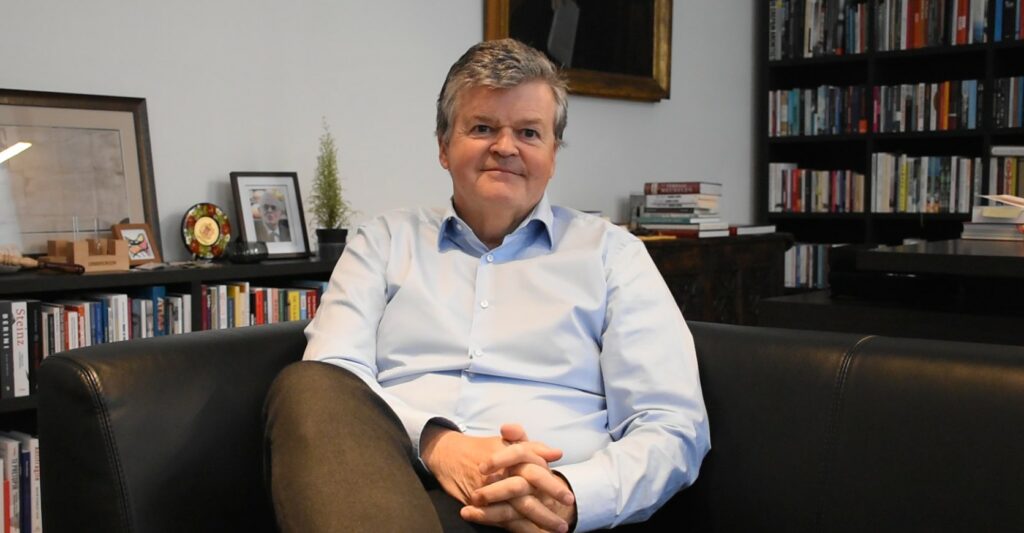
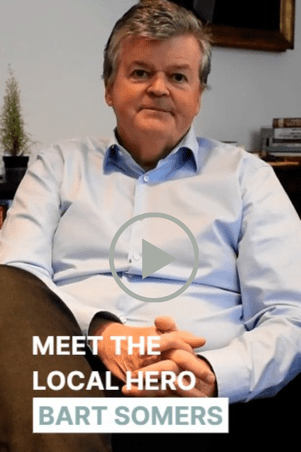
When Bart Somers talks about local government, one idea keeps coming back: it is the level where you can really make a difference.
He has been mayor of Mechelen in Belgium for 26 years — a tenure that ran in parallel with a national political career that took him through parliament, a ministerial post, and the leadership of a political party. Somers has spent much of his career moving between the two levels of politics. He never doubted which one he wanted to keep.
“The real strength of politics in the 21st century is situated on the local level, where you really can make a difference.”
A love for the city, a case for the local level
Somers was born and raised in Mechelen, and that attachment to the city is part of why he stayed. But it is not the whole story. Early in his career, he became convinced that the local level was where politics could achieve the most — a conviction he carried with him even while sitting in national government and parliament, where he pushed colleagues to lean on local leverage far more than they typically do.
*Bart Somers, Mayor of Mechelen in Belgium – interview on 29 April 2026
Climate action recognised at street level
That belief runs through Mechelen’s climate work too, recently recognised with the EUCovenant of Mayors Award for its heat decarbonisation success, which served as inspiration for other cities and towns across Europe. At a moment when some EU institutions appear to be easing off the pace of the green transition, Somers sees the local level as where the urgency is most visible and most actionable.
“At the local level, you can see with your own eyes what the impact of climate change is, and sometimes it’s really devastating. So, you feel the urgency to do something about it.”
Mechelen has been recognised for its large-scale roll-out of heat networks combined with heat storage to provide green heat to densely populated areas, while maximising the potential of local, renewable and residual heat sources.
The jury of the EU Covenant of Mayors Award applauded Mechelen’s comprehensive planning and concrete implementation steps of this specific project. The implementation of Mechelen’s heat plan is driven by strong local stakeholder mobilisation through a Heat Coalition of over 25 key organisations, from district system operators, energy cooperatives and government bodies to social housing corporations and local businesses. The jury praised Mechelen’s vast engagement and outreach efforts to get everyone on board with their heat plan, as well as their focus on supporting vulnerable communities facing energy poverty.
International, European and national frameworks matter, he says, but it is within them that cities do the concrete work: getting people onto bicycles instead of into cars and shifting investment away from fossil energy and into solar power.
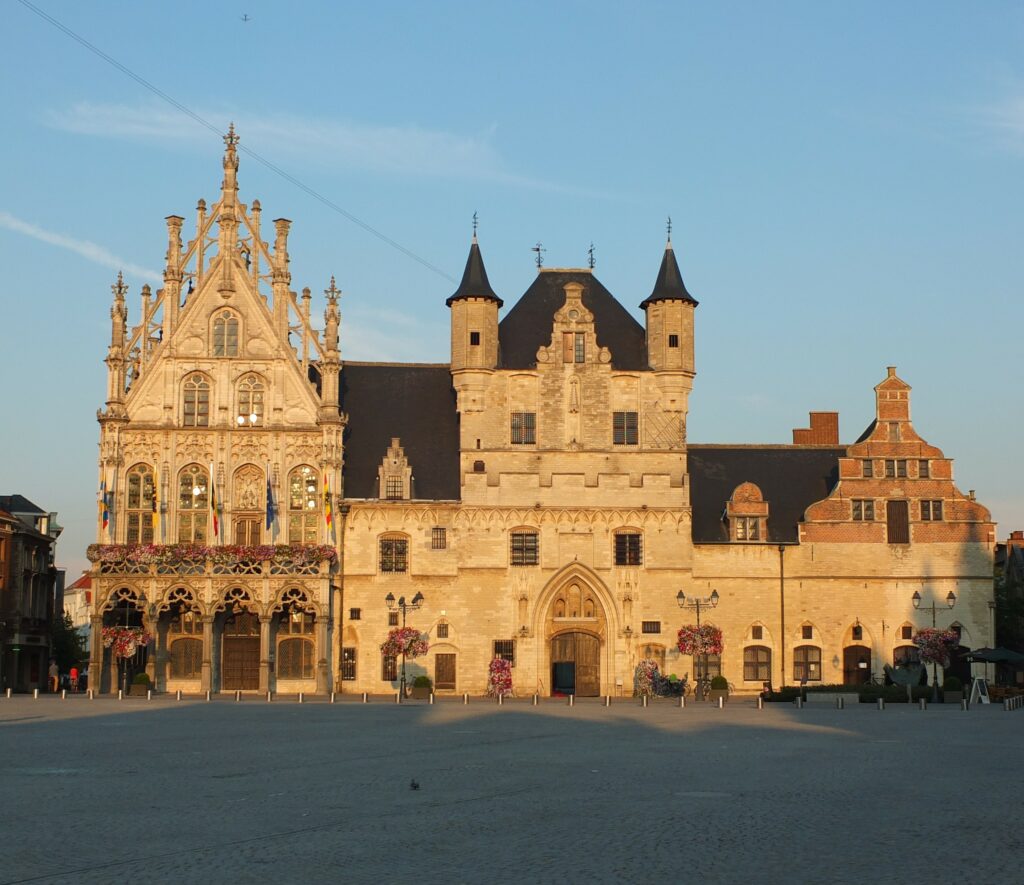
*Mechelen, city centre and city hall
Refugees, and a city that remembers
Mechelen’s response to Russia’s full-scale invasion of Ukraine was, for Somers, emotional as much as political. He had visited Maidan in 2014, as a member of parliament, while the uprising against Ukraine’s government was unfolding. Standing behind Ukraine afterwards felt like the only option for a city that, in his words, embraces human rights and European values.
“They are fighting our fight. They are sacrificing lives to protect also my country.”
Convincing the city to act was not difficult, he says, partly because Mechelen carries its own history of displacement. During the First World War, 90% of the city’s residents became refugees; Somers’ own grandfather spent three years in a refugee camp in the Netherlands, from the age of 14. It is a story many families in Mechelen share, and one that shaped how naturally the city opened its doors this time.
Safety and inclusion, hand in hand
Somers has built his reputation on combining an inclusive approach with a firm stance on the rule of law — a combination he says is often misunderstood. Asked about his most difficult decision as mayor, he points to the work of convincing people that safety and inclusion reinforce each other rather than conflict.
“Safety and inclusion go hand in hand, it strengthens each other.”
The people who most need a safe city, he argues, are not the ones in comfortable, middle-class neighbourhoods, they are mothers raising children in more vulnerable areas, where danger is closer to home. That conviction, he says, has helped Mechelen become a city where people from different backgrounds live together well.
A message to Brussels: trust the local laboratory
Asked what he would tell national and EU leaders, Somers is direct: solving today’s crises requires the local level. Cities and towns hold people’s trust, sit close to citizens, and can move fast and pragmatically in ways higher levels of government often cannot.
“We not only need a top-down policy, but we need a bottom-up policy. The place where you can reinvent democracy, where you can find real answers for the challenges of today and tomorrow, is at the local level.”
His advice is to treat that local level as a laboratory: a place to experiment and build strength that, in turn, feeds back into national and European politics.
CEMR is launching a call for proposals for the design and production of the Bridges of Trust Partnerships Award 2026 trophies.
The Bridges of Trust community brings together Ukrainian towns and cities and their European counterparts, fostering cooperation, resilience, recovery, decentralisation and mutual learning. The Bridges of Trust Partnerships Award 2026 will recognise outstanding municipal partnerships and celebrate their contribution to Ukraine’s European integration journey.
To mark these achievements, CEMR will award five municipal partnerships as Bridges of Trust Ambassadors 2026 and is looking for a creative professional or organisation to design and produce the trophies presented during the award ceremony.
What are we looking for?
Artists
Designers
Craftspeople
Studios
Creative agencies
Other qualified professionals
The selected contractor will design and produce ten trophies (two per awarded partnership), inspired by the Bridges of Trust identity and symbolising the connection between partner municipalities.
The trophies should visually reflect the values of Partnership, European Ukrainian cooperation, solidarity and trust, and resilience and reconstruction.
How to apply
Applicants should submit:
A portfolio showcasing relevant work and experience
A short concept proposal
Visual references, sketches or mock-ups
A proposed timeline for design, production and delivery
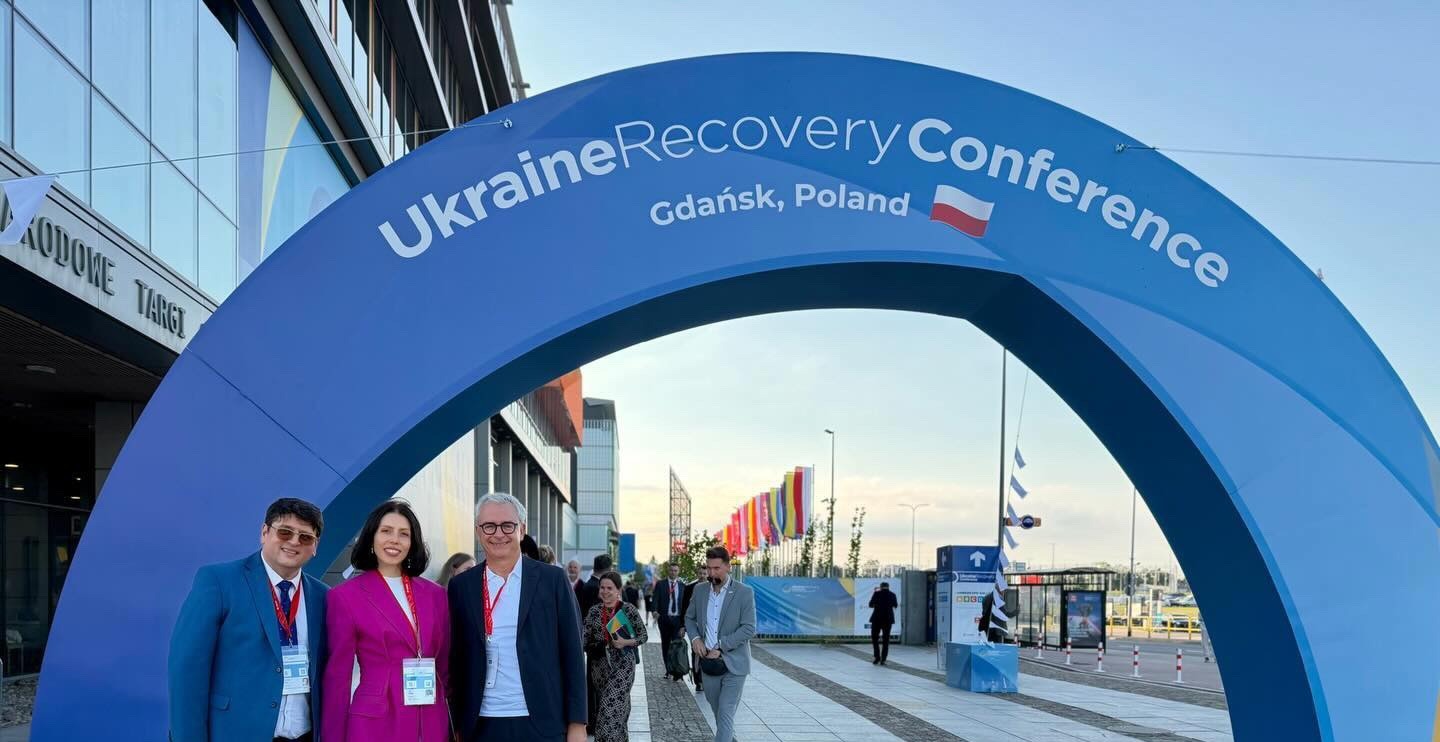
In Gdańsk, the Ukraine Recovery Conference confirmed the importance of local and regional governments in Ukraine’s recovery and EU accession
1,349 words
6–9 minutes
The Ukraine Recovery Conference (URC 2026), co-hosted by Poland and Ukraine, took place in Gdańsk on 25 and 26 June 2026. Being one of the largest international gatherings dedicated to bolstering international support for the country’s reconstruction, as well as catalysing investments for Ukrainian businesses and local governments, this edition brought together more than 5,000 participants.
Heads of state, ministers, donors, and international organisations converged in the Polish city to address the most relevant challenges to Ukraine’s future: energy, critical infrastructure, logistics, and, for the first time, security capabilities.
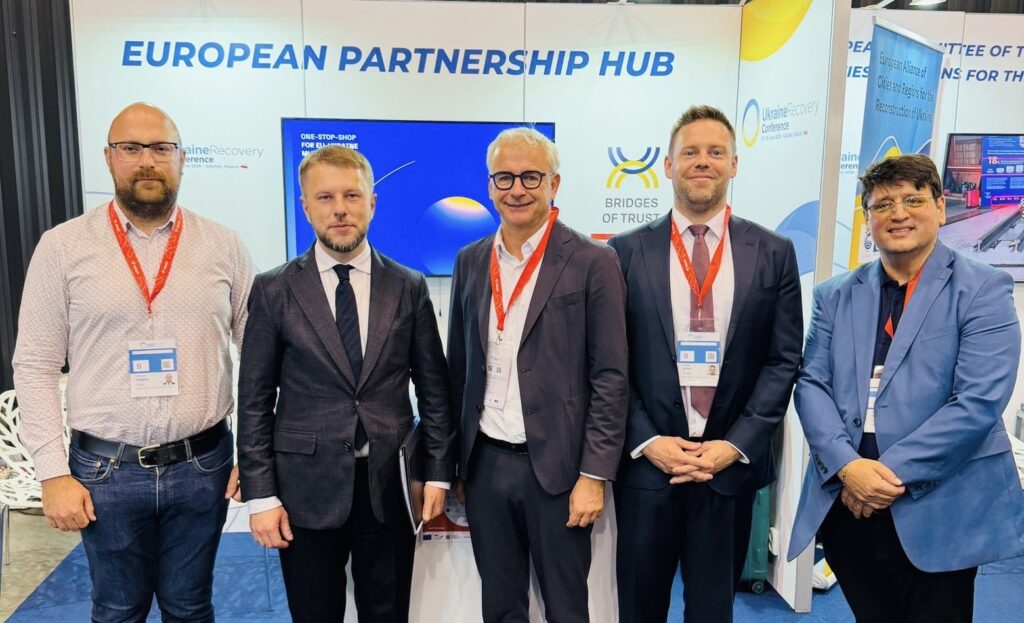
The Council of European Municipalities and Regions (CEMR) participated in the URC2026 representing the secretariat of the European Partnership Hub (EPH), which facilitates the Bridges of Trust (BoT) Community. Two years after the launch of the Matchmaking Platform at URC 2024, and one year after, the launch of the European Partnership Hub (EPH) – hosted by CEMR – at URC 2025 to facilitate the BoT Community actors active in international municipal cooperation with Ukraine, CEMR was present at URC 2026 with a dedicated booth showcasing the collective efforts of the BoT Community and best practices in international municipal cooperation with Ukraine.
CEMR contributed to the local and regional dimension of the conference and thus carried a specific voice, that of local and regional governments. CEMR President Christoph Schnaudigel represented the organisation throughout the two days conference together with Olha Pikula, CEMR Spokesperson on Enlargement and Deputy Mayor of Mariupol City Council, and Oleksandr Vasylenko, Head of the Cherkasy District Council and First Vice-President of the Ukrainian Association of Rayon and Oblast Councils (UAROR).
A joint statement and a call for coordination
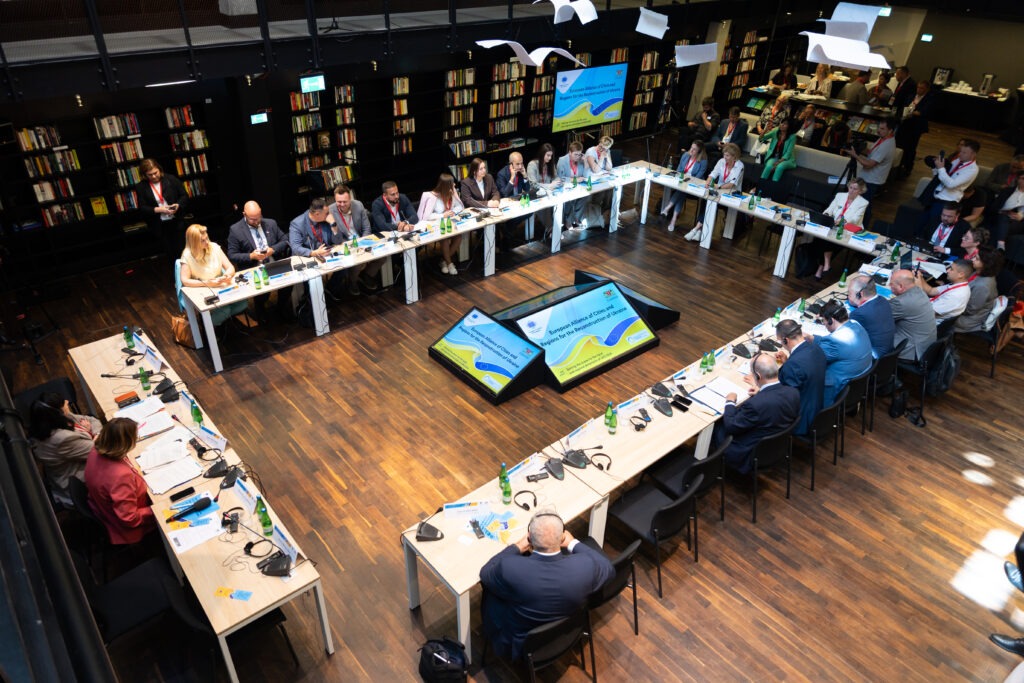
On the eve of the conference, the European Alliance of Cities and Regions for the Reconstruction of Ukraine gathered its 100 members to endorse a joint statement setting out concrete priorities for donor action and Ukraine’s EU integration. As a founding member of the Alliance, CEMR contributed directly to this collective effort. Oleksandr Vasylenko, represented CEMR during the political-level Alliance meeting.
In his statement, he emphasised: “The Bridges of Trust Community, facilitated by the European Partnership Hub and supported by U-LEAD with Europe, is a successful example of practical cooperation and joint efforts of various actors across Europe. All of these actors deliver tangible results in partnership building and capacity development demonstrating the diversity and potential of municipal cooperation.”
The statement recognises that Ukrainian towns, cities and regions have been at the core of the country’s resilience since the start of the full-scale invasion, providing emergency response, maintaining infrastructure, and acting as operational hubs for humanitarian assistance, all whilst preparing for a sustainable future. It calls on institutional partners to treat local and regional governments as strategic partners and integral decision-makers in reconstruction governance, and urges donors to allocate ring-fenced, transparent funding for local and regional development, including direct access to finance and dedicated technical assistance.
Critically for CEMR and the EPH, the statement underlines the potential of municipal cooperation with Ukraine and calls for a reinforcement of existing coordination structures, including the Alliance itself and the BoT Community facilitated by the EPH, and to foster links between local needs, funding opportunities, and the tools already established to support peer-to-peer partnerships such as the Matchmaking Platform.
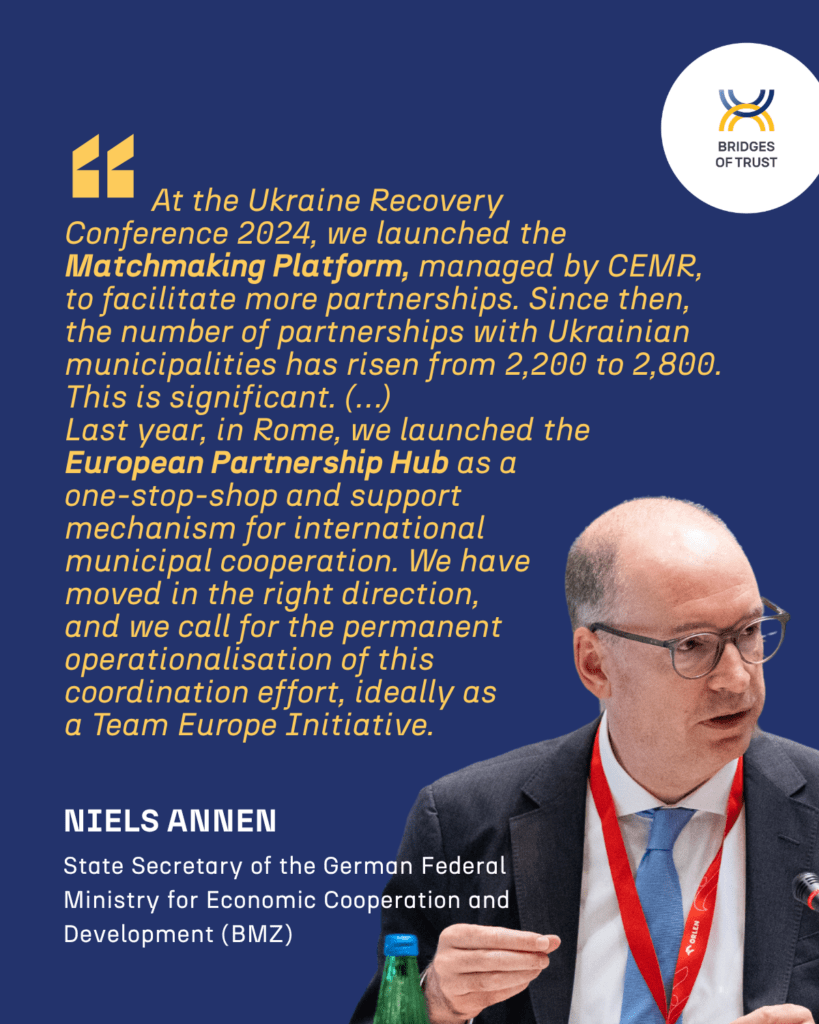
Niels Annen, State Secretary in the German Federal Ministry for Economic Cooperation and Development, recognised in his intervention the significant increase of international partnerships with Ukrainian municipalities in the last years: “We have moved in the right direction, and we call for the permanent operationalisation of this coordinated effort.”
Together with Muriel Lacoue-Labarthe, Special Envoy of the President of the French Republic for Ukraine’s Recovery and Reconstruction, he announced the launch of a new funding line for multi-partner cooperation involving municipalities from Germany, France, Poland and Ukraine.
Meetings and exchanges at the European Partnership Hub booth
The EPH booth was more than a presence at the conference. Positioned alongside partners from the Committee of the Regions, Eurocities and the Polish Association of Cities, it became a point of convergence for Ukrainian and European partners, hosting a series of exchanges that moved between the political and the technical, the bilateral and the collective.
CEMR President Christophe Schnaudigel met with Aleksandra Dulkiewicz, Mayor of Gdańsk, for a focused conversation on the next Multiannual Financial Framework and the persistent need to ensure that local and regional governments have a genuine seat at the European table. The discussion touched on the importance of coordinated messaging across CEMR, the Committee of the Regions, and city networks, with Ukraine’s recovery and the potential of municipal partnerships running as a thread throughout.
A particularly significant exchange took place between CEMR President Christoph Schnaudigel and Oleksandr Vasylenko, Head of the Cherkasy District Council and First Vice-President of the Ukrainian Association of Rayon and Oblast Councils (UAROR). The two sides explored future prospects of cooperation, covering institutional ties, peer-to-peer exchanges, and support for local self-government. The conversation also engaged with a structural question that matters enormously for Ukraine’s governance: the clarity of competences assigned to rayons and oblasts as the country pursues rebuilding and decentralisation.
CEMR President Christoph Schnaudigel also met with Vitali Klitschko, Mayor of Kyiv, Ukrainian Deputy Minister Oleksii Riabykyn, and Olha Pikula, CEMR Spokesperson on Enlargement and Deputy Mayor of Mariupol City Council, alongside representatives of the BoT Community and partner organisations.
The Director General of Expertise France, one of the key actors within the BoT Community, also visited the EPH stand. The exchange focused on the value of mapping and evaluating existing partnerships, and on the EPH’s role as a coordination structure that helps avoid duplication and fragmentation among international actors. Within the framework of the Global Gateway, the EPH was put forward as a model for building coherent, multi-stakeholder engagement in partner countries.
On the technical side, CEMR’s Director of Projects and Programmes Durmish Guri met with Astrid Kohl, newly appointed Programme Director of U-LEAD with Europe. The meeting was an opportunity to reflect on the results of this partnership: what began as a project has grown into a genuine community of actors committed to Ukraine’s recovery, decentralisation, and EU accession. That trajectory owes much to the sustained support and long-standing cooperation of U-LEAD with Europe, without which the BoT Community and the EPH would not be what they are today.
URC 2026 has shown a strong commitment to the local and regional dimension in the reconstruction of Ukraine, by the organising City of Gdansk as well as by the various associations and networks represented. Side events and exchanges at the EPH booth provided insights into the practical work of municipal partnerships, their opportunities and challenges. CEMR will use this feedback to improve the services of the EPH even further and to shape the future of municipal cooperation with Ukraine with partners from the BoT Community.
CEMR will continue working with its members and partners to ensure that local and regional governments remain central actors in shaping Ukraine’s future, as the institutions closest to the people that reconstruction is ultimately for.
About the next Ukraine Recovery Conference 2027
At the end of URC 2026 in Gdańsk, Estonia announced it will take over as host of the next Ukraine Recovery Conference, to be held in Tallinn in 2027, succeeding Poland’s role as organiser. The Prime Minister of the Republic of Estonia, Kristen Michal, confirmed the news, framing support for Ukraine’s reconstruction as directly tied to European security, and said Estonia intends to build on the momentum generated in Gdańsk. The Estonian Minister of Foreign Affairs, Margus Tsahkna, described Ukraine’s rebuilding as Europe’s largest economic project of the coming decade, spanning infrastructure, democratic institution-building, and EU integration. Estonia also plans to draw on the Nordic-Baltic Eight (NB8) cooperation format to pool regional expertise and resources in organising the 2027 conference.
For CEMR and the EPH, this transition sets the horizon for the next phase of municipal cooperation with Ukraine, building on the commitments and coordination structures reinforced in Gdańsk.
In a new position paper, the Local Alliance – a coalition of CEMR, ACR+, Climate Alliance, Energy Cities, Eurocities, FEDARENE, ICLEI Europe, and POLIS – calls on the EU to seize the revision of the Governance Regulation to make National Energy and Climate Plans (NECP) truly implementable, investable, and grounded in local realities.
Cities, towns and regions across Europe are already acting — renovating buildings, deploying renewables, transforming mobility systems. Yet the EU’s climate planning framework has not caught up. National Energy and Climate Plans (NECPs) continue to be drafted largely without the involvement of the local and regional governments that will ultimately deliver them.
The revision of the Governance Regulation, expected from the European Commission in the last quarter of 2026, is therefore a critical opportunity — one the Local Alliance is determined not to miss.
A structural disconnect
A wealth of local data, investment pipelines and climate plans already exists across Europe — from Sustainable Energy and Climate Action Plans to Climate City Contracts and local heating strategies. Yet this territorial knowledge rarely feeds into NECPs, creating duplication, fragmentation and missed investment opportunities.
Meanwhile, the multi-level dialogues already required under Article 11 of the current Regulation have largely remained disconnected from real implementation decisions or remained tick-the-box level only.
The result is a dangerous two-speed dynamic: high ambition at European and national levels, too little attention to what happens on the ground.
The Local Alliance’s answer: connect what already exists
The position paper calls for the revised Regulation to be built around four mutually reinforcing elements:
a permanent multi-level dialogue platform in each Member State to align all levels of government around NECP preparation and monitoring, taking into account national governance structures and needs;
a territorial chapter in each NECP drawing on existing local plans to show where and how national objectives will be delivered;
territorially informed sectoral pathways linking national targets across buildings, transport, heating, renewable energy, and circular economy with the local realities that determine whether delivery is actually possible;
and investment strategies that take account of local investment and capacity needs.
This is not a call for more bureaucracy. It is a call to make what already exists work together — reducing consultation fatigue, cutting administrative duplication, and turning NECPs from reporting exercises into genuine frameworks for implementation and investment.
European local leaders meet in Tangier to champion Europe’s priorities in the global UCLG network
905 words
4–6 minutes
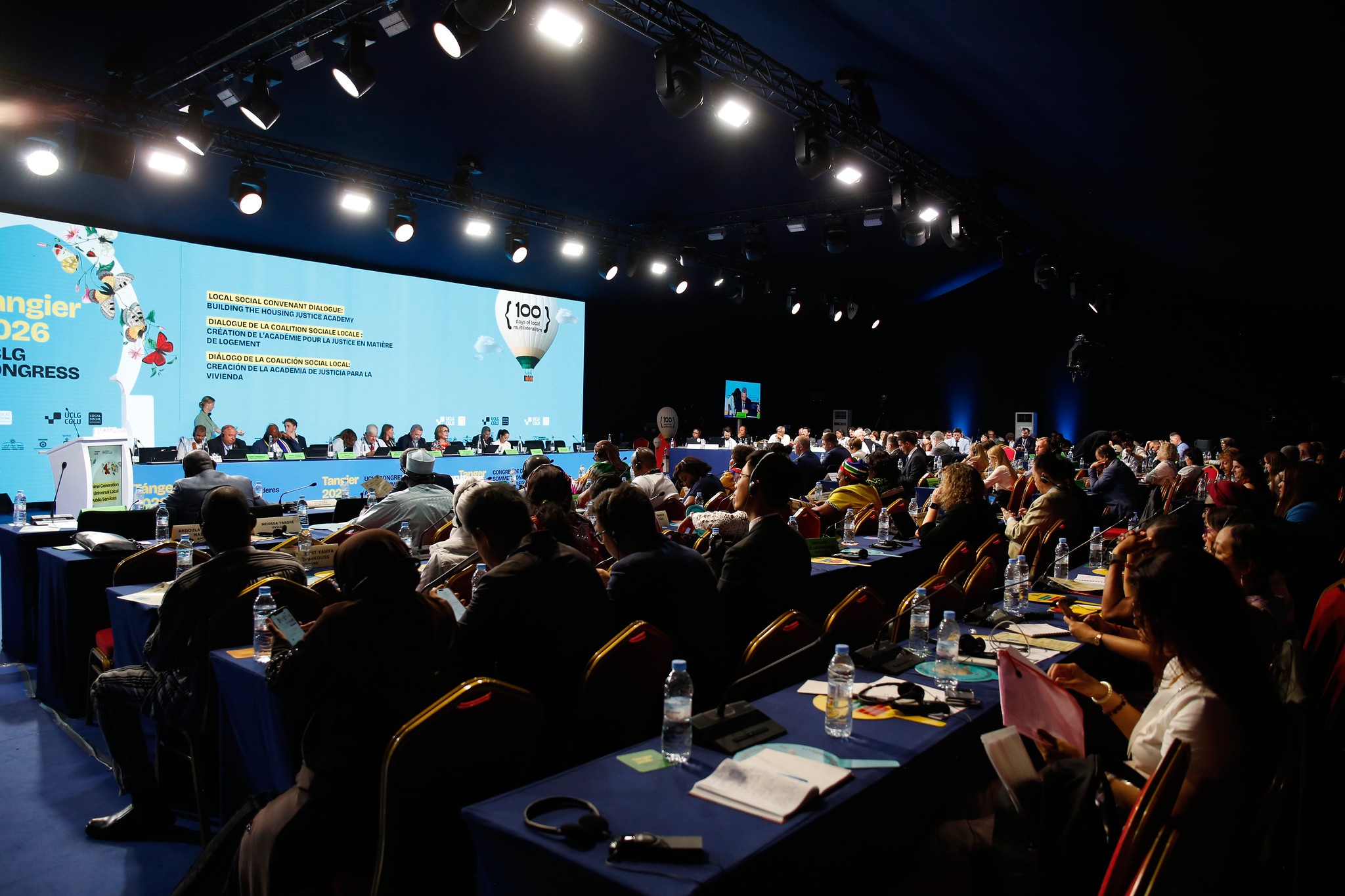
The City of Tangier hosted the 2026 United Cities and Local Governments (UCLG) World Congress and World Summit of Local and Regional Leaders from 22 to 26 June 2026, bringing together local and regional leaders from across the globe to shape a shared vision for the future of their communities. The Council of European Municipalities and Regions (CEMR), as the European section of UCLG, was present throughout the event, with two particularly significant days marking their contribution to the global programme.
Strengthening Europe’s voice in the global arena
Fabrizio Rossi, Secretary General of CEMR at the UCLG Congress 2026.
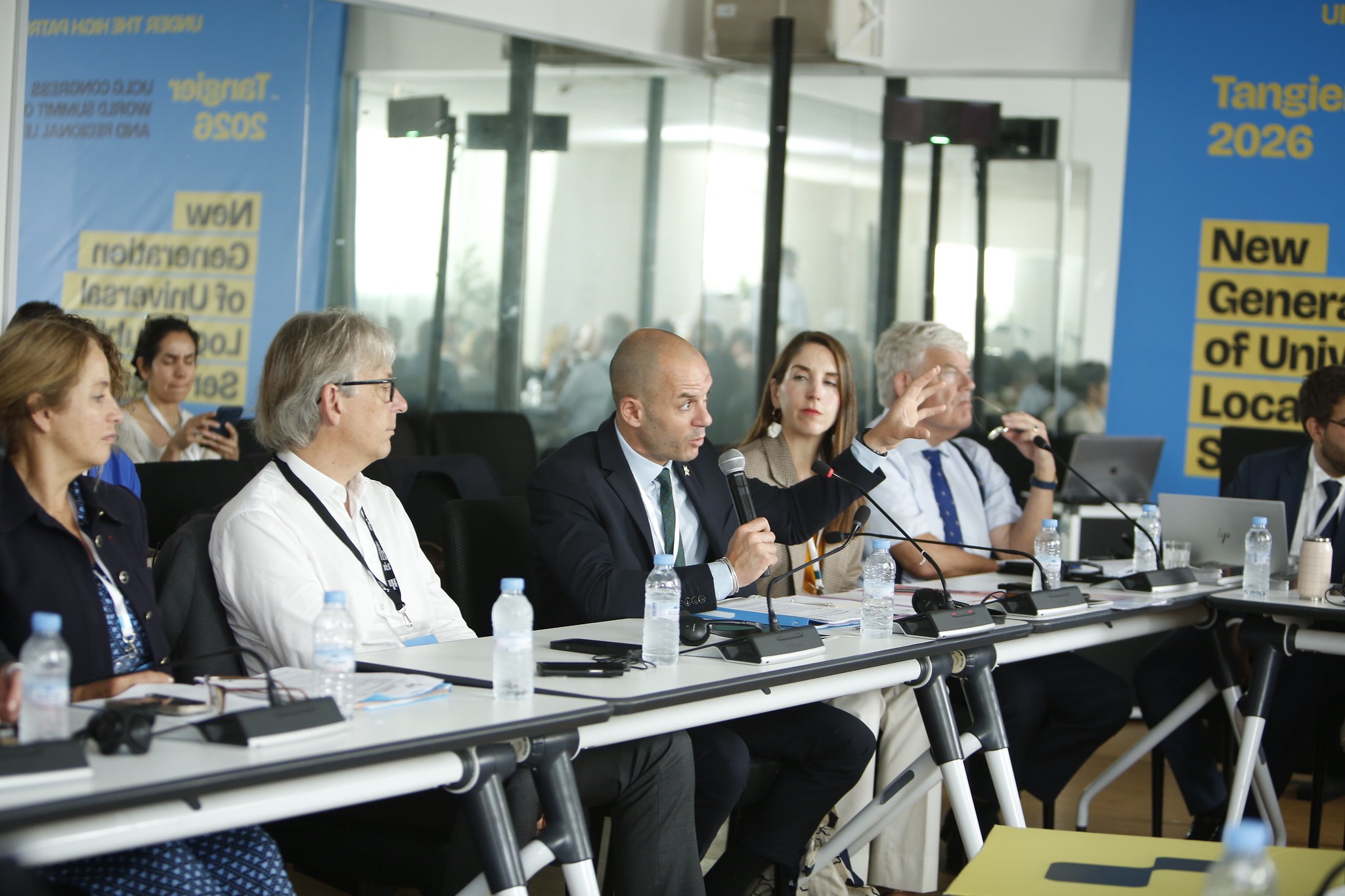
On June 23, CEMR convened the Assembly Track session “From Local Action to Global Impact: Strengthening Multilevel Governance from a European Perspective”. The session brought together local leaders from across the continent to chart European priorities for the 2026–2029 UCLG mandate, explore how local action can feed into global agendas through the Local Social Covenant, and strengthen the role of towns, cities and regions as genuine political partners in global governance.
Participants in the first two panels included Councillors and CEMR spokespersons Carola Gunnarsson and Eider Inuntziaga, as well as Shona Morrisson, Tiit Terik, and André Viola, Deputy Mayor Ursula Sautter and Regional President Marta Prates. Mayor Jan van Zanen, who served as UCLG President until this UCLG Congress, delivered the closing remarks, anchoring the session’s conclusions in a firm commitment to Europe’s role in shaping the next UCLG mandate.
New study on EU Delegations and local governments
On June 24, the third day of the Congress, PLATFORMA and CEMRannounced the publication of an upcoming study on how EU Delegations engage with local and regional governments across the globe — the first update to their landmark 2021 report, due to be released in July 2026. Preliminary findings were presented at the session, highlighting opportunities for cooperation as well as ongoing challenges.
By offering a snapshot of how EU Delegations engage with cities, towns, regions and their representative associations under the NDICI–Global Europe framework and the Global Gateway initiative, the session contributed to the broader reflection on EU development policy ahead of the next Multiannual Financial Framework (MFF) for 2028–2034.
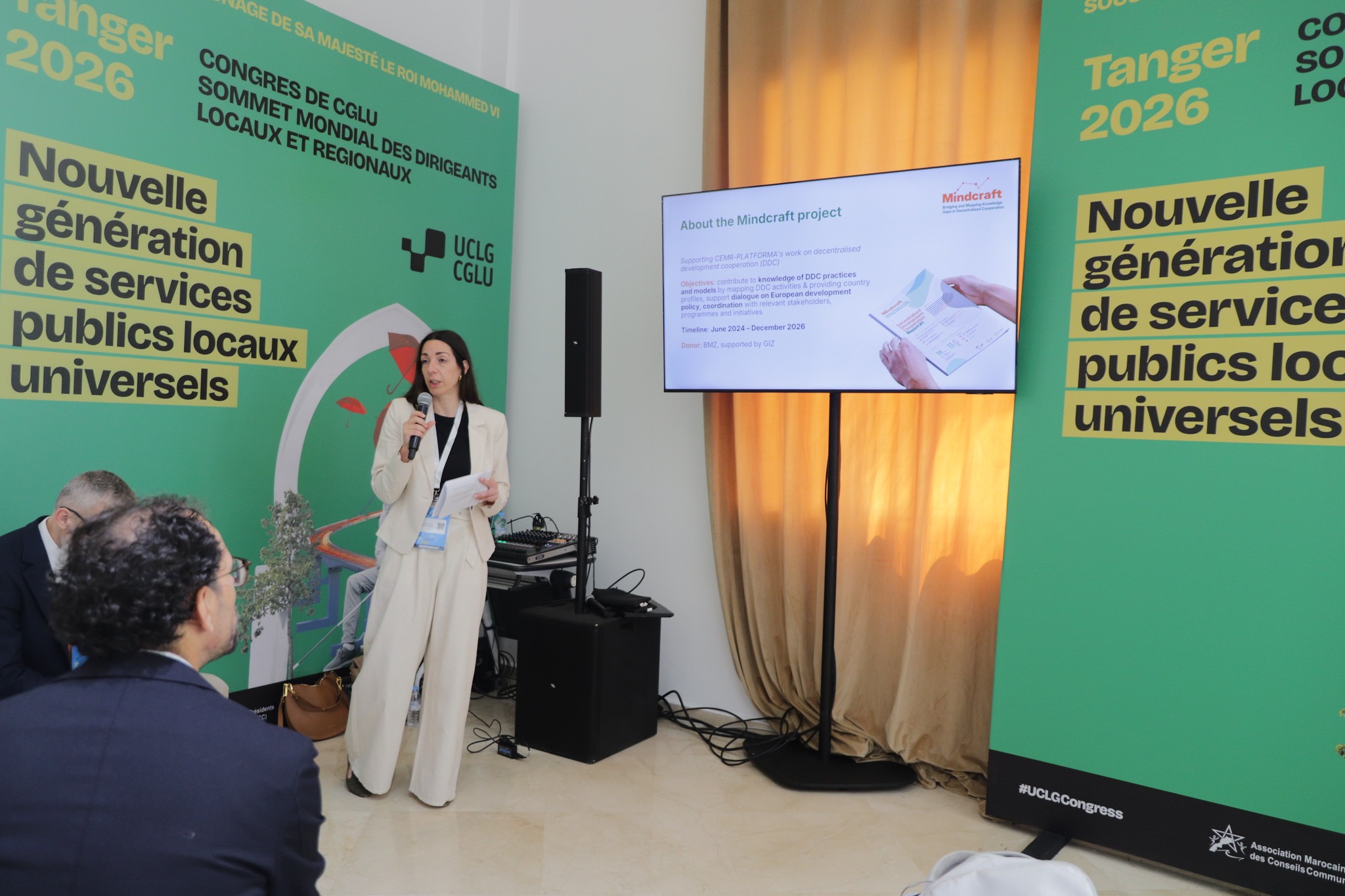
Mindcraft project presentation at the UCLG Congress 2026.
This study is produced in the framework of the Mindcraft project, funded by the German Federal Ministry for Economic Cooperation and Development (BMZ) and supported by Deutsche Gesellschaft für Internationale Zusammenarbeit (GIZ).
Advancing gender equality: the Feminist Municipal Movement
On the same day, the first-ever UCLG Women’s Assembly hosted women mayors, governors, and local leaders to advance gender equality and strengthen the Feminist Municipal Movement globally. CEMR’s Spokesperson on International Affairs, Councillor Carola Gunnarsson, reflected on eight years of progress within UCLG on gender equality — from the earliest proposals to embed gender activities in the UCLG workplan to the organisation’s broader commitment to becoming a Global Feminist Municipal Movement.
Gunnarsson was frank about the work that remains, in particular regarding female representation in upcoming leadership elections.
Gunnarsson stated: “Now it is time for us to strengthen our efforts to support and help all local governments to become Feminist Municipal Movements. Then we can see a real change and also give women and girls the rights to flourish and society the possibility to grow stronger and better for everyone.”
The UCLG Congress in Tangier reaffirmed the central role of European local and regional governments in the global municipal movement, and CEMR’s commitment to ensuring that local voices — in all their diversity — are at the heart of international decision-making.
Renewal of UCLG governance
During the UCLG Congress in Tangier, the governance bodies of the global organisation were renewed.
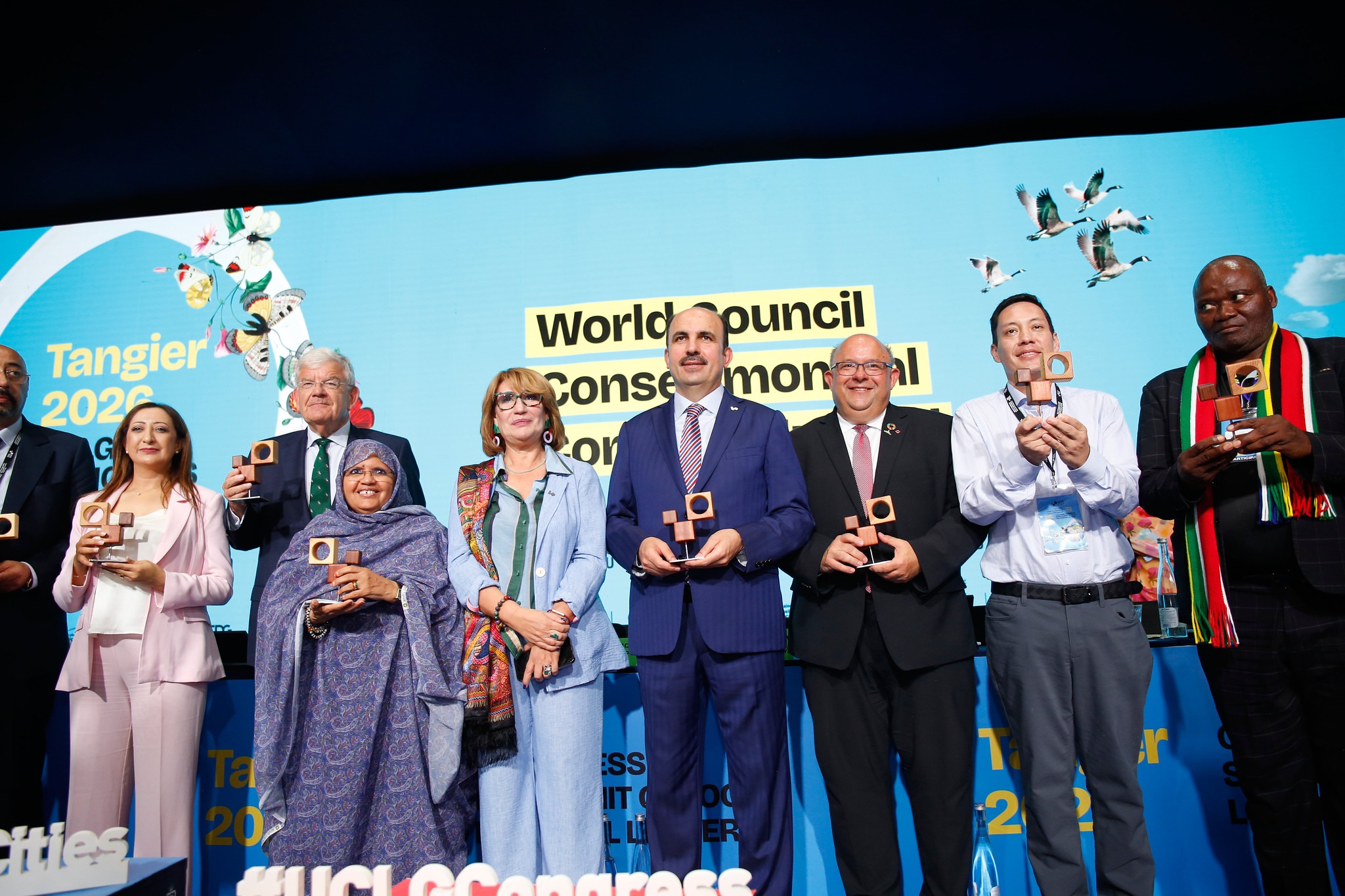
Members of the new UCLG co-presidency elected during the World Congress in Tangier.
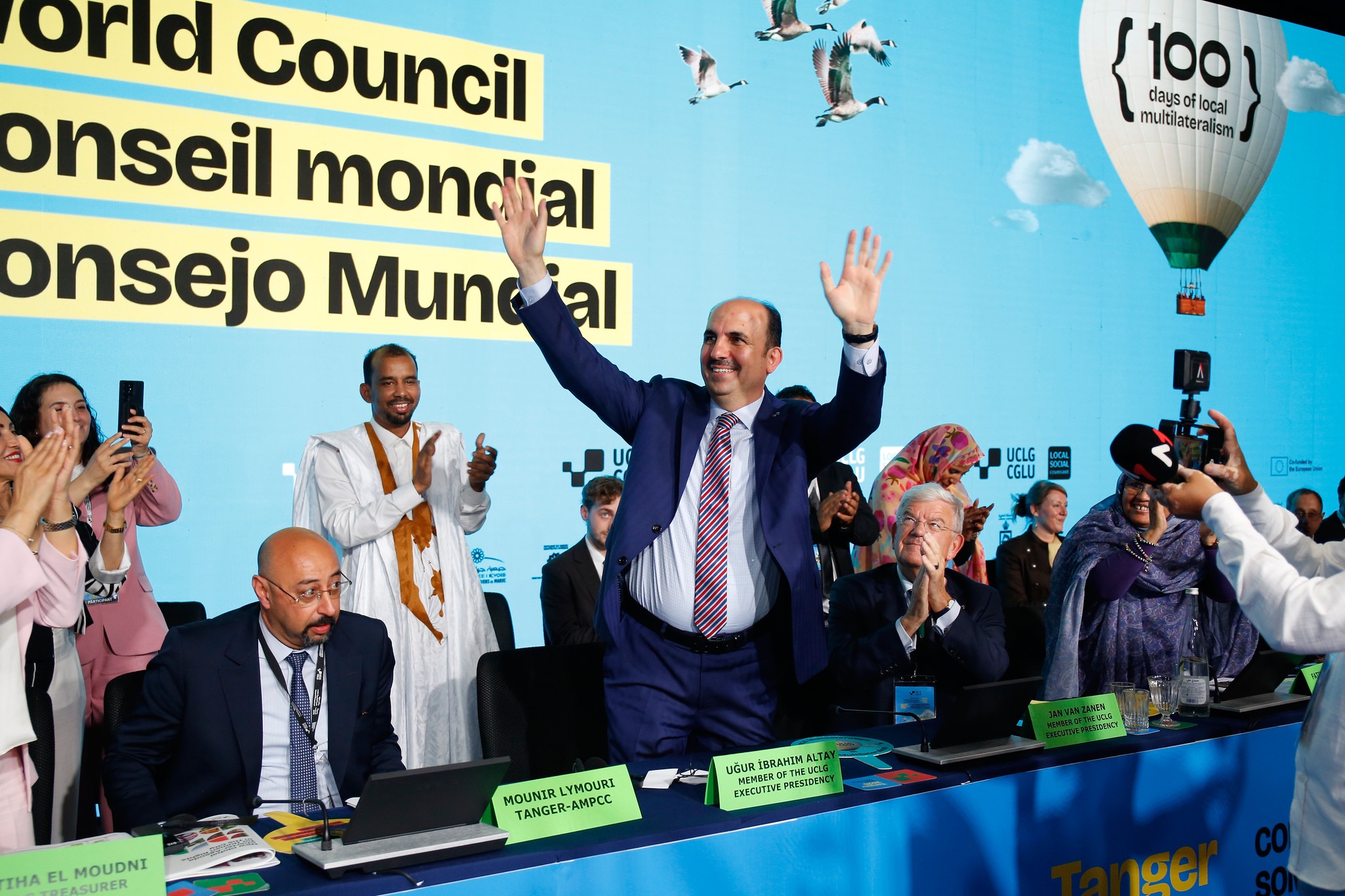
The World Congress was also the occasion to renew the UCLG’s statutory bodies, including the election of its Presidency. The Mayor of Konya, Uğur Ibrahim Altay, was elected President of UCLG, while Mr Jan van Zanen, Mayor of The Hague, was elected as one of the five Co-Presidents. CEMR warmly congratulates the new UCLG Presidency.
The Mayor of Konya elected as UCLG President during the World Congress in Tangier.
The new UCLG co-presidency was also appointed during the Congress and is composed of Bheke Stofile, President of SALGA; Aysen Nikolaev, Head of the Sakha Republic; Jan van Zanen, Mayor of The Hague; Cristian Zamora, Mayor of Cuenca; and Berry Vrbanovic, Mayor of Kitchener. Fatimetou Abdel Malick, was appointed President of the Standing Committee on Gender Equality and will also serve as Co-President of UCLG.
The Tangier Outcome Document
The Tangier Outcome Document charts the path towards a renewed social contract grounded in care, solidarity and universal local public services.
UCLG has adopted the Tangier Outcome Document, a renewed political commitment pledging local and regional governments worldwide to universal, rights-based public services. It frames housing, food, health, culture and care not as commodities – but as public goods essential to equality, democracy and peace, and lays out priority areas including housing justice, local finance reform, climate justice, food systems and conflict prevention.
It also introduces the concept of “New Essentials”; services like care, digital rights and democratic AI governance — as part of the next generation of local public provision. To back the commitments, UCLG will also be setting up new bodies, among them a Housing Justice Academy, a Women’s Council for Equality, an Intergenerational Council, and a Global Facility for Innovation in Local Public Services.
Committee of the Regions adopts AgoraEU opinion with CEMR’s key policy recommendations at its core
742 words
3–5 minutes
The European Committee of the Regions (CoR) adopted its opinion on the proposed AgoraEU programme at its 171st plenary session. Drafted by rapporteur Csaba Borboly (RO/EPP), Vice-President of Harghita (Romania) County Council, the opinion sends a clear message to EU institutions: local and regional governments are essential implementing partners in Europe’s cultural, media and democratic future.
AgoraEU is the Commission’s proposal to merge Creative Europe and the Citizens, Equality, Rights and Values (CERV) programme into a single framework for the EU budget 2028–2034, covering three strands: culture, media, and democracy. While the ambition to create coherence is welcome, CEMR and the CoR have both underlined that this merger must not dilute the specific objectives and funding of each stream.
Ahead of the CoR’s deliberations, CEMR submitted several policy recommendations to the European Committee of the Regions, which have been reflected across four critical areas.
Town twinning: from omission to recognition
The most important alignment concerns town twinning and networks of towns. CEMR called for twinning to be recognised as a strategic democratic instrument with a clearly earmarked budget line — a cost-effective vehicle for civic participation, intercultural dialogue and European identity-building, especially in the context of geopolitical instability and enlargement process.
The CoR echoes this directly, calling for twinning networks and cross-border municipal partnerships with dedicated multi-annual funding. It also formally regrets that the Commission’s proposal dropped the twinning actions provided for under CERV and calls for their reinstatement. Town twinning reaches hundreds of thousands of citizens each year, including in small towns and rural areas rarely served by complex EU funding instruments. A CEMR Analysis of Twinning in Europe in 2023 showed that local and regional government associations (LRGAs) play an important role in twinning. More than 80% of respondents stated that they have been active in this field in the last two years and 75% declared interest to continue and to develop activities even further including cultural exchange, peer learning and joint project implementation.
National Contact Points and simplified access
National local and regional government associations and city networks have a proven track record in channelling EU funding to grassroots actors. CEMR argued that well-resourced National Contact Points, hosted by national associations of local and regional governments, are essential to reach smaller municipalities, rural areas and first-time applicants, and that national associations and municipal networks should be formally recognised as strategic bridge actors empowered to manage Financial Support to Third Parties (FSTP) mechanisms.
The CoR moves in the same direction, though with its own framing. It stresses that proportionality must be assessed not only in policy scope but in accessibility and inclusivity, and endorses simplified grant formats, capacity-building support and two-step application and cascade grant processes that have proven their value in previous programmes. It also calls for AgoraEU contact points to be established at least at national level, and where appropriate at regional level. Critically, it proposes that own contribution requirements for small-scale and grassroots initiatives be capped at 10% of total eligible costs, coverable through national, regional or local co-financing — a practical measure that directly addresses one of the most persistent barriers to bottom-up participation.
Embedding local governments within the programme’s governance framework
The CoR holds that AgoraEU must fully align with active subsidiarity and multilevel governance, calling for the role of LRAs to be formally recognised in the regulation, for territorial participation indicators to be introduced, and for evaluation criteria to be explicitly linked to territorial cohesion and citizen engagement.
What comes next
The CoR opinion is a strong institutional signal. The challenge now is to carry this territorial voice into the EU budget negotiations between the European Parliament and the Council.
CEMR will continue to advocate for the four pillars essential to making AgoraEU work for local and regional governments: a protected budget line for twinning actions; well-resourced National Contact Points with a genuine territorial mandate; formal recognition of intermediary organisations to facilitate the access to small subgrants; and meaningful participation of LRGs representatives in programme governance from the outset.
Culture, media and democracy are lived every day in town squares, local theatres and municipal councils across Europe. AgoraEU has the potential to reinforce that. The CoR has made clear what it takes — now it is up to the European Parliament and the Council to move towards this direction.
Read the Committee of the Regions’ adopted opinion [here]
CEMR warns EU Parliament’s move risks weakening the Polluter Pays Principle and undermining investments by local and regional governments and wastewater operators
Following today‘s European Parliament vote on a motion for resolution calling for a “stop the clock” on the implementation of the revised Urban Wastewater Treatment Directive (UWWTD), the Council of European Municipalities and Regions (CEMR) regrets the adoption of amendments calling on the European Commission to consider suspending the implementation of the Extended Producer Responsibility (EPR) and quaternary treatment obligations*. CEMR finds the resolution to be contradictory to all the efforts that are currently being undertaken by local and regional governments, and wastewater operators, which include optimising the machinery to meet the requirements of the revised Directive.
According to Andrea Carli, CEMR spokesperson for the environment and Regional Councillor of Friuli Venezia Giulia “we are deeply concerned with the outcome of today’s plenary vote. We are standing with Europe’s local and regional governments and wastewater operators that have already been preparing the investments needed to implement the revised Urban Wastewater Treatment Directive. What they need now is aclear commitment that the agreed implementation timeline will be respected.”
The polluter pays principle, which states that those responsible for causing pollution should bear the costs of managing it and repairing the damage caused, is one of the cornerstones of EU environmental policy. Any suggestion that the implementation of EPR could be suspended risks undermining investor confidence. The revised Directive reached a carefully negotiated balance between protecting public health, safeguarding the environment, and ensuring that those responsible for pollution contribute to the costs of its removal.
CEMR recognises the legitimate need to monitor the impact of the Directive on the availability of critical and generic medicines. However, it strongly believes these concerns should be addressed through the monitoring and flexibility mechanisms already provided for in the legislation.
Therefore, CEMR calls the Commission to maintain the agreed implementation timeline and provide the legal certainty that local and regional governments, and wastewater operators need to invest in quaternary treatment. As Member States will likely start preparing next year their National and Regional Partnership Plans (NRPPs) under the next EU budget, delaying implementation could result in wastewater infrastructure investments being deprioritised or excluded from future funding plans.
In a letter written last year to Commission President Ursula von der Leyen, CEMR and 11 other European organisations representing local and regional governments, public utilities, environmental NGOs, trade unions, and water professionals urged the Commission to firmly uphold the EPR scheme introduced by the revised UWWTD, which entered into force on 1 January 2025.
*The quaternary treatment is the additional treatment step for removing micropollutants from urban wastewater, which is now an obligation introduced in the last revision of the UWWTD. EPR is the scheme that makes the contributor (pharmaceutical and cosmetic industry), cover at least 80% of the related treatment costs.
In its contribution to the European Commission’s call for evidence on the upcoming “Right to Stay” strategy, the Council of European Municipalities and Regions (CEMR) calls for a politically ambitious, place-based framework that puts local and regional governments at the centre of Europe’s response to territorial, social, economic and demographic imbalances.
For CEMR, the right to stay means that people must be able to live, work and thrive in the place of their choice: whether in a city, a town or a rural area, without being forced away by lack of public services, economic opportunity, poor connectivity or rising living costs.
This is not just a matter of territorial cohesion. It is also a question of fairness, democracy and trust in the European project. If the EU wants to respond to growing territorial inequalities, it must start by investing in the places people call home and by recognising the governments closest to citizens as strategic partners.
In its response, CEMR underlines that there can be no right to stay without access to services, housing and opportunity. Across Europe, too many territories still face shortages in healthcare, education, mobility, childcare, energy and digital infrastructure. At the same time, rising housing costs are pushing people out of cities, while many rural and shrinking areas continue to suffer from depopulation and underinvestment.
CEMR therefore calls on the EU to strengthen support for services of general interest, affordable housing and integrated territorial development. It also stresses the need to create enabling conditions for local economic opportunities in every territory, including through better transport and digital connectivity, support for entrepreneurship, and action to tackle labour shortages in key local public services.
CEMR also highlights the growing importance of climate resilience, sustainable mobility and local energy production for territorial attractiveness and energy security. Investments in adaptation, renewable energy and accessible transport must therefore be part of any credible Right to Stay agenda.
For CEMR, Cohesion Policy must be the main delivery tool of the future strategy. In the next EU budget, the Right to Stay should be recognised as a clear strategic objective, backed by strong funding, integrated territorial instruments and genuine partnership with local and regional governments in the design of national and regional plans.
CEMR also calls for the Right to Stay to be embedded in EU governance, including through the European Semester and stronger territorial impact assessments. Europe cannot continue to shape policies for territories without systematically involving the authorities responsible for delivering them.
The message is clear: the right to stay will only be real if the EU gives territories the means to remain attractive, affordable, connected and resilient. That requires political ambition, long-term investment and a genuine multilevel partnership with local and regional governments.
Jan Van Zanen, Mayor of The Hague and President of United Cities and Local Governments (UCLG), has been a long-standing figure in international municipal cooperation. With more than a decade of active involvement in both CEMR and UCLG, he has witnessed first-hand how cities increasingly shape global responses to shared challenges, from climate change to social cohesion.
This interview was recorded in Barcelona during the UCLG Retreat in February 2026. In it, Van Zanen reflects on the defining moments of his engagement within the global municipal movement, the importance of international city networks, and his vision for the future of CEMR and UCLG.
For three days, more than 300 local leaders from around the world gathered in the Dutch city, in a moment that carried both political and symbolic significance. The meeting took place 125 years after The Hague hosted the first Peace Conference, adding historical depth to the occasion.
“To see that global community come together in The Hague,” he recalls, “was very meaningful.”
*UCLG World Council in the Hague 2024
The event also marked a personal milestone, as Van Zanen took over the rotating presidency of UCLG. In line with the city’s long-standing identity as a centre for peace and justice, the gathering led to the adoption of The Hague Charter on Municipal Peace — a document designed to guide cities in fostering dialogue and strengthening peaceful communities at the local level.
“Doing so in my own city, surrounded by colleagues from all over the world, made it truly memorable,” he says. “It is something I always look back on with pride.”
Cities at the heart of global challenges
Beyond memorable milestones, Van Zanen emphasises the growing importance of international cooperation between cities. In his view, local and regional governments today are on the frontline of major global transformations.
“From climate adaptation and migration to digitalisation and social cohesion, these developments may be global, but they always land locally in our streets and neighbourhoods,” he explains.
This is precisely why networks such as CEMR and UCLG play a crucial role. For cities like The Hague — home to numerous international institutions — engagement at the global level is both natural and necessary. But, he insists, the value of these networks goes beyond visibility or prestige.
“It is about connecting with fellow cities,” he says. “Sitting around a table with other mayors and local leaders, exchanging openly about what works in practice.”
Through this peer-to-peer exchange, cities are able to share solutions, learn from each other, and build collective resilience. Ultimately, this cooperation translates into more effective policies and tangible benefits for citizens.
Recognising local governments as key partners
Looking ahead, Van Zanen outlines an ambitious but clear vision for CEMR and UCLG in the coming decade. His expectation is that both organisations become fully recognised as indispensable partners in policymaking at all levels.
“I would hope that CEMR and UCLG are recognised everywhere as key actors in shaping solutions,” he says, “not only globally but also within the European Union and at national level.”
Central to this ambition is the idea that local governments should be involved from the very beginning when major agreements are designed, whether on climate, migration or development. For Van Zanen, this early involvement is essential to ensure that policies are both practical and impactful.
“Involved from the beginning, with a clear and recognised role,” he insists.
However, recognition alone is not enough. He also stresses the importance of aligning responsibilities with adequate resources, particularly in terms of access to funding. Without this, cities cannot fully deliver on their commitments.
From ambition to impact
Underlying Van Zanen’s reflections is a consistent message: local and regional governments are not just implementers but also innovators and essential drivers of change.
“Cities implement, cities innovate, cities are closest to citizens,” he notes.
This proximity gives local governments a unique capacity to translate global ambitions into concrete action. But to fully unlock this potential, stronger collaboration between levels of governance is needed.
“If we really want impact, global governments and local governments must go hand in hand,” he concludes.
For Van Zanen, the history of CEMR over the past 75 years demonstrates precisely this capacity: turning shared ambition into tangible results. Strengthening that role in the years to come will be key to addressing the complex challenges ahead — and ensuring that solutions are rooted where they matter most: in towns, cities and regions and its local communities.