International Partnership

International Partnership - News 2022

Local government leaders renew their partnerships with the EU to boost international development


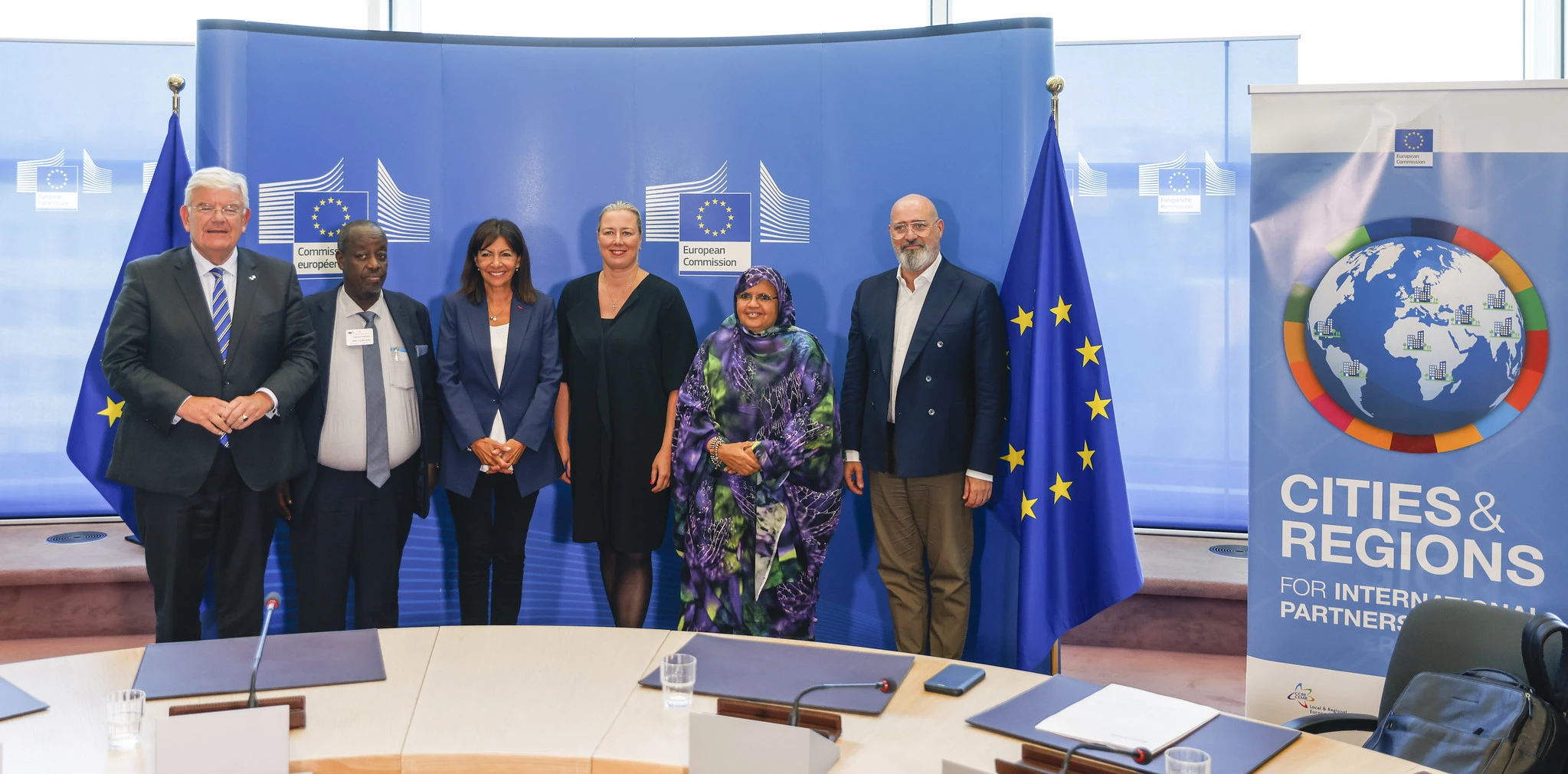
The presidents of the five largest associations of local and regional governments met yesterday (September 12, 2022) in Brussels with Jutta Urpilainen, European Commissioner for International Partnerships, to renew their partnership with the European Union on international development.

The five local government leaders present were:

  • Anne Hidalgo, Mayor of Paris (France), President of the International Association of Francophone Mayors (AIMF)
  • Stefano Bonaccini, President of the Emilia-Romagna Region (Italy) and President of the Council of European Municipalities and Regions (CEMR) & PLATFORMA
  • Innocent Uwimana, President of the Rwanda Association of Local Government Authorities (RALGA) and Board member of the Commonwealth Local Government Forum (CLGF)
  • Jan van Zanen, Mayor of The Hague (Netherlands), Chair of the Board of United Cities and Local Governments (UCLG)
  • Fatimetou Abdel Malick, President of the Regional Council of Nouakchott (Mauritania), President of United Cities and Local Governments – Africa (UCLG-A)

The five presidents signed new framework partnership agreements with the European Union for a period of four years. These agreements notably include financial support to local and regional government associations in designing policies aimed at promoting sustainable development at the international level, with a budget of €50 million under the NDICI-Global Europe financial program.

The agreements also strengthen the associations’ role in coordinating the voices of all development partners at the local level. Beyond aid to associations, development efforts by local governments will also be supported “on the ground” with €500 million, Commissioner Urpilainen said. These funds directly help cities and regions to tackle global challenges such as climate change, rising energy prices, gender equality, and democracy at the local level.

“We believe decentralised cooperation is essential to keep communication channels open and mutually enrich our practices,” said CEMR President Stefano Bonaccini. “The European Union can count on us to implement reforms that contribute to the democratisation of our territories and the revitalisation of our economies.”

The five associations “are committed to strengthening local governments in Europe and in third countries,” notably to implement the Sustainable Development Goals aimed at “making cities and human settlements inclusive, safe, resilient, and sustainable, and revitalising the global partnership for sustainable development.”

The first framework partnership agreements between these five associations and the European Union were signed seven years ago.

The presidents were accompanied by their associations’ respective secretaries-general and met other senior EU officials, including Koen Doens, Director-General of the European Commission’s Directorate-General for International Partnerships (DG INTPA).

See all the photos from the event
Watch the video recording of the ceremony
Watch the interview with the Presidents of the local government associations

Africities Summit

Calendar - Conference banner

Youngest Mayor of Portugal: “Young people should be seen as change leaders”


It is essential to better involve young people in politics and decision-making, according to João Fortes, the mayor of the Portuguese city of Mourão and the youngest mayor of Portugalduring the Africities Summit organised by UCLG Africa in Kisumu (Kenya).

The Summit, which took place from 16 to 20 May, gathered local governments and communities, civil society organisations, and development actors from across Africa, as well as many international players. The participants discussed the high stakes involved in the implementation of the UN’s 2030 Agenda. A day dedicated to youth issues highlighted the crucial role that the next generations play in the development of their territories.

Speaking on behalf of PLATFORMA and CEMR’s Committee of Young European Elected Representatives, João Fortes took part in different sessions dealing with sustainable development and challenges faced by young people.

The young elected mayor presented some of the policies being implemented at the European and local levels to move towards a more inclusive and sustainable social model. According to him, young people must be considered “change leaders” in this process.

João Fortes participated in three Africities sessions:

  • A meeting of the partners of the Covenant of Mayors in Sub-Saharan Africa (CoM SSA) on the issues related to sustainable development and climate change
  • The General Assembly of the Network of Young Elected Local Officials of Africa (YELO)
  • A “youth day”, notably dealing with urban policies aiming to better integrate young people

What role for young people in Africa and Europe’s mid-sized cities?

Whereas 2022 is the European Year of Youth, a Eurobarometer survey has found that a large segment of young Europeans consider that they are not sufficiently listened to by public authorities.

Young people face an increased risk of poverty, notably in the post-pandemic context, and there are reasons to fear the disengagement of young citizens from political life. To answer this, João Fortes stressed the need “to provide the conditions for young people to be genuinely involved in decision-making.”

The mayor of Mourão also highlighted several projects being undertaken in his municipality and in Portugal. Indeed, Portuguese youth are also being affected by the consequences of the health crisis and a difficult economic situation.

Mourão is taking numerous initiatives in these areas with the creation of a Local Assembly of Young People, a participatory budget, technical support for youth organisations, strengthened children’s access to medical and dental care, and the development of youth exchanges and volunteering opportunities.

The Summit was also an opportunity to bring together PLATFORMA and CEMR’s Committee of Young European Elected Representatives and YELO members. These two networks of African and European local leaders could soon undertake actions in cooperation to put into perspective the issues encountered in the development of their territories.

Check on Twitter with #Africities9

e-Academies

Online - News Section

From southeast Europe to central Asia: how NALAS is setting up an e-Academy in a Mongolian province


Local governments and their associations can lead international efforts to achieve sustainability. Consider the Network of Associations of Local Authorities of South-East Europe (NALAS) and its partnership with the Mongolian province of Darkhan-Uul.

With funding from the EU’s FRIENDSHIP project, NALAS is supporting the province and the efforts of its capital, Darkhan, to become a national model city for urban sustainability and livability, with a vision of becoming a “smart and green city” by 2032. But can this transition happen in practice?

One key aspect is knowledge and expertise. Since its set-up in 2004, NALAS has evolved over time into the main knowledge platform of local government affairs in south-east Europe. In particular, the NALAS e-Academy provides knowledge on topics relevant to local government professionals in the areas of investment planning, improving local services, energy efficiency, municipal finance, water management, gender equality and much more.

The idea then came of enabling Darkhan-Uul to create its own e-Academy to train its provincial and local officials. To achieve this, content and knowledge from the NALAS e-Academy will be transferred to the Mongolian province.

From reflection to reality
A Memorandum of Understanding was prepared, coordinated, and agreed upon between the project partners, including the School of Agroecology and Business, Mongolian University of Life Sciences. The document was signed during a NALAS study visit to Darkhan-Uul province in July.
In particular, the agreement aims to:

  1. Strengthen the capacities of municipal staff, elected representatives and relevant local stakeholders in governance.
  2. Transfer NALAS know-how in virtual capacity development.
  3. Contribute to the setup of an e-Academy at Darkhan-Uul Province Municipality.

The immediate next steps will be to include staff from Darkhan-Uul province and the School of Agroecology and Business in upcoming NALAS e-learning courses, identify together the courses to be transferred, include staff in developing online moderation and facilitation skills in a virtual environment and provide technical advice and support for the transfer and the initiation of activities.

During the study visit, the mayor of Darkhan City also invited NALAS to support the setting up of the Mongolian Association of Municipalities. Drawing from NALAS’ extensive experience in municipal network-building, the next steps will be defined during Darkhan-Uul officials’ upcoming visit to south-east Europe in October 2022.

Annual Report on SDG

SDG Report - News

Our annual report on the Sustainable Development Goals (SDG) goes digital


Available for the first time in an online format, PLATFORMA and CEMR have just published their fifth annual study on the localisation of the Sustainable Development Goals (SDGs). Released on the occasion of the UN High-Level Political Forum on Sustainable Development (HLPF) in New York, discover this innovative publication today at local-sdgs.eu

This study gathers the most recent information on how and to what extent associations and networks of local and regional governments have been involved in the localisation of the SDGs, both in Europe and with their global peers, and in particular during the COVID-19 pandemic. This year’s survey therefore included questions on the SDGs’ implementation since 2015 and the impact of the COVID-19 crisis. In the last two sections, there were also additional questions regarding Voluntary Subnational Reviews (VSR) and decentralised cooperation.

It gathers 63 answers from 28 European countries, 37 associations of local and regional governments and 18 municipalities and regions.

Main recommendations

Six main recommendations came out of this study, targeting EU institutions, national governments and local and regional governments and their national associations:

  1. The European Commission should report regularly on any progress made in achieving the Sustainable Development Goals (SDGs)  at the EU level and indicate how the different levels of governance have contributed to this process.
  2. We encourage associations of local and regional governments to actively take part in the Voluntary Subnational Reviews (VSR) process.
  3. Local and regional governments (LRGs) are calling for the firm recognition and inclusion by national governments of the role of LRGs and their associations in the monitoring and reporting of progress in the implementation of SDGs at the national level.
  4. European states and the EU need to strengthen their dialogue with the subnational levels and include them in any relevant high-level delegation meetings.
  5. Strengthen international cooperation to achieve the 2030 Agenda at the local and regional levels.
  6. There is still a need to localise and territorialise the SDGs through the deployment of appropriate funds and resources.

This study will be presented by a PLATFORMA-CEMR delegation at different events during the second week of the High-Level Political Forum on Sustainable Development (HLPF) taking place in New York between 5 and 15 July 2022.
This delegation is composed of:

  • Fabrizio Rossi, CEMR Secretary General
  • José Hila, Mayor of Palma de Mallorca (Spain, FEMP)
  • Hannah-Lea Braun, Member of Maichingen Council (Sindelfingen, Germany) and the CEMR Young Elected Officials Committee
  • Luis Salaya, Mayor of Cáceres (Spain, FEMP)
  • Valérie Dumontet, Vice-President of Aude Region (France, Cités Unies France)
  • Pilar Díaz, Mayor of Espluges de Llobregat, Deputy to the Presidency, Delegate for International Relations at the Diputació de Barcelona (Spain, Barcelona Provincial Deputation – DIBA)
  • Jan van Zanen, Mayor of The Hague (Netherlands, VNG International)

Directors, advisers and technicians from CEMR, the City of Paris, DIBA, FEMP, the Norwegian Association of Local and Regional Authorities (KS), UCLG and VNG International are also attending HLPF this year.

Annual report on SDGs goes digital

PLATFORMA - banner 3

Our annual report on the SDGs goes digital at the UN High-Level Political Forum on Sustainable Development (HLPF)


Available for the first time in an online format, PLATFORMA and CEMR have just published their fifth annual study on the localisation of the Sustainable Development Goals (SDGs). Released on the occasion of the UN High-Level Political Forum on Sustainable Development (HLPF) in New York, discover this innovative publication today on local-sdgs.eu

This study gathers the most recent information on how and to what extent associations and networks of local and regional governments have been involved in the localisation of the SDGs, both in Europe and with their global peers, and in particular during the COVID-19 pandemic. This year’s survey therefore, included questions on the SDGs’ implementation since 2015 and the impact of the COVID-19 crisis. In the last two sections, there were also additional questions regarding Voluntary Subnational Reviews (VSR) and decentralised cooperation.

It gathers 63 answers from 28 European countries, 37 associations of local and regional governments and 18 municipalities and regions.

Main recommendations

Six main recommendations came out of this study, targeting EU institutions, national governments and local and regional governments and their national associations:

  1. The European Commission should report regularly on any progress made in achieving the Sustainable Development Goals (SDGs) at the EU level and indicate how the different levels of governance have contributed to this process.
  2. We encourage associations of local and regional governments to actively take part in the Voluntary Subnational Reviews (VSR) process.
  3. Local and regional governments (LRGs) are calling for the firm recognition and inclusion by national governments of the role of LRGs and their associations in the monitoring and reporting of progress in the implementation of SDGs at the national level.
  4. European states and the EU need to strengthen their dialogue with the subnational levels and include them in any relevant high-level delegation meetings.
  5. Strengthen international cooperation to achieve the 2030 Agenda at the local and regional levels
  6. There is still a need to localise and territorialise the SDGs, through the deployment of appropriate funds and resources

This study will be presented by a PLATFORMA-CEMR delegation at different events during the second week of the High-Level Political Forum on Sustainable Development (HLPF) taking place in New York between 5 and 15 July 2022.

This delegation is composed of:

  • Fabrizio Rossi, CEMR Secretary General
  • José Hila, Mayor of Palma de Mallorca (Spain, FEMP)
  • Hannah-Lea Braun, Member of Maichingen Council (Sindelfingen, Germany) and the CEMR Young Elected Officials Committee
  • Luis Salaya, Mayor of Cáceres (Spain, FEMP)
  • Valérie Dumontet, Vice-President of Aude Region, (France, Cités Unies France)
  • Pilar Díaz, Mayor of Espluges de Llobregat, Deputy to the Presidency, Delegate for International Relations at the Diputació de Barcelona (Spain, Barcelona Provincial Council – DIBA)
  • Jan van Zanen, Mayor of The Hague (Netherlands, VNG International)

Directors, advisers and technicians from CEMR, the City of Paris, DIBA, FEMP, the Norwegian Association of Local and Regional Authorities (KS), UCLG and VNG International are also attending HLPF this year.

More

For more information, contact:

PLATFORMAwards

UCLG - News section

Applications are open until 15 July!


Get ready for the third edition of the PLATFORMAwards! This exceptional event rewards excellence in the field of decentralised cooperation.

Local or regional governments have until 15 July to submit their projects and partnerships online. This year our international panel of experts and elected representatives will judge the projects based on their contribution to achieving the Sustainable Development Goals (SDGs). 

If you win, we’ll make a short film promoting your cooperation partnership!

For more info on how to take part, please visit PLATFORMA‘s website. 

Capitals for Culture

Cities - News

Training capacity-building for European Capitals of Culture


On 12 & 13 May 2022, the final Academy Camp of the project “Capacity-building for European Capitals of Culture (ECoC)” will take place online, under the moderation of the the UCLG Committee on Culture. The project started in October 2019 with the aim at supporting capacity building and peer-learning activities for ECoC.
This final session of the project will provide the opportunity to review lessons learnt in the previous workshops as well as discussing additional topics and way forward.


The programme and registration link are available here.

Eastern Partnership

People Europe - News

Don’t miss the 3rd edition of the EU-Eastern Partnership Local Leaders’ Forum


The 2021 EU-EaP Local Leaders Forum will focus on the Local Public Administration and Decentralisation Reform as a booster for sustainable and inclusive development.

Decentralisation reforms in Eastern Partnership (EaP) countries (Georgia, Moldova and Ukraine) have increased the role of local governments in key strategic sectors and while significant progress has been made, major challenges remain in terms of political commitment and advancing the fiscal dimension of trends.

Against this backdrop, the Network of Associations of Local Authorities of South-East Europe (NALAS), in cooperation with the Latvian Association of Local and Regional Governments (LALRG), the Association of Local Authorities in Lithuania (ALAL), CEMR and PLATFORMA, organises this 3rd Forum online on 7 December 2021, from 10:00 to 14:00 (CET).

Local leaders from the Eastern Partnership and the European Union countries will hear about the future post 2020 Eastern Partnership priorities and the EU support: how to build a cooperation framework on local level which would promote effective governance and institutional reforms in EaP countries such as public administration and decentralisation processes in order to reinforce local democracy.

Register for the event before 1 December 2021. The working languages are English, Ukrainian, Georgian and Romanian (with simultaneous interpretation).

Follow the conversation on Twitter with #EaPLocal.

IUCN Conservation Congress

Calendar - internal events

Local governments are taking part at the IUCN World Conservation Congress in Marseille


The IUCN World Conservation Congress which will be held in Marseille from 3 to 11 September will be a highlight of the expression and commitment of local authorities in favour of biodiversity, in a context marked by the pandemic and its consequences.

This is a key step for nature conservation and the development of a new global framework for biodiversity at the 15th Conference of the Parties to the Convention on Biological Diversity (COP 15).

On this occasion, it is indeed a question of defining a new global framework for biodiversity after 2020 (following the plan defined at the Nagoya Conference (Japan – 2010), including for the action of local and regional authorities It is a question of ensuring strong recognition of the role of local authorities and of renewing decision X / 22 adopted in Nagoya which defined a specific action plan for sub-national governments, cities and local authorities.

At the initiative of AFCCRE and its spokesperson for climate, environment, sustainable development, Ronan DANTEC, Senator, city councilor of Nantes, and in conjunction with representatives of the IUCN, the French government, together with national and European organisations and global networks of local governments, several sequences devoted to local authorities are scheduled:

  • Friday 3 September (12.00-16.00): The IUCN Local Action Summit is organised by and for the members of IUCN. Those interested can consult: iucnlasummit.org.
  • Tuesday 7 September (8.30-18.00): thematic session led by the Aix-Marseille-Provence metropolis and France Urbaine which will bring together French urban areas wishing to both affirm their commitment to biodiversity and share their initiatives in this area.
  • Wednesday 8 September (10.00-13.00): the networks summit “Local and Regional authorities and their networks on the way to the COP 15” organised by AFCCRE will focus on the contribution of local and regional authorities and their networks to European and international negotiations.
  • Wednesday 8 September (15.00-17.30): session devoted to decentralised cooperation, organised by PLATFORMA, AFCCRE, DAECT, the French Committee of IUCN.

Participation is free on Wednesday 8 September but registration mandatory via this form.

Check the detailed program of these different sequences with local and regional governments.

Follow the conversation on Twitter with #IUCNCongress.

Agenda 2030

UCLG - News

Local and regional governments pave the way for the implementation of Global Goals


“Local and regional governments in Spain and across Europe are paving the way to the active implementation of the global goals”, writes Carlos Martínez Mínguez Mayor of Soria (Spain), CEMR Vice-President & Spokesperson on the 2030 Agenda and the Sustainable Development Goals (SDGs). He signed the foreword of PLATFORMA and CEMR’s joint study “European Territories Localise the SDGs: Continuity and Change in Times of COVID-19“. This opinion piece was originally published in EURACTIV.

Sustainable development is increasingly being linked with a new trending concept: sustainable recovery. The COVID-19 pandemic which hit Europe so hard, and continues to affect us, still requires local and regional governments to be at the forefront of crisis management and recovery planning, touching not only upon health issues but also social, environmental and economic priorities for citizens and local governments.

For us to build back better together towards a stronger and more resilient Europe, we need to fully harness and foster the power of the 2030 Agenda and all the values it showcases: inclusiveness and diversity; fostering new multi-sectoral and multi-level partnerships; policy coherence; gender equality; and territorial cohesion, with a particular focus on depopulated Europe. For effective localisation to take place, it is imperative to address all of the Sustainable Development Goals (SDGs) as a whole, as an indivisible set of objectives that need to be achieved from the bottom-up.

New localisation strategies need to be addressed to promote synergies between the 2030 Agenda and the New Urban Agenda, as this political commitment will lay down the foundations for the holistic urban and rural design of Europe 2030: i.e. territories for better lives.

This year, Spain is presenting a Voluntary National Review at the United Nations High Level Political Forum that includes the recently approved Sustainable Development Strategy 2030, recognising and promoting the essential role of Spanish local governments to make the Sustainable Development Goals possible in the decade of action that lies ahead.

At the local level, periodical reports have been published (such as the Voluntary Local Review by Valencia, Barcelona, Diputación de Córdoba and Málaga, among others). Progress has been made in the definition of indicators, both with the Secretary of State for the 2030 Agenda of the Spanish Government and with a national think tank (Red Española para el Desarrollo Sostenible). All this with the strong support our national association, the Spanish Federation of Municipalities and Provinces (FEMP).

Local and regional governments in Spain and across Europe are paving the way to the active implementation of the global goals, but we need to have a dedicated space in these national and international reports and decision-making processes to showcase the realities of our territories: our differences, our challenges and most of all our strengths.