

From COP commitments to local action: key messages from the CEMR-PLATFORMA Town Hall COP
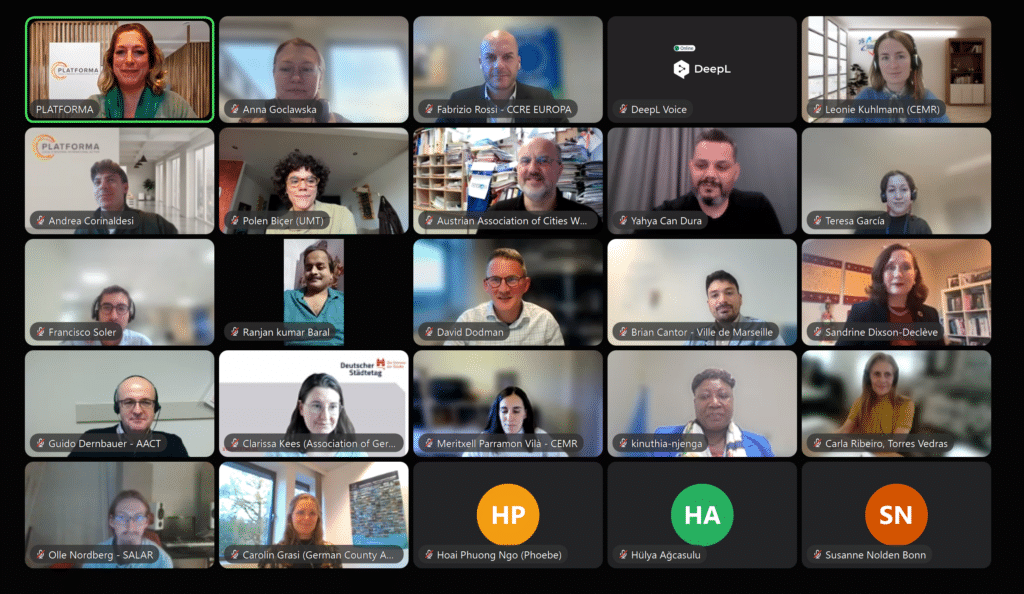
On 18 November 2026, CEMR and PLATFORMA held their second Town Hall COP, an online public webinar titled “Resilient cities for a changing climate: from COP commitments to local action”. Organised alongside COP31 in Antalya, Türkiye (9–20 November), the webinar focused on multilevel governance, adaptation, resilience and science as tools to fight climate change.
The Town Hall COP is a global initiative that helps local and regional governments connect their communities to national and international climate processes, with outcomes feeding into countries’ Nationally Determined Contributions.
An implementation COP, with a seat at the table still to be won
Opening the session, CEMR Secretary-General Fabrizio Rossi stressed that local and regional governments must be recognised as strategic partners in delivering climate ambition as the next cycle of climate commitments and future global stocktakes approach. The solutions are already known, he noted; the challenge is to unlock the enabling conditions to deliver them at scale: adequate climate finance, effective multilevel governance, access to innovation and technology, stronger institutional capacity and international cooperation.
Sandrine Dixson-Declève, Commissioner of the WHO Pan-European Commission on Climate and Health, set the scene by underlining that 2030 is “something really concrete,” within immediate reach. She called for explicit recognition of multilevel governance as essential to the climate transition and insisted that the transition must be fair. Local and regional governments, she stressed, are now in “the implementation and action game”, which means engaging with the actors who actually deliver change. She also raised hard questions about the architecture of the process: how to limit the influence of those blocking progress, such as the fossil fuel sector, how to move beyond consensus voting, and how to include towns, cities, regions and citizens in the feedback loop, alongside science through the Intergovernmental Panel on Climate Change (IPCC).
Cecilia Kinuthia-Njenga, Director for Intergovernmental Support, Collective Progress at the UNFCCC, offered a view from inside the negotiations. Governments have communicated more than 165 climate plans, she said, so “who delivers them?” is the question. Recognition of local and regional governments is growing, but “on a practical level not much has changed so far.” She identified three issues: the central role of national governments in implementation; the fact that cities and subnational authorities are named among non-party stakeholders contributing to progress, which amounts to recognition without a mandate; and calls for inclusive, multilevel and cooperative action. She also pointed to the gap between this and what local and regional governments have requested over recent COPs, including a common position endorsed by 80 networks and carried by the LGMA Constituency.
Adaptation and resilience: responsibilities need resources
Teresa García Perez, Policy Officer in the Environment Committee of the European Committee of the Regions and co-lead of the LGMA working group on adaptation, recalled that the Global Goal on Adaptation, set in Paris in 2015, still carries little influence. Discussions on indicators and on who provides the finance continue, and she considers the current draft weak because it does not address the role of subnational governments. The preamble should recognise local and regional governments, she said, and the second Global Stocktake should include both them and the scientific community.
Leonie Kuhlmann, Policy Officer on Climate and Energy at CEMR, turned to the EU level. The EU Climate Resilience Framework, she said, “gets the direction right”, with a common, preventive and territorial approach to adaptation, a scientific reference, and the inclusion of local and regional governments and nature-based solutions. Its main weakness is the gap between stronger planning and accountability requirements and the means available for local delivery. “Responsibilities assigned to local and regional governments must be matched by adequate powers, capacity and resources,” she said, adding that “cities and regions are where climate risks hit first. They must also be where resilience is built.”
What the science says about cities
David Dodman, Director of the Institute for Housing and Urban Development Studies (IHS) and a Coordinating Lead Author in the IPCC’s 5th to 7th assessments, highlighted the importance of cities in climate action: 195 governments have approved an IPCC Special Report on Climate Change and Cities in the 7th assessment cycle, due in 2027. Delay, he warned, risks an unprecedented, damaged world, whereas acting now can limit overshoot of 1.5°C, and our choices determine whether that overshoot lasts decades or millennia. Adaptation and mitigation are both urgent, mutually reinforcing and interdependent.
He described three challenges to be tackled in parallel: immediate response (addressing impacts and reducing emissions), coping and containment (managing risks and limiting peak warming), and long-term resilience (scaling adaptation and sustaining decline).
Youth and municipal perspectives
In the debate, Adam Ó Ceallaigh of the Irish Youth Delegation described how young people are working to match their actions to the promises of the Irish Presidency of COP, with phasing out fossil fuels at the top of the agenda. Young people in Ireland have pushed for the transition roadmap and are working to organise citizens’ assemblies to bring in young voices. He noted that Ireland is fortunate to have such a programme, while many countries have no equivalent.
Yahya Can Dura, Director of the Foreign Relations Department at the Union of Municipalities of Türkiye (UMT), welcomed the stronger voice of local and regional governments and shared findings from a survey of Turkish municipalities: finance was raised in 63% of responses, a lack of specialist staff in 41% and coordination with central government in 35%. The core idea of UMT’s position paper, he explained, is that local governments are not merely implementers but partners from the preparation of decisions to their financing and monitoring. New tasks must not be handed to municipalities without resources and capacity, and access to finance must not push them into unsustainable debt or exchange-rate risk.
Beyond COP31
Finally, closing the session, Boris Tonhauser, Director of PLATFORMA, highlighted the growing recognition of science and evidence-based policymaking. Climate governance, he said, does not begin or end at the COP: the road to the next round of national climate commitments, the next Global Stocktake and the post-2030 Agenda for Sustainable Development will require even stronger partnerships between local, regional, national and international actors.
The message from the Town Hall COP was consistent across speakers: recognition of local and regional governments is growing, but it must now translate into mandates, finance and capacity.
CEMR and PLATFORMA will continue to carry this message into the final days of COP31 and the processes that follow.
Watch the recording: https://youtu.be/22ArGbj7BEY
For more information, contact:

Senior Advisor – Global Agendas, SDGs & Climate