How do cities shape Europe’s digital future?
Who should Europe call to understand its digital future? How local governments are shaping Europe’s digital transformation
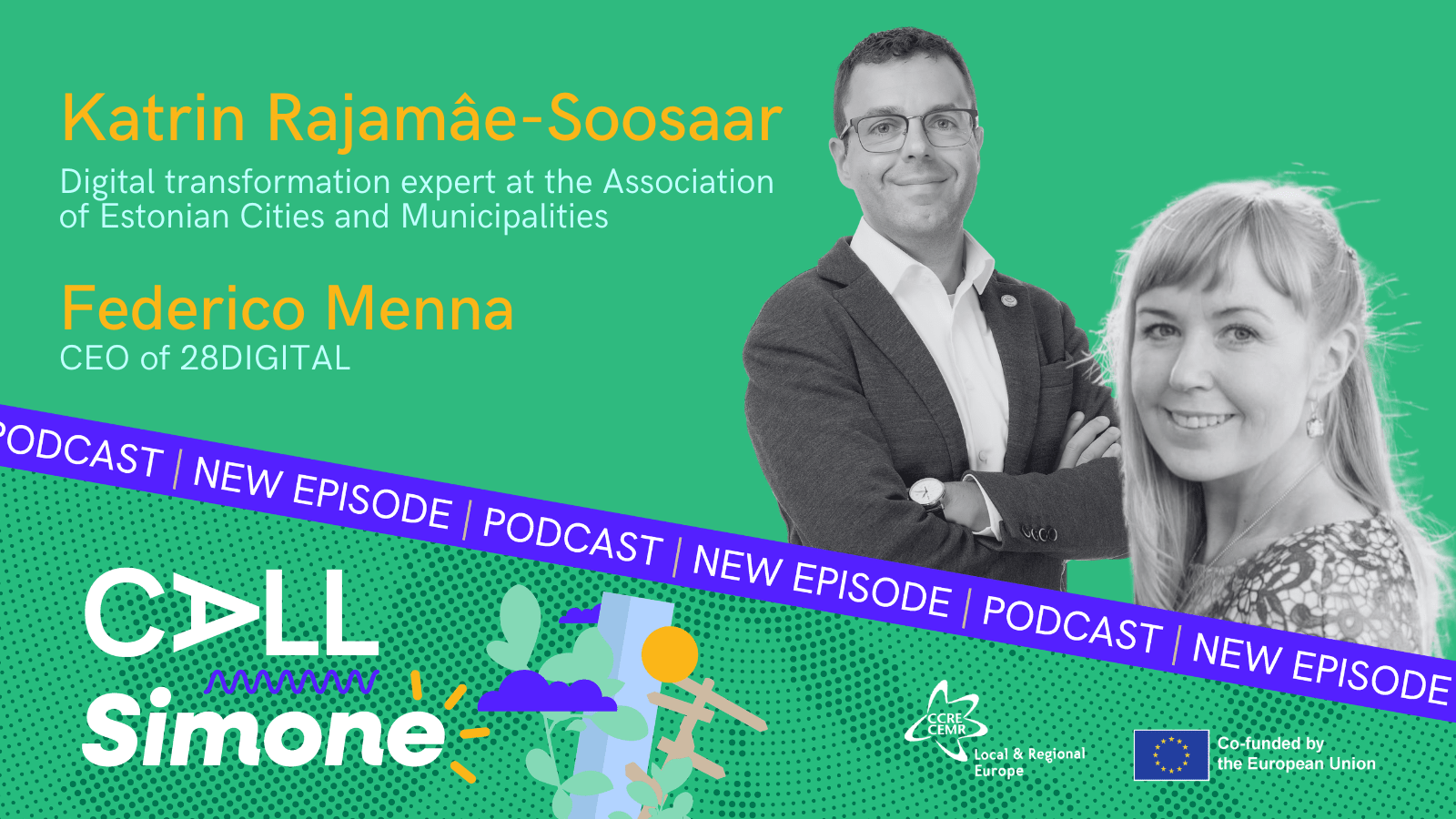
A European Commissioner, a tech company, a national government or the people delivering public services on the ground? That is the question at the heart of the latest Call Simone episode, which brings together two very different voices: Katrin Rajamäe-Soosaar, digital transformation expert at the Association of Estonian Cities and Municipalities, and Federico Menna, CEO of 28Digital.
Estonia’s digital success starts with the basics
Estonia is often described as Europe’s digital pioneer, but Katrin is quick to note that this reputation rests less on flashy technology than on decades of investment in shared infrastructure and a national digital identity used by citizens for over twenty years. Today, residents can complete most administrative procedures online, from anywhere.
That success is not confined to big cities like Tallinn. Estonia also has villages and islands of only a few hundred people, all expected to deliver the same digital services. The answer has been to build shared, reusable platforms with national authorities rather than asking each municipality to build its own.
A transition that can widen the gap
Despite this reputation, digital transformation in Estonia remains uneven. Some municipalities offer full self-service portals; others still rely on email or paper. As expectations grow around cybersecurity, data management and AI-readiness, Katrin warns that smaller administrations risk falling further behind; turning digitalisation into a source of new inequality rather than a solution to it.
Trust, e-voting and the limits of AI
Estonians’ comfort with digital public services, including secure, widely trusted electronic voting, shows what sustained investment in identity systems and user-friendly design can achieve over time. Traditional channels haven’t disappeared either: citizens who prefer face-to-face contact can still visit their municipal office.
Most current use is generative AI supporting everyday administrative work, with more advanced applications; such as detecting unauthorised construction from satellite imagery, still emerging. Her message is clear: AI should support decision-making, not replace it. Accountability and human oversight remain essential.
A stronger voice for local government
A recurring theme is the distance between European policymaking and local implementation. Local and regional governments are usually the ones putting EU digital rules into practice, yet they rarely help shape them upstream; a disconnect Katrin believes needs correcting if regulation is to work on the ground.
From Tallinn to Cluj-Napoca
The episode’s second guest is Federico Menna, CEO of 28Digital, who has led the organisation through a strategic transformation aimed at positioning it as Europe’s leading platform for digital entrepreneurship, talent and innovation. His work centres on strengthening Europe’s digital sovereignty and building bridges between startups, corporates, scale-ups, researchers and students across the continent.
Asked who he would call to talk about Europe’s digital future, Federico’s answer echoes Katrin’s: not a capital, but a city, specifically, the mayor of Cluj-Napoca.
For Federico, digital transformation doesn’t happen only in capitals or in the largest member states, and Cluj is proof of that. Having recently opened an office there, he describes a city that has used technology in an ethical and inclusive way to build a genuine tech ecosystem, complete with a strong presence of European institutions and, crucially, a good quality of life for its residents.
It is a combination he believes could be replicated across Europe, and one that reinforces the episode’s broader theme: that mayors, not just national governments, are central to shaping where Europe’s digital transformation goes next.
Looking ahead
Asked who Europe should call in ten years, Katrin’s answer is a city; one where digital skills are no longer confined to specialist teams but shared across every public service. Her hope, echoed throughout the episode, is for closer cooperation between local and regional governments across Europe, and for digital transformation decisions to be guided by democratic values rather than business interests alone.
Europe’s digital future, this episode suggests, won’t be decided solely in Brussels or in national capitals. It will be shaped, city by city, by the people turning policy into public service.
And as Europe navigates the opportunities and risks of digital transformation, finding the right balance between innovation, regulation and democracy may prove to be the most important challenge of all.
For more information, contact:

Communications Officer (matternity leave cover)