Equality in Poland

Equality in Poland - News 2020

Local and regional leaders across Europe oppose self-declared “LGBTI-free zones” in Poland


Whereas in Poland around 100 municipalities have instituted “anti-LGBTI” zones or other discriminatory measures, the Council of European Municipalities and Regions (CEMR) calls on Europe’s local and regional officials to support their peers fighting against homophobia.

Frédéric Vallier, CEMR’s Secretary General, and Emil Broberg, Regional Councillor of Östergötland (Sweden) and Chair of CEMR standing committee for Equality, have jointly penned an open letter opposing these measures to Polish municipalities, counties and regions. They call on local and regional governments throughout Europe to express their support by signing on to the letter. To date, CEMR has collected 120 signatures from 14 European countries.

Expressing his view on the situation in Poland, CEMR President and President of the Emilia-Romana Region Stefano Bonaccini said: “Equality is for all Europeans. It is a core European value. As we are striving to build a better and brighter future for all, we simply cannot turn back the clock on human rights and sweep aside decades’ worth of progress.

“In the world we live in today, equality must be built from the ground up”, said Emil Broberg. “Local and regional governments should not give way to national political movements opposing equality. On the contrary, municipalities and regions can set an example by holding firm to the principles of human rights and to the progress we have made so far.

Further confirmation of the gravity of the situation came last week with the publication of the European Union Agency for Fundamental Rights’ survey on LGBTI equality, which revealed that 40% surveyed people in Europe said they experienced harassment due to their sexual orientation. In the case of Poland, intolerance towards LGBTI people has increased overall and the country has the highest rates of physical or sexual attacks motivated by the victim being LGBTI (15%).

The open letter also seeks to counter the rise in anti-LGBTI rhetoric. It affirms the signatories’ support for Polish local and regional governments that have rejected and resisted discriminatory measures and who continue to champion the common fundamental European values of freedom and human rights.

Many local and regional officials in Poland are fighting against these anti-LGBTI measures. Marta Mazurek, Municipal Councillor for Poznan, is one of them. “As a Polish elected representative and as a European, I am very grateful for any international support for human rights and gender equal policies”, she said. “Such support energises our efforts and fortifies our courage.”

With this action, CEMR calls for dialogue and invites European cities who have relations with the concerned Polish municipalities and regions to raise the issue. Local and regional governments across Europe should share their experiences in addressing issues of discrimination and equal rights, for the benefit of all.

List of signatories (as of 25 August):

Stefano Bonaccini, CEMR President and President of the Emilia-Romana Region – Italy | Emil Broberg, Chair of CEMR’s standing committee for Equality, Regional Councillor of Östergötland – Sweden | Frédéric Vallier, CEMR Secretary General and:

Anne Hidalgo, Mayor of Paris – France | Dagur B. Eggertsson, Mayor of Reykjavík – Iceland | Fernando Medina, Mayor of Lisbon – Portugal | Zoran Janković, Mayor of Ljubljana – Slovenia | Dieter Reiter, Lord Mayor of Munich – Germany | Anders Knape, President of the Congress of Local and Regional Authorities of the Council of Europe, SALAR President, Lord Mayor of Karlstad – Sweden | Gunn Marit Helgesen, President of the Chamber of Regions of the Congress (Council of Europe), Councillor of Telemark – Abel Caballero Álvarez, FEMP President, Mayor of Vigo – Spain | Aldis Hafststeinsdottir, SAMBAND President, Mayor of Hveragerðisbær – Iceland | Bjørn Arild Gram, KS President, Mayor of Steinkjer – Norway | Emile Eicher, SYVICOL President, Mayor of Clervaux – Luxembourg | Gorka Urtaran, EUDEL President, Mayor of Vitoria-Gasteiz – Spain | Jan Van Zanen, VNG President, Mayor of Utrecht – Netherlands | Philippe Laurent, AFCCRE President, Mayor of Sceaux – France | Stéphane Roberti, BRULOCALIS President, Mayor of Forest – Belgium | Ahmed Laaouej, Mayor of Koekelberg – Belgium | Andreas Starke, Lord Mayor of Bamberg – Germany | Belit Onay, Lord Mayor of Hanover – Germany | Bojan Srot, Mayor of Celje – Slovenia | Carlos Martínez Mínguez, Mayor of Soria – Spain | Carola Gunnarsson, Lord Mayor of Sala – Sweden | Christian Scharpf, Lord Mayor of Ingolstadt – Germany | Dirk De fauw, Mayor of Bruges – Belgium | Eva Döhla, Lord Mayor of Hof – Germany | Felix Schwenke, Lord Mayor of Offenbach – Germany | François Rebsamen, Mayor of Dijon – France | Frédéric Valletoux, Mayor of Fontainebleau – France | Fritz Kuhn, Lord Mayor of Stuttgart –- Germany | Henriette Reker, Lord Mayor of Cologne – Germany | Hermann-Josef Pelgrim, Lord Mayor of Schwäbisch Hall – Germany | Javier Ayala, Mayor of Fuenlabrada – Spain | Jochen Partsch, Lord Mayor of Darmstadt – Germany | Johan Rocklind, Mayor of Gnesta – Sweden | Johanna Rolland, Mayor of Nantes – France | Josep Mayoral Antigas, Mayor of Granollers – Spain | Juan María Aburto Rique, Mayor of Bilbao – Spain | Jürgen Zieger, Lord Mayor of Esslingen am Neckar – Germany | Katrin Stjernfeldt Jammeh, Mayor of Malmö – Sweden | Klaus Mohrs, Lord Mayor of Wolfsburg – Germany | Klaus Schmotz, Lord Mayor of Hansestadt Stendal – Germany | Lilja Einarsdóttir, Mayor of Hvolsvöllur – Iceland | Madelaine Jakobsson, Mayor of Nordmaling – Sweden | Mari-Louise Wernersson, Mayor of Falkenberg – Sweden | Maria Noelia Garcia Leal, Mayor of Los Llanos de Aridane – Spain | Markus König, Lord Mayor of Nuremberg – Germany | Markus Lewe, Lord Mayor of Münster – Germany | Michael Ebling, Lord Mayor of Mainz – Germany | Michael Makiolla, Head of Unna District Council – Germany | Nathalie Appéré, Mayor of Rennes – France | Norbert Zeidler, Lord Mayor of Biberach an der Riss – Germany | Peter Freier, Mayor of Offenbach – Germany | Peter Kurz, Lord Mayor of Mannheim – Germany | Phedon Phedonos, Mayor of Paphos – Cyprus | Pietro Puccio, Mayor of Capaci – Italy | Pit Clausen, Lord Mayor of Bielefeld – Germany | Rico Badenschier, Lord Mayor of Schwerin – Germany | Simone Lange, Lord Mayor of Flensburg – Germany | Stefan Belz, Lord Mayor of Böblingen – Germany | Thomas Andersson, President of the Regional Council of Jämtland Härjedalen – Sweden | Thomas Geisel, Lord Mayor of Düsseldorf – Germany | Tim Kähler, Mayor of Hansestadt Herford – Germany | Ulrich Markurth, Lord Mayor of Brunswiek – Germany | Vanessa Slimani, Mayor of Saint Jean de Braye – France | Victor Hadjiavraam, Mayor of Morphou – Cyprus | Yoomi Renström, Lord Mayor of Ovenåker – Sweden | Alessandra Medici, Councillor of Guastalla – Italy | Amelie Tarschys Ingre, Vice-Mayor of Lidingö – Sweden | Anders Henriksson, Regional Councillor of Kalmar – Sweden | Andreas Höffler, Councillor of Berching – Germany | Andreas Wolter, Vice-Mayor of Cologne – Germany | Andri Michalia, Councilor of Lakatamia – Cyprus | Angela Everbäck, Councillor of Vellinge – Sweden | Anne Herrezeel, Councillor of Eghezée – Belgium | Anne Tyssaen, Deputy Mayor of Koekelberg –Belgium | Benjamin Debroux, Councillor of Jumet – Belgium | Jürgen Czernohorszky, Executive City Councillor of Vienna – Austria | Benjamin Plach, Councillor of Innsbruck – Austria | Carine Gol-Lescot, Deputy Mayor of Uccle – Belgium | Carine Henry, Chair of Floreffe public centre for social welfare – Belgium | Caroline Quintero P., Councillor of Namur –Belgium | Cécile Egrix, Councillor of Uccle – Belgium | Cecilia Dalman Eek, Regional Councillor of Gothenburg – Sweden | Christine Oppitz-Plörer, Councillor of Innsbruck – Austria | Christophe Pierroux, Councillor, Etterbeek public centre for social welfare – Belgium | Dennis Wedin, Vice-Mayor of Stockholm – Sweden | Dejan Lukovic, Councillor of Innsbruck – Austria | Elisabeth Unell, Vice-Mayor of Västerås – Sweden | Fatmir Limani, Deputy Mayor of Koekelberg – Belgium | Gabi Laschet-Einig, Councillor of Lahnstein – Germany | Giovanni Allodi, Councillor of Poviglio – Italia | Gunilla Westerberg Dupuy, Deputy Mayor of Suresnes – France | Henrik Hammar, Councillor of Örkeljunga – Sweden | Irlin Bråten, Trosopplæringsleder – Norway | Janine Bex, Councillor of Innsbruck – Austria | Jelena Drenjanin, Vice-Mayor of Huddinge – Sweden | Jens Sjöström, Regional Councillor of Stockholm – Sweden | Jonathan Biermann, Alderman of Uccle – Belgium | Khalil Aouasti, Deputy Mayor of Koekelberg – Belgium | Kathleen Delvoye, Councillor of Uccle – Belgium | Laura Goffart, Councillor of Liège – Belgium | Laurence Vandeputte, Councillor of Uccle – Belgium | Lorenzo Pasini, Councilor of Colorno – Italy | Maëlle Brouwer, Deputy Mayor of Uccle – Belgium | Magnus Berntsson, Vice-President of the Regional Council of Västragötland – Sweden | Marie Bijnens, Deputy Mayor of Koekelberg – Belgium | Martin Casier, Councillor of Watermael-Boitsfort – Belgium | Nadia Badri, Deputy Mayor of Koekelberg – Belgium | Nora Bednarski, Councillor of Ixelles – Belgium | Ossamah Maghfour, Lord Mayor of Koekelberg – Belgium | Patrick Klugman, Deputy Mayor of Paris – France | Paul-Gerhard Weiß, Councillor of Offenbach – Germany | Romain De Reusme, Alderman of Ixelles – Belgium | Ronan Dantec, Senator and Councillor of Nantes – France | Sabine Groß, Councillor of Offenbach – Germany | Sihame Haddioui, Deputy Mayor of Schaerbeek – Belgium | Theresa Ringler, Councillor of Innsbruck – Austria | Thomas Lechleitner, Councillor of Innsbruck – Austria | Véronique Lefrancq, Deputy Mayor of Koekelberg – Belgium

Gender equality: A local matter

Gender Equality - News

Exploring the EU Gender Equality Strategy 2020–2025 and what it means for Europe’s local and regional governments 


In a significant move for gender equality in Europe, the European Commission has adopted a new Gender Equality Strategy for 2020–2025. As the first high-level communication of its kind in years, this strategy sets out a clear ambition to achieve a Europe free from gender-based violence, stereotypes, and structural inequalities. 

The Council of European Municipalities and Regions (CEMR) has conducted an in-depth analysis of the strategy, identifying its opportunities, shortcomings, and implications for local and regional governments. 

Key developments and opportunities 

The Commission’s strategy adopts a dual approach, combining targeted actions with systematic gender mainstreaming, and for the first time, takes an intersectional perspective. The strategy touches on six key areas, from violence prevention to women’s representation and gender equality in the workplace. 

Local and regional governments stand to benefit from new funding and networking opportunities, particularly in the areas of gender-based violence prevention, childcare provision, care infrastructure, and women’s entrepreneurship. The establishment of an EU network for preventing domestic violence, EU-wide awareness campaigns, and future updates to childcare targets all offer a space for local actors to lead and share practices. 

New investment and support opportunities through the European Social Fund Plus, Horizon Europe, and Common Agricultural Policy also provide avenues for local authorities to implement gender-sensitive services and policies. 

Gaps and concerns 

Despite these strengths, CEMR highlights areas where the strategy could go further. The role of local and regional governments is not sufficiently acknowledged, and the Commission misses the opportunity to reference the European Charter for Equality of Women and Men in Local Life, which has nearly 1,800 signatories across 36 countries. 

Furthermore, while the strategy rightly focuses on gender balance in the private sector, political representation at the local and regional levels is underdeveloped. There is also no mention of violence against elected women, a critical issue that undermines women’s participation in democratic life. 

CEMR’s key messages 

CEMR puts forward several recommendations to strengthen the strategy and better support local authorities: 

  • Recognise local and regional governments as strategic partners in implementing, monitoring, and reporting on the strategy. 
  • Include the European Charter for Equality in the EU Platform for Diversity Charters. 
  • Address the underrepresentation of women in politics and promote initiatives supporting female political leadership at all levels. 
  • Strengthen protections for women in public life, particularly against gender-based violence and harassment. 
  • Improve data collection on women’s representation and leadership and fund new studies across all European countries. 
  • Support local gender equality initiatives through EU funding programmes, including the Charter and work on men and masculinities. 

A call for greater collaboration 

Local and regional governments are not only essential for implementing EU policy, but they are also drivers of innovation in equality. As the level of government closest to citizens, they play a unique role in translating ambition into action. 

CEMR urges the European Commission to fully recognise and support this role in the implementation of the Gender Equality Strategy, ensuring local authorities have the tools and resources to build a truly inclusive Europe. 

Read the position paper here 

For more information, contact:  

#InvolveMen

Gender Equality - News

How redefining masculinity can improve the lives of both men and women


The promotion of positive forms of masculinity can improve the lives of both men and women. If gender equality is to be achieved, men and boys need to be involved as allies as well as targets of transformative initiatives.

These are some of the conclusions of CEMR’s seminar “#InvolveMen: Redefining masculinities”, held in Brussels on 19 November. The event was co-organised with CEMR’s member associations from Sweden (SALAR) and the Basque Country (EUDEL).

“Gender equality work must challenge the notions of masculinity that are a barrier to true equality,” said Emil Broberg, CEMR spokesperson on equality and regional councillor of Östergötland.

The participants emphasised that adherence to perceived ‘traditional’ gender norms can be harmful to both men and women, being associated with dangerous driving, unhealthy eating and drinking, violence and academic underachievement. “Challenging and changing toxic norms of masculinity can be a win-win: it can improve the life of men and women, and it can improve the equality and effectiveness of the services that we provide our citizens,” Broberg added.

Sandy Ruxton, an independent policy advisor and researcher, provided an overview of how masculine identities are formed and reinforced by culture and social institutions. He argued that society can move towards gender equality by promoting positive images of masculinity – such as active male parenting and fitness – or by “disinvesting” in masculinity altogether.

How regions and cities are promoting gender equality

Local and regional representatives showcased an inspiring array of projects which are promoting gender equality on the ground. These ranged from awareness-raising campaigns to mentoring and professional retraining programmes.

In Botkyrka municipality, Sweden, youth violence is being tackled at school through the Mentors in Violence Prevention (MVP) programme that educates older students as agents of change. An older student takes a younger one under their wing, discouraging negative behaviour such as sexist language and ‘honour’ based violence.

In the Basque Country, the regional government and Emakunde – the Basque Institute for Women – have been raising awareness about gender equality among men for a decade. Through various campaigns, ranging from training programmes to the distribution of ‘Backpacks for Fathers’ promoting gender-equal parenting, tens of thousands of men have been reached. The region has also organised meetings of male politicians to discuss how they can do more to promote gender equality, as shown in this video.

In the Swedish region of Värmland, the campaign “A Real Man” confronts men from various backgrounds with stereotyped statements about masculinity and shows their reactions. A website and mobile application were launched to involve as many men as possible in the conversations and a discussion-starting box was also distributed locally.

In Trondheim, Norway, a special programme is retraining unemployed men between the ages of 25-55 to become health professionals, a field that has often been stereotyped as ‘women’s work’. Since 2010, some 300 men have completed vocational training in this area.

The EU’s new Gender Equality Strategy must #InvolveMen

During the event, CEMR’s Standing Committee for Equality adopted a Statement affirming the importance of involving men and boys in gender equality and challenging certain notions of masculinity.

The seminar is particularly timely given that Ursula von der Leyen’s incoming European Commission will be elaborating a new, holistic post-2019 Gender Equality Strategy. Halliki Voolma, an EU official representing the Commission at the seminar, invited CEMR to provide their input in developing the Strategy. CEMR will seek to ensure that the Strategy involves men, boys and masculinities in the work for gender equality. The Strategy should also recognise and support the work in favour of gender equality being done by municipalities and civil society organisations.

An online photo album of the event is also available.

Women in politics – first edition 

CEMR study reveals persistent underrepresentation of women in politics and calls for stronger action at local and European levels 


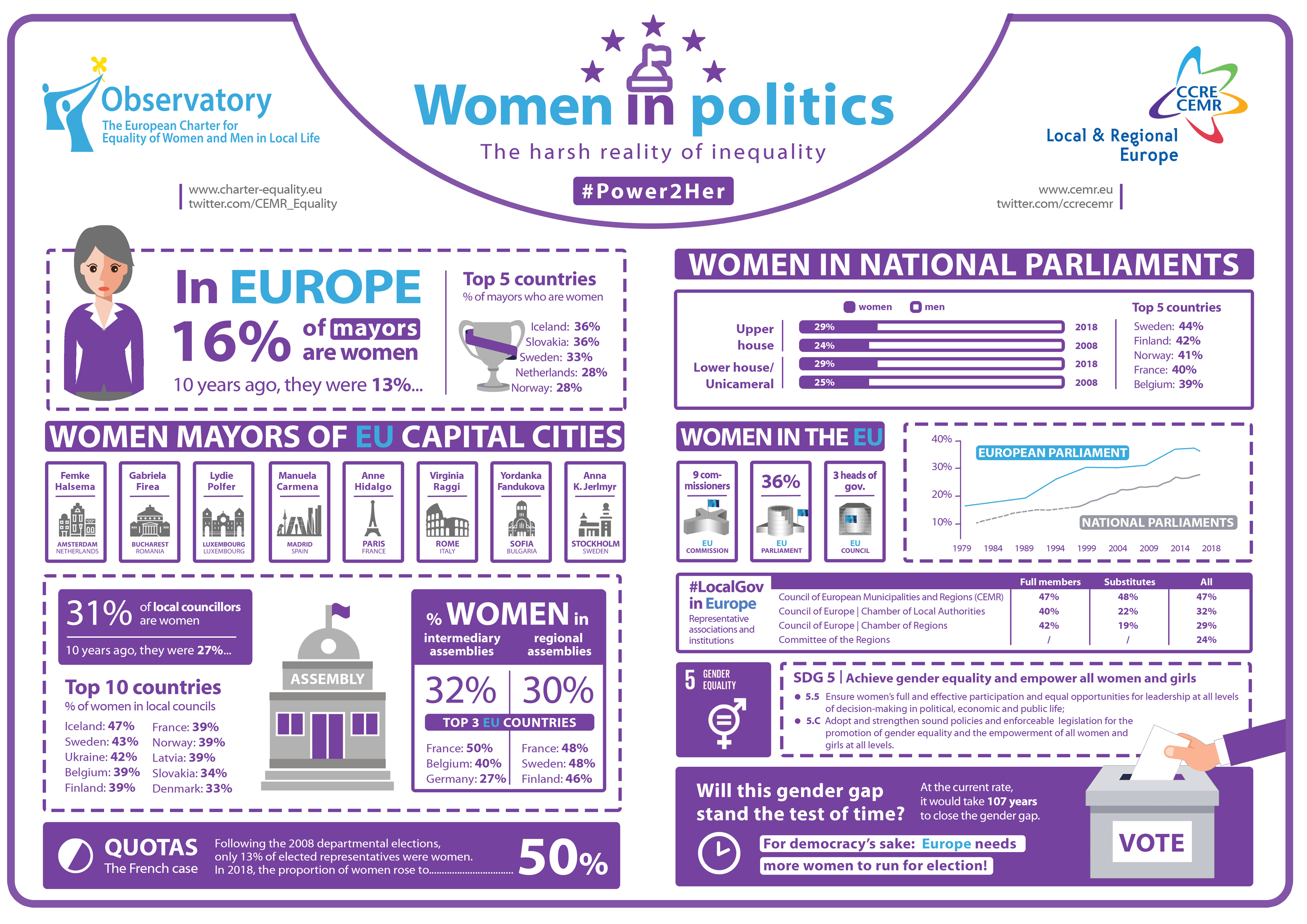
Gender equality is a cornerstone of democracy, yet women remain significantly underrepresented in politics across Europe. According to CEMR’s study Women in Politics: Local and European Trends, women account for only 34.1% of political decision-makers, despite representing half of the population. 

At the local level, the situation is particularly concerning: only 15.4% of mayors are women, while women councillors make up just under 30% of local councils. Although there has been gradual progress over the last decade, the pace is slow, and parity remains a distant goal. 

The report highlights important regional variations. Nordic countries lead the way, thanks to decades of policies fostering a genuine culture of equality. In Central and Eastern Europe, positive trends are visible, especially in the Balkans, where reforms and EU accession processes have strengthened gender mainstreaming. Yet, in much of Europe, women still face structural, cultural, and financial barriers to political participation. 

CEMR stresses that achieving gender equality requires more than political rhetoric. Quotas and legal measures have proven effective in boosting women’s representation, but they must be accompanied by mentoring, training, and dedicated funding to empower women candidates and dismantle persistent stereotypes. 

As the level of government closest to citizens, municipalities and regions are pivotal in fostering inclusive leadership. Local office often serves as the first step towards regional, national, or even European roles. Supporting women at this level is therefore essential for building stronger, more representative democracies. 

CEMR, through its European Charter for Equality of Women and Men in Local Life and the Equality Observatory, continues to mobilise local and regional governments, promote good practices, and push for equality to remain at the heart of the EU’s political agenda. 

The study’s message is clear: while progress has been made, gender parity in politics is far from achieved. Europe must act now, through quotas, support structures, and political will, to ensure that women and men share power equally at every level of governance. 

Read the study here 

Check the infographics

For more information, contact: 

Guidelines for gender equality  

UCLG people banner

Updated CEMR-EPSU framework supports inclusive employment and service delivery 


The Council of European Municipalities and Regions (CEMR) and the European Public Service Union (EPSU) have adopted revised guidelines to help local and regional governments strengthen gender equality in the workplace. These updated guidelines replace the original 2007 version, reflecting new social challenges and priorities, such as the effects of austerity policies and demographic change. 

Recognising the central role that municipalities and regions play as employers and service providers, the guidelines provide a practical framework for developing Gender Equality Action Plans (GEAPs). These plans aim to improve working conditions, promote equal career opportunities for women and men, and support a better work-life balance for all staff. 

“Gender equality is essential to create fair and resilient communities. Local governments can lead by example,” state the social partners. 

The revised guidelines: 

  • Encourage positive action and gender mainstreaming in HR and service provision; 
  • Offer templates and checklists to support the creation of tailored local plans; 
  • Promote cooperation between employers, employees, and trade unions; 
  • Align with existing EU legislation and the ILO’s Decent Work Agenda. 

The document also outlines the importance of political backing, training, and long-term commitment to ensure successful implementation. CEMR and EPSU plan to assess the impact of these updated guidelines through the Social Dialogue Committee in 2019. 

For municipalities, county councils, and regions, this tool is an opportunity to foster more inclusive, equitable workplaces while meeting broader European goals on gender equality. 

Read the position paper here 

For more information, contact: 

Strengthening work-life balance 

Work Life - News

Improving equality, labour participation, and social cohesion through better policies on leave, childcare, and flexible work 


Work-life balance remains one of the most pressing challenges in Europe, with direct implications for gender equality, labour market participation, and social cohesion. Despite progress in recent decades, women remain underrepresented in employment, face higher risks of poverty, and continue to carry a disproportionate share of care responsibilities. Addressing these issues is not only a matter of fairness but also an economic necessity, as women’s employment is a key driver of growth. 

Policies that support better reconciliation of work and family life are crucial to close the gender employment gap. Several measures stand out: ensuring high-quality and affordable childcare, promoting equal sharing of parental leave, developing flexible working arrangements, and adopting gender-sensitive budgeting practices. 

Childcare plays a central role in enabling equal participation in the labour market. Meeting the “Barcelona objectives”, with at least 90% of children between the ages of three and school age having access to childcare, is essential. Investment in childcare infrastructure reduces the burden of informal care, often borne by women, and creates conditions for greater economic independence. 

Equally important are leave provisions. While maternity leave remains a cornerstone, extending its duration may sometimes hinder women’s reintegration into the workforce. Alternatives such as affordable childcare, telework options, or flexible work schemes can provide more balanced solutions. Paternity leave, especially when non-transferable, is vital for promoting equal responsibility between parents, while parental leave policies must go further in encouraging fathers’ participation. Carers’ leave also deserves attention, particularly as ageing populations increase the demand for informal care. 

Flexible working arrangements, including telework, temporary reductions in working hours, and adaptable schedules, can further support families. Properly implemented, they improve retention, motivation, and productivity, while helping both women and men manage family responsibilities. 

Finally, transparency in pay structures and the regular monitoring of gender equality measures at all levels can help reduce persistent wage gaps and ensure progress is visible. Sharing good practices and setting benchmarks allows countries and regions to learn from one another and target actions where they are most needed. 

Work-life balance is not just a matter of private concern but a cornerstone of social and economic development. By strengthening childcare, modernising leave policies, and encouraging flexible and equal working arrangements, societies can ensure greater gender equality, reduce poverty risks, and boost long-term growth. Achieving these goals requires commitment across all levels of governance, with local and regional authorities playing a decisive role in turning principles into everyday realities. 

Read the position paper here 

For more information, contact: 

Women Leadership

Women - News Section

Women leadership at the local level: a requirement to fight against climate change


“As a woman leader I encourage us all to take development challenges into our own hands,” said the Mayor of Paris, Anne Hidalgo, at the meeting on women’s leadership in development organised by our global association (UCLG), on 6 December, in the city hall of Paris.

Organised in the margins of the COP21 negotiations, the event gathered local elected representatives worldwide to put forward the gender equality approach in the fight against climate change, to achieve the Sustainable Development Goals and to shape sustainable urban policies.

Read a full article on the event on the website of the Charter of the Observatory for equality of women and men in local life.

Gender Equality Policies

Gender Equality - News Section

European institutions should support towns and regions to plan, monitor and evaluate gender equality policies


The Observatory on the European Charter for equality of women and men in local life (the Observatory) and the Council of European Municipalities and Regions (CEMR) call on the European institutions to support towns and regions to implement initiatives to advance gender equality at the local level. 

Today, 1500 towns and regions from 32 European countries are already taking action towards gender equality, for instance, by promoting gender diversity in municipal professions, like bus drivers, or by offering training programmes in schools to prevent gender-based stereotypes. This is why, in October 2015, the Observatory launched a toolkit to support these towns and regions to plan, monitor and evaluate gender equality policies. The new tool includes a set of 76 indicators covering areas such as employment, decision-making process or social care.

Despite local government efforts, several challenges remain, such as the lack of financial and human resources or non-adapted national institutional framework. To overcome these challenges, EU institutions must support fully policies developed by towns and regions. Otherwise the risk is that initiatives undertaken by municipalities, cities and regions will diminish or even disappear. Using this tool will therefore provide a real chance to achieve this goal: “We must ensure that this new tool does not remain hidden away in a drawer,” said Ibon Uribe CEMR spokesperson for gender equality.

In addition, locally elected representatives should be included in the implementation of the EU’s future strategy for equality that will frame European actions and policies to improve gender equality over the next five years. 

The Observatory and CEMR call on towns and regions to use the tool

The new tool will make it easier to identify needs on the ground and to set up suitable projects, such as the establishment of public bodies to ensure gender equality or the promotion of women in decision-making positions at the local level.  

“The toolkit will constitute a common framework at European level for local and regional governments to monitor gender equality policies,” said CEMR spokesperson on gender equality. This is why it is important for CEMR’s associations to undertake their responsibility and support the implementation of public policies. “Now it is our role to ensure that this tool is disseminated and used. This is our collective responsibility, the European institutions, CEMR member associations and we as politicians and experts at local and regional level,” stated Ibon Uribe. 

Gender Equality in Strasbourg

Strasbourg - News 2011

Strasbourg on the road to gender equality


The mayor of Strasbourg, Roland Ries, signed the European Charter for the equality of women and men in local life, on 18 January.

The signing of the charter was held at the Strasbourg city hall on the occasion of the meeting.

of the monitoring group of the charter chaired by Jocelyne Bougeard, President of CEMR’s Committee of Women elected representatives of local and regional authorities. French members of the European Parliament participated in the event.

An action plan will be implemented within two years, said city councillor in charge of gender equality, Mine Günbay. It will be based on three axes: first, within the administration, the second largest employer in the urban community of Strasbourg with 6 000 staff ; second, awareness and information campaigns will be organised among the population. ; finally, support will be given to local associations working in the field of gender equality.

The charter has been elaborated by the Council of European Municipalities and Regions. It aims to encourage local authorities in Europe to use their powers and partnerships to promote gender equality.

Strasbourg is the 65th French local government to have signed the charter.

– Website of the French section of the Council of European Municipalities and Regions (AFCCRE)