Ukranian recovery strategy

Bridges of Trust Visit - News 2023

Bridges of Trust initiative helped in the cooperation between Ukrainian and French municipalities for a reconstruction plan


3 Ukrainian municipalities Apostolove, Zelenodolsk and Korosten began their study visit to partner municipalities in France with a Solidarity Forum in Issy-les-Moulineaux on 1 of July.
 
The cooperation between Ukrainian and French municipalities is being developed in the framework of the Bridges of Trust initiative implemented by the Council of European Municipalities and Regions (CEMR) together with the Association of Ukrainian Cities (AUC) and with the support of U-LEAD with Europe programme. 
 
The partnership of Bourges and Korosten is taking a new step since the first contact between the municipalities in March 2022. While Zelenodolsk and Apostolove are only at the initial stage of building partner relationships with Sceaux and La Rochelle.
 
The Ukrainian delegation was warmly welcomed during the Solidarity Forum held by AFCCRE in the framework of the National Forum on Europe, Twinning and Partnerships. The Ambassador of Ukraine to France, Vadym Omelchenko was among the speakers at the event and reiterated the important and substantial results of cooperation between France and Ukraine on different levels and in various sectors. He reminded the success of the Bilateral Conference for the resilience and reconstruction of Ukraine held by the French government in December 2022 where hundreds of French companies took part and confirmed their interest in engaging in Ukraine’s reconstruction process.
 
The representatives of 3 Ukrainian municipalities Korosten, Zelenodolsk and Apostolove had an opportunity to speak about the daily challenges they face because of the war provoked by Russia against Ukraine, their needs and the ideas of projects that can help the municipalities in the recovery process. Among the priority topics of cooperation were mentioned the exchange of knowledge and experience on water management and purification, inclusivity of municipalities towards disabled people, reconstruction of municipal infrastructure, mental health and rehabilitation. 
 
The representatives of Ukrainian local governments begin today their 3 day study visits to Sceau, Bourges and La Rochelle in order to work on joint projects of reconstruction and recovery and to strengthen partnership ties between municipalities of Ukraine and France. 

Bridges of Trust

Bridges of Trust Branding - News 2024

Fostering Collaboration and Hope: Ukrainian Local Governments Visit Spain under ‘Bridges of Trust’ Project


A delegation of local government officials from Ukraine embarked on a visit to Spain from June 19 to June 23 as part of the “Bridges of Trust” project. This project, implemented by the Council of European Municipalities and Regions (CEMR) in collaboration with the Association of Ukrainian Cities (AUC) and with the support of the U-LEAD with Europe Programme, aims to foster cooperation and rebuild Ukrainian towns devastated by Russian attacks. The Ukrainian delegation, representing Novomoskovsk, Kremenchuk, and Nikopol, visited prominent Spanish cities to explore collaboration opportunities and gather support for their respective communities.

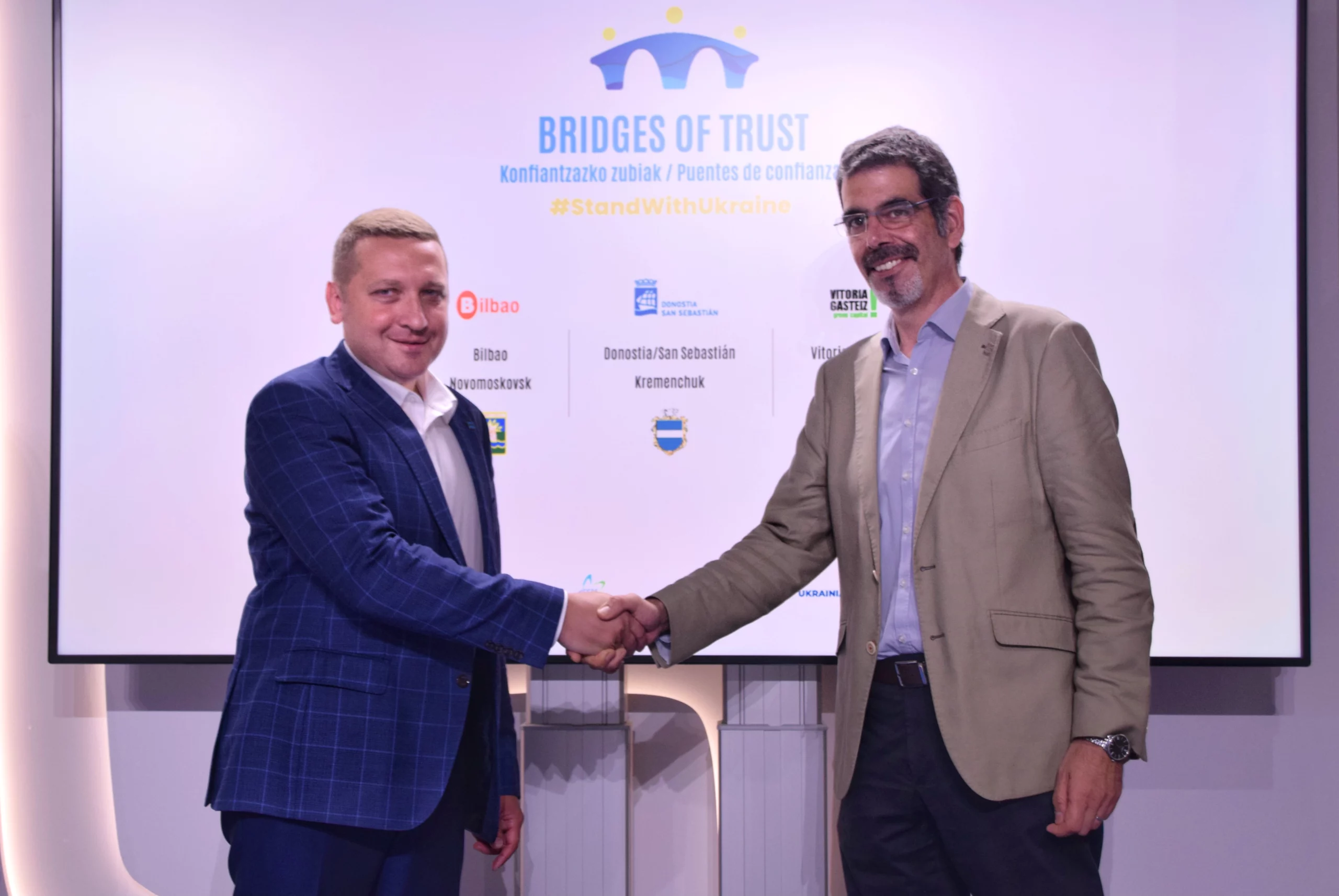
The Mayor and Vice Mayor of Kremenchuk, Vitalii Maletskyi and Olga Usanova, received a warm welcome from Mayor Eneko Goia of Donostia / San Sebastián. Donostia / San Sebastián, along with Bilbao and Vitoria-Gasteiz, is participating in the “Bridges of Trust” project facilitated by the Association of Basque Municipalities EUDEL, one of the ten local government associations chosen for this noble undertaking.

The Mayor and Vice Mayor of Kremenchuk, Vitalii Maletskyi and Olga Usanova, were warmly welcomed by Mayor Eneko Goia of Donostia / San Sebastián. Donostia / San Sebastián, along with Bilbao and Vitoria-Gasteiz, participates in the “Bridges of Trust” project facilitated by the Association of Basque Municipalities EUDEL, one of the ten local government associations chosen for this endeavour.

Donostia / San Sebastián, known for its commitment to solidarity and support, will provide assistance to Kremenchuk. Kremenchuk, a Ukrainian city with a population of 215,271, endured a devastating missile attack on its main shopping center in 2022. Donostia / San Sebastián, in collaboration with the Sociedad de Fomento de Donosti, will offer guidance and support to promote economic development and urban transformation in Kremenchuk. The city is renowned for its vehicle manufacturing and oil processing sectors, along with two prominent universities.

The Nikopol delegation met with Mayor Maider Etxebarria and representatives of municipal groups at the City Hall in Vitoria-Gasteiz. Vitoria-Gasteiz, a symbol of peace and advocate for rights and freedoms, expressed solidarity and support for the Ukrainian delegation. Nikopol, one of the Ukrainian towns heavily affected by Russian attacks, will receive technical assistance from AMVISA to rebuild its water supply, sewerage, and wastewater treatment networks.

During their visit to Vitoria-Gasteiz, the Nikopol delegation engaged in technical meetings with AMVISA and the Development Cooperation Service. They also had the opportunity to visit key infrastructure projects, such as the Crispijana treatment plant, as well as notable landmarks like the Medieval Quarter and the Green Ring.

Nikopol, a former industrial hub with a population of 105,200, has been grappling with the aftermath of the Russian invasion. Situated near the Dnipro River, close to the Zaporizhia nuclear power plant and the recently destroyed Kakhovka dam, Nikopol aims to rebuild its economy and infrastructure with the support of European cities like Vitoria-Gasteiz.

The “Bridges of Trust” project, involving 30 European cities, signifies a collective effort to restore hope, cooperation, and stability in Ukrainian towns severely impacted by Russian aggression. By fostering collaborations and sharing expertise, the project aims to create a brighter future for the communities affected by the conflicts.

Bridges of Trust Training

BoT Training - News 2023

Enhancing Municipal Capacities: Training for Bridges of Trust Project


CEMR, in collaboration with the Association of Ukrainian Cities and with support from the U-LEAD with Europe Programme, is organising training sessions for municipalities participating in the Bridges of Trust project. These trainings aim to equip municipalities with practical knowledge of EU funding programmes, including Interreg Next, Erasmus+, and the Black Sea programme, along with essential project management skills.

One objective of the training is to strengthen the capacities of local governments for international cooperation and European integration, with a particular focus on the reconstruction efforts in Ukraine. Participants will gain a comprehensive overview of the programmes, including eligibility criteria and the intricacies of the application process. The sessions will enhance the abilities of Ukrainian and European local governments to access EU funds effectively.

In addition, three specific training sessions will concentrate on project management, covering the three crucial phases of a project’s lifecycle: planning and initiation, implementation, and monitoring and control. These sessions aim to provide participants with a solid understanding of project management principles and practical tools to assist them throughout the process.
Leading the sessions will be Kirill Dimanopoulos, an expert from CEMR specialising in EU funding and project management. Following the training, participants will apply their newly acquired knowledge and skills to develop collaborative reconstruction projects with their partners as part of the Bridges of Trust initiative.

Take a look on the trainings’ agendas: Introduction to Interreg Next – Bilateral and Multilateral Interreg Next programmes – Erasmus+ programme – Interreg Danube programme – Black Sea programme – First Steps in Project Management – Implementing the Project – Monitoring and Control

Rebuild Ukraine

Bridges of Trust Branding - News 2024

Cooperating to rebuild Ukrainian: A Journey to Lombardy


In a successful venture from 11th to 17th June, representatives from various local governments in Ukraine visited Lombardy, Italy. This visit, organised under the Bridges of Trust project by CEMR and supported by the U-LEAD with Europe Programme, marked an important step towards fostering stronger ties and cooperation between Ukrainian and Italian municipalities.

The visit began with a welcome meeting at Arconate’s city hall. Mr. Durmish Guri, the Director of External Resources and Knowledge Strategy at CEMR, expressed gratitude to Italian mayors for their outstanding hospitality and cooperation. He also applauded the participation of Arconate, Inveruno, and Sesto San Giovanni in the Bridges of Trust initiative, acknowledging the support of Italian authorities and citizens towards Ukrainian mothers and children in need.

Mr. Guri highlighted CEMR’s efforts in helping Ukrainians affected by Russia’s invasion. “From mobilising humanitarian aid and financial support to offering refuge and steadfast political support, I am proud of every step taken by CEMR to help our Ukrainian partners. More than ever, we need mutually beneficial cooperation between Italian and Ukrainian municipalities, both within the Bridges of Trust project and beyond”, he affirmed.

Mr. Guri stressed the need for cooperation between Italian and Ukrainian municipalities in reconstruction projects, covering infrastructure, water treatment, waste management, sewage facilities, machinery renewal, heat supply modernization, and human development. Afterwards, the parties discussed these priorities and established memoranda of cooperation, laying the foundation for long-term collaboration.

The Ukrainian delegation’s visit was a crucial milestone in the Bridges of Trust project, promoting stronger ties between the local governments of Ukraine and Italy. As Mr. Guri concluded, “this initiative showcases the power of international partnerships in addressing common challenges and working towards a prosperous future.”

The Ukrainian delegation, led by distinguished representatives from various local governments, was accompanied by Ms. Yulia Bandura from the Association of Ukrainian Cities. Notable participants included Mr. Mykola Baksheiev and Ms. Tetiana Orlova from Pervomaysk, Ms. Nataliia Moskalenko and Ms. Pavlina Ohanesian from Romny, and Mr. Denys Petrenko and Mr. Serhii Hrankin from Lozova. The delegation was warmly welcomed by their Italian counterparts, including Mr. Sergio Calloni, Mayor of Arconate; Ms. Sara Bettinelli, Mayor of Inveruno; and Mr. Fabio Merlotti, Mayor of Buscate.

For more information on the Bridges of Trust project and collaboration between Ukrainian and Italian municipalities, please contact Bridges of Trust Project Officer Olga Ivanova at Olga.Ivanova@ccre-cemr.org.

Ukrainian municipal delegation 

Bridges of Trust Branding - News 2024

Members of a delegation of Ukrainian local and regional governments are on a study visit to Hungary as part of the “Bridges of Trust” initiative, where they visited the TÖOSZ Local Government Information and Coordination Center


The Ukrainian delegation was welcomed by TÖOSZ General Secretary dr. Ferenc Gyergyák. The participants exchanged on Hungarian and Ukrainian local government systems, the decentralisation reform in Ukraine and the role of local governments during the war.
The Ukrainian delegation is on this study visit to work on projects of reconstruction in Kyiv, Sumy and Poltava regions. Extensive work is ongoing with three TÖOSZ member municipalities: Bácsalmás, Budakeszi and Pápa.


“Bridges of Trust” is implemented by the Council of European Municipalities and Regions (CEMR) in partnership with the Association of Ukrainian Cities (AUC) and with the support of the U-LEAD with Europe program, with the goal of contributing to the reconstruction efforts in Ukraine. During this project, local government associations of 10 CEMR members – including TÖOSZ – are promoting 30 new local government partnerships.


The next exchange of experience, knowledge and expertise will take place in Latvia in a week. Also, a Solidarity Forum will take place on 8 May in Latvia to promote municipal cooperation between Ukrainian and EU municipalities, present the best examples of local support, raise awareness about the recovery and reconstruction efforts and discuss challenges that were encountered and addressed.


More information on TÖOSZ Facebook page

Women in Ukraine

Women in Ukraine - News 2022

Courage and resilience have no gender, says Chernihiv city councillor


On the occasion of a workshop “Amplifying the voices of Ukrainian Women in post-war recovery” organised by Cities Alliance, CEMR was represented by Nataliia Kholchenkova, a member of the Chernihiv city council – a city besieged by Russia for 39 days in the spring of 2022. On this occasion, an interview was conducted by Cities Alliance with Nataliia Kholchenkova to discuss the city’s efforts to recover from war and the role women are playing in this recovery.

Chernihiv was besieged by Russia for 39 days in the spring of 2022. Since then, a recovery and reconstruction process has started. Could you please share the city’s experiences during and after the siege? How has the city tried to address the recovery issues, including the trauma and the loss that people have experienced?

Chernihiv is a city in the north of Ukraine. It is circa 100 km from the border with Russia and Belarus. From the very beginning of the war, the city was under attack. Chernihiv acted like a shield against Russian forces on the way to Kyiv. It was due to the resistance of our citizens that the enemy could not proceed. The city was not occupied, but it was blockaded from all sides and under heavy shelling for almost 40 days.

Due to this, Chernihiv was heavily ruined and damaged. Our only bridge that connected the city with Kyiv and the rest of Ukraine was destroyed. This meant we could not receive any humanitarian support and brought the city close to a humanitarian crisis. The city was without power, gas, and water for circa two weeks, and it was a really hard time for us.

The most terrible thing is that many residents were killed. Almost every day we received news that our neighbours, our friends, our relatives were killed due to the war. One of the main problems was how to bury people. Under constant shelling, we had no possibility to bury the bodies. There were no medicines available for some time, and we received information that some residents died because they could not get treatment for their chronic diseases.

I would like to emphasise the unity, bravery and resilience of all residents who supported each other and shared any available products and medicines. There was no hesitation on how to act: Men got the ammunition and weapons and went to join the armed forces or the local territorial defence units, and women did everything possible to support them with supplies, food, medicines, clothes, and so on.

What infrastructure and services were destroyed and most affected? How did the city adapt to the lack of them?

Because of the Russian invasion, social and critical infrastructure and residential housing were heavily damaged. Circa 850 multi-story buildings were partially damaged, while 150 multi-story buildings were heavily damaged due to direct hits from shelling. Five buildings were destroyed. About 2,000 private houses were damaged, and of those, 600 were totally destroyed.

People shared everything with each other, including housing, but the worst part was that there were no shelters. We were not prepared for the war. When the war started, we used simple basements in buildings or spaces underground to shelter. These were the places where we had to live, because we were under constant shelling, and we had no opportunity to even go find food. It was really dangerous.

As for critical infrastructure, we had to live for circa two weeks with no water. The city has a central water supply system that was damaged. Of a total of five pumping stations, two were totally destroyed and two were damaged. The whole city with almost 300,000 residents could not get water and the sewage system did not work. The heating system also did not work. The weather was cold with temperatures below zero degrees [Celsius] and some peaks of minus seven degrees. Also, there was no power and no possibility to use any electrical equipment. We could not call or get the news from the TV or the internet, so we were disconnected in the shelter just with the company of people. But we had to survive somehow.

How did people start living again? How did the recovery efforts start?

During the siege, a lot of residents tried to leave the city. It was a great risk and there were many cases of civilians killed while trying to leave because there was no humanitarian corridor or organised conditions to leave the city. There were cases of cars with signs indicating children and families on board that were shelled by the enemy. It was very dangerous, but people had to leave because it was also dangerous to stay in the city.

Before the war, we had circa 284,000 residents, and in the middle of March, there were circa 70,000 left. After the enemy left, during summer, people started returning to the city. In September we had about 220,000 residents back in the city. Of course, it was up to the local government to ensure the provision of all kinds of recovery measures and services. This also incentivised citizens to come back.

How was the process of livelihood recovery carried out when residents started coming back? With the majority of men going to combat, did women take up new or different roles?

I would like to emphasise the role of local authorities in the recovery process. We had to make quick decisions. The first priority was to repair multi-story buildings and housing for people to have a roof over their heads, and to repair the water supply and heating systems to be ready for autumn and winter. It was a great multitasking effort to provide all services at the same time, and it is still an ongoing process. After these interventions, we also started building shelters because we had to ensure the safety of our citizens. We equipped educational institutions and multi-story buildings with real shelters including ventilation and bio toilets.

One other very important action was the reopening of schools and the provision of offline education. We understood that parents wanted their children to get an education in schools, and this was the factor that motivated people to return. Now we have combined both offline and online education. We also worked to reopen kindergartens. All kindergartens were equipped with shelters so that when the alarm started, the children could be safe. Restoring education facilities was also a main condition for people to continue to work. If kindergartens do not work, we mothers and parents must be with the children at home.

As for livelihoods and jobs, it is still a big issue for us, because our industries and enterprises were located in the suburbs, which were the most heavily shelled areas. Many businesses relocated to more secure regions in the west of Ukraine, and the number of people without jobs unfortunately increased.

A lot of men went to the front line, while a lot of women had to take care of children. It is very difficult to combine work with childcare at home. This is still a problem, although there has been some progress at the community level. We have some women’s organisations that provide support; however, it is still very hard to get new jobs due to the many enterprises that closed or relocated. As we are on the border and with the war still ongoing, it is hard to persuade investors or businesses to start new activities in the region. So yes, it is a problem for all residents, but it is even more complicated for women.

Our task as local authorities are to provide economic support and to create the conditions for businesses to return and invest again in our city. We are now trying to cooperate with international partners to attract investors for future projects. These international partnerships are a good signal for our residents. It shows that they will have a future.

What has been the role of civil society and local organisations in the last months of reconstruction? Did women take up new roles in these organisations?

I would like to emphasise the role of volunteer organisations, many composed of women. These women provided a huge support to suffering people by delivering humanitarian aid, gathering supplies and food for our armed forces, and helping with childcare and education.

The role of education is very important. It is a great psychological support and aid for our children who have to endure this terrible war. The war has not only caused physical injuries but also psychological trauma to all residents, especially women. For women, it has been more complicated because they have a lot of pressure to keep their children safe and healthy while also having a job. In the case of war, this responsibility and pressure has doubled or tripled. So, the role of women has been incredible.

One more thing that I can say for sure is that bravery and resilience have no gender, and that women are acting as leaders on all front lines and battlefields: educational, cultural, and health.

You mentioned psychological trauma. Are there mental health programmes that have been started by the city or local organisations to support the healing process for the city and its residents?

Yes, we have municipal programmes under the Department of Social Politics and a service for people who remain alone. We also have ongoing partnerships with international organisations that are part of the UN. At the same time, with the war still ongoing and with the constant threat of new shelling, women feel like they do not yet have time for psychological aid and to take care of their health. It is our task as local governments to ensure that they are not only healthy physically, but also psychologically. We still have to persuade them that we should also pay attention to ourselves and our mental condition and that we should be healthy for our children, colleagues, men, and the city.

How is the situation now in Chernihiv? What does the city need the most at the moment?

We have managed to advance the recovery and the restoration of some services. There are less and less power outages. We have provided schools and all critical infrastructure with generators to prevent power outages, and we have helped businesses also get generators. We are organising activities for children. More has to be done. Street lighting, for instance, is still not working due to power saving, and around 5 pm it is dark already in the streets.

What the city needs the most right now is financial support to cover larger-scale reconstruction. With the municipal budget, we have repaired the small and medium-sized damage to buildings, but we cannot cover the repair of heavy damages. For instance, the next project we would like to implement is the reconstruction of two water pumping stations, but we cannot cover that with the local government budget. This is also an issue with the damaged public transport system. We would like to incorporate new European technological solutions and innovations to create a better future for our residents and to improve their quality of life.

I can definitely say that women’s participation in all kinds of activities and decision-making processes in our country is stronger now than it was before due to cooperation with, and examples of, international and women’s organisations. It is a part of our European integration process and it is very important for us to continue with such cooperation processes. It gives us strength and spirit to unite as women following the example of the European Union, where there are many strong women in politics, economy and business. We should continue in this direction.

Nataliia Kholchenkova is the Head of the International Relations and Investments Department of Chernihiv City Council. Since 2020, she has also been Head of the Permanent Deputy Commission on Regulations, Legality, Corruption, Freedoms and Rights of Citizens and Prevention of Corruption and Head of the Deputy Association “For Equal Rights and Opportunities” of Chernihiv. She holds a PhD in the speciality of Secondary Education from T.H. Shevchenko National University “Chernihiv Collegium”, where she was also an Associate Professor. She is a member of the board of the Chernihiv Women’s Union and a member of the Association of Ukrainian Cities (AUC) and the Council of European Municipalities and Regions. She is the PLATFORMA spokesperson for AUC.

War on Ukraine first declaration

European local and regional leaders reaffirm solidarity with Ukraine and call for peace, justice, and reconstruction.


On the first anniversary of Russia’s full-scale invasion of Ukraine, local and regional leaders across Europe renew their strongest support for Ukraine, its people, and its democratic institutions. 

Condemning Aggression 
The war has brought devastation to civilians, elected representatives, and essential infrastructure. The abduction of Ukrainian mayors and the ongoing detention of five of them highlight the assault on democracy and the rule of law. These acts are condemned in the strongest terms, with urgent calls for the immediate release of the detained leaders. 

Solidarity and Support 

Local and regional governments across Europe stand firmly by Ukraine. Partnerships such as the Bridges of Trust project, the Eastern Partnership programme, and the European Alliance of Cities and Regions for the Reconstruction of Ukraine are mobilising resources, expertise, and cooperation. These initiatives are not only helping communities recover but also preparing Ukraine for its future as a full member of the European Union. 

Shared Values 
This declaration is a reminder that Europe’s foundations rest on peace, democracy, and respect for international law. As the war continues, European leaders join the international community in reaffirming Ukraine’s sovereignty and territorial integrity, and in urging the Russian Federation to end its illegal war. 

A year into this unjustified conflict, the commitment of Europe’s municipalities, cities, and regions is unwavering: to stand with Ukraine, to defend shared values, and to contribute to rebuilding a peaceful, democratic future. 

Read the declaration here 

For more information, contact: 

Release of Ukrainian Mayors

Mayors in Ukraine - News 2023

CEMR stands behind Ukraine and calls for the release of captured mayors


On the occasion of the one-year anniversary of the beginning of the Russian aggression in Ukraine, the Council of European Cities and Regions (CEMR) demands the release of five abducted Ukrainian mayors. 

In a statement released by CEMR’s Secretariat, the CEMR president Gunn Marit Helgesen strongly condemns the violation of Ukraine’s sovereignty: “One year after Russia’s full-scale invasion of Ukraine, let me reiterate my steadfast support for our Ukrainian peers, especially for the detained local leaders.” 

Gunn Marit Helgesen reminds us of the abduction of Ukrainian local government representatives: “Over the past year, 35 Ukrainian mayors have been abducted and five are still being held by Russian forces. Targeting local elected representatives is an attack on the very foundations of our Europe, a Europe rooted in respect for the rule of law and freedom. There can be no free Europe without a free Ukraine”.

In light of the anniversary, CEMR also released a declaration (ENFRUA) reiterating its full support of Ukraine and its people. The organisation denounces the violence targeting innocent civilians, but also the local and regional elected representatives that are being held captive: “We reaffirm our full commitment to supporting the Ukrainian people and local and regional elected representatives in their path to victory and reconstruction.” CEMR therefore joins the international community that firmly supports the sovereignty and territorial integrity of Ukraine and calls upon the Russian Federation to stop its illegal war.

Financial and humanitarian help

In the last year, CEMR and other partner organisations have continuously shown their support for Ukraine. To do so, they have taken many actions. Amongst them is the mobilisation of humanitarian aid. One of the partner organisations, the Association of Towns and Communities of Slovakia (ZMOS) allocated €50,000 in humanitarian aid. ZMOS also sent thousands of packages of various medical supplies, such as bandages, plasters, gauze compresses, and disinfectants, as well as thousands of packages of personal hygiene kits and emergency sleeping bags.

Other members of CEMR, municipalities and regions, Non-Governmental Organisations, and citizens have offered their financial help, too. One of the smallest municipalities in Estonia, the municipality of Tõrva, transferred €10,000 from its local budget and collected more than €2,000 euros from citizens to support their twin city in Ukraine – Baranivka. 

Welcoming refugees

The municipalities also helped by taking in refugees from war-torn Ukraine. CEMR and European municipalities and regions have coordinated their efforts to assist them as effectively as possible. Providing housing, opening schools to Ukrainian children, navigating the administrative processes and teaching the refugees new languages proved to be essential. 

The city of Tbilisi made public transport free for all Ukrainian citizens, along with all municipal services and cultural, sports and educational centres. In addition, the municipality organised a blood donation campaign. 

Helpful initiatives and partnerships 

Showing support by maintaining existing partnerships and creating new ones was another step taken by some European municipalities. Within the Bridges of Trust initiative, the district municipality of Ukmergė in Lithuania signed a partnership agreement with the Ukrainian Korosten municipality to strengthen their relationship.

The mayor of Korosten Volodymyr Moskalenko praised the partnership: “Each of our conversations comes down to the question ‘How can we help you?’” According to him, “the city has found true friends”. 

What about the future? 

Because the Russian attack has left many Ukrainian cities in ruins, reconstruction is going to be key in the coming years. Some efforts are already underway, but as most of them are organised on a regional level, CEMR is asking its members for support and further help for Ukraine. 

By fully supporting CEMR’s flagship partnership initiative with Ukrainian municipalities that are currently implemented with the support of the U-Lead with Europe programme, other local associations can help with the rebuilding process in Ukraine and further develop international cooperation at the municipal level.