
Local voices shaping European choices: CEMR hosts its first peer exchange on enlargement
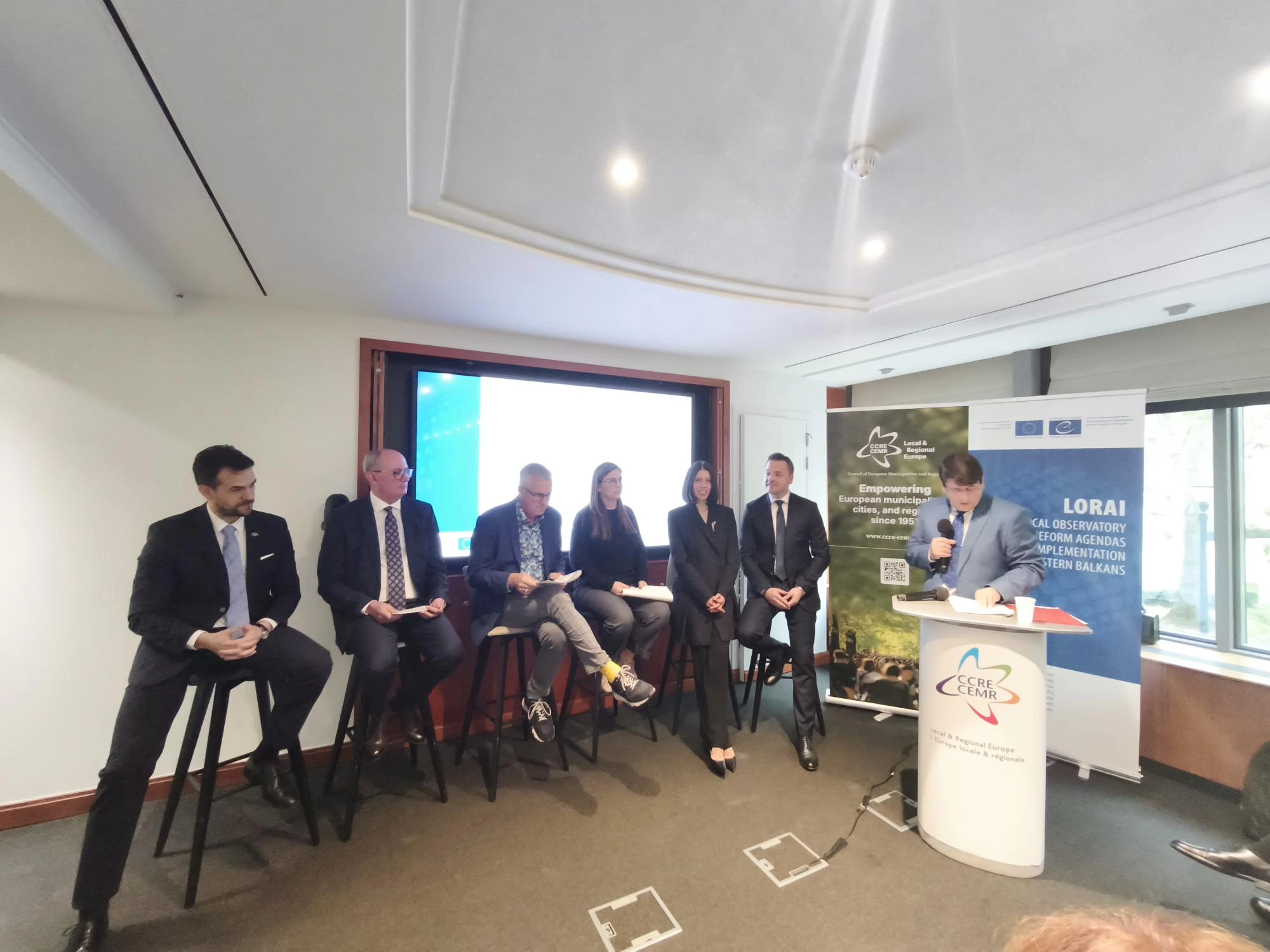
On 4 November 2026, the Council of European Municipalities and Regions (CEMR) brought together mayors, local government associations, national and EU officials in Brussels for a Peer Exchange on Enlargement, “Local voices shaping European choices”. The event took place at CEMR’s office and was organised under the programme Local Observatory on Reform Agendas Implementation (LORAI).
The event was organised by CEMR under the EU–Council of Europe joint programme LORAI – Local Observatory on Reform Agendas Implementation in the Western Balkans, which aims to strengthen local authorities’ role and capacity to contribute to the implementation and monitoring of Reform Agendas under the EU’s Reform and Growth Facility, a key element in the region’s progress towards EU accession.
Why local governments matter for enlargement
Enlargement has regained strong political momentum, driven by geopolitical change, security concerns and hybrid threats. Yet a faster accession process also raises questions: Are candidate countries ready? Can they absorb EU funds effectively? Can reforms be sustained over the long term, leaving no one behind?
CEMR’s answer is that the road to the European Union does not run only through national capitals. It also runs through towns, cities and regions, where reforms become visible in people’s everyday lives, from public services and infrastructure to local democracy.
A programme built around local delivery
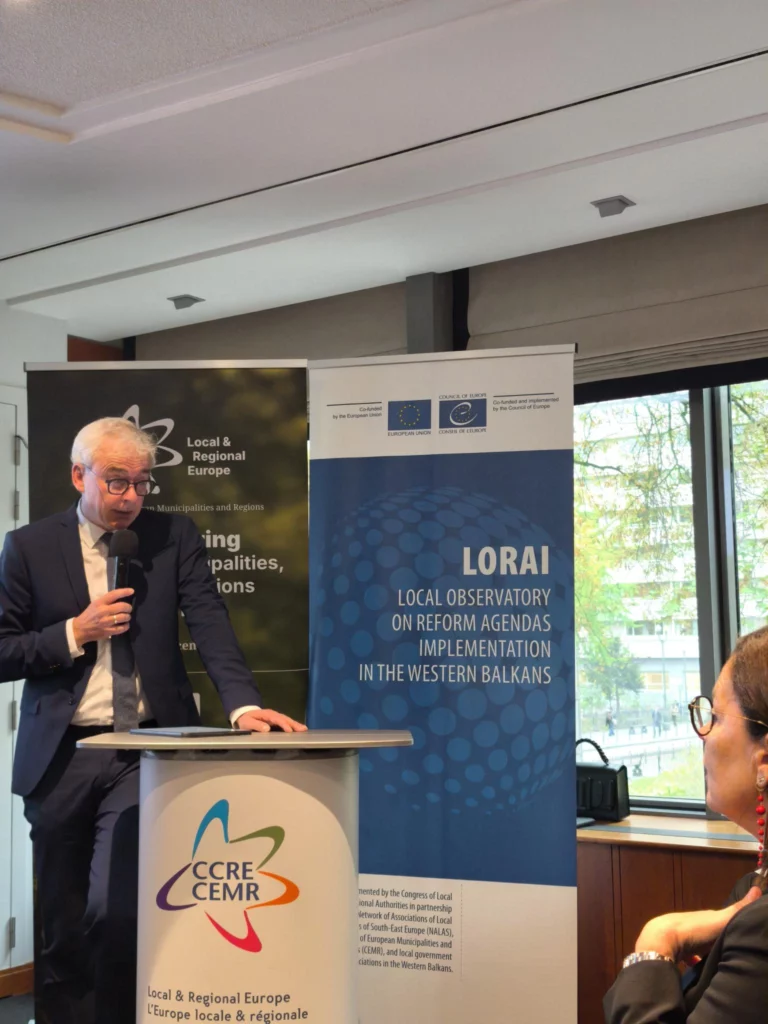
CEMR Secretary-General, Fabrizio Rossi, opened the event with the words: “When we speak about a larger Europe, we speak about a Europe in which every community, every municipality and every country can find its place, contribute its strengths and share common values. The sustainability of enlargement depends on creating opportunities for all Europeans to sit at the same table.”
Gunn Marit Helgesen, the President of the Congress of the Council of Europe, amplified that ”to join the EU, candidate countries must meet certain standards, but too often between these criteria we forget the fundamental truth that democracy is built from the bottom up, not the other way around.” She added that”democracy cannot be rebuilt without citizens’ trust.”
Christoph Schnaudigel, CEMR President and President of the County of Karlsruhe (Germany), emphasised that “the road to the European Union does not pass only through national capitals. It also runs through cities, towns and regions. Municipalities are not only implementing reforms; they help make them meaningful and visible in people’s everyday lives.”
Finally, Valentina Superti, Director of the Western Balkans Sector DG ENEST of the European Commission, said that “LRGs have an important role to play in this EU enlargement and geopolitical efforts; to implement EU policies effectively, they need to be equipped with the right administrative and financial capacities and have ownership”.
The introduction to LORAI programme before the first panel was led by Dušan Raičević, Mayor of Bar, Montenegro, amplified that “to make reforms more inclusive and responsive to citizens’ needs, the citizens need to take active participation in the process. By investing in stronger local institutions, we invest in a stronger Montenegro and a stronger Western Balkans”.
He recognised that ”for Montenegro, the EU accession is a strategic priority and an opportunity to strengthen democracy, support sustainable development and improve citizenship. ”
Irina Sahakyan Vetter, Head of Unit, Institutional Partnerships, Congress of Local and Regional Authorities, explained the aim and role of the LORAI programme.
The programme “is built on two pillars: two complementary areas of work. The first one is the monitoring and evidence gathering. It aims to improve information on the local impact of reform agenda implementation and strengthen local authorities’ participation in the monitoring processes”, she stressed.
“Under this pillar, the program will develop a dashboard to monitor the local impact of the reforms, and we are in the process right now of developing the regional-level and beneficiary-specific indicators”, she added.
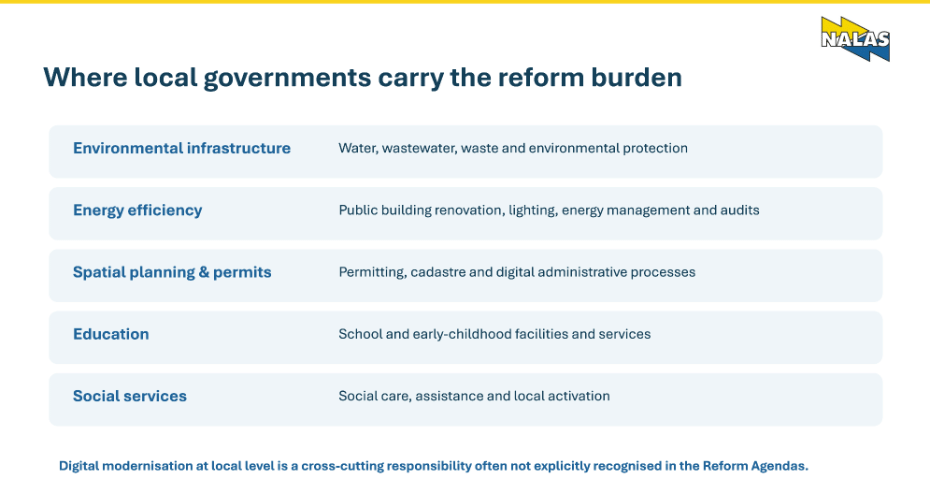
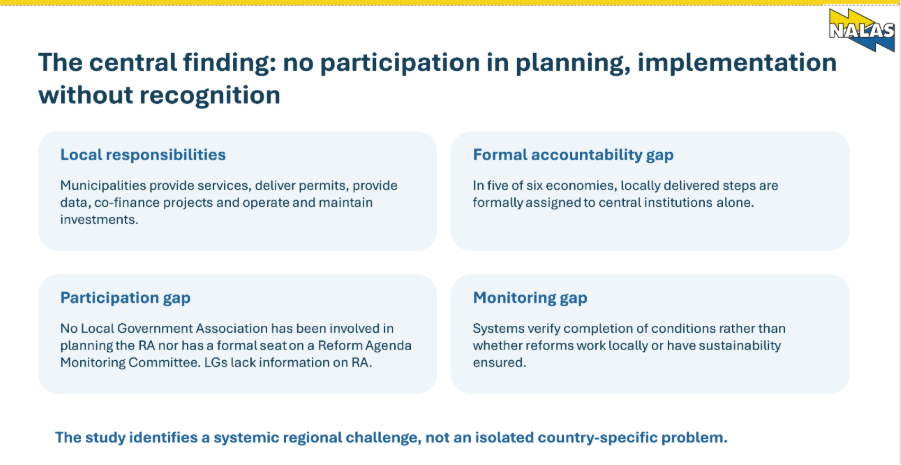
Finally, Jelena Janevska, the Programme Director of NALAS, presented a regional baseline study on Involvement of the Local Authorities in the Western Balkans Reform Agenda and Growth Facility.
Green transition – the first challenge on the path to EU enlargement
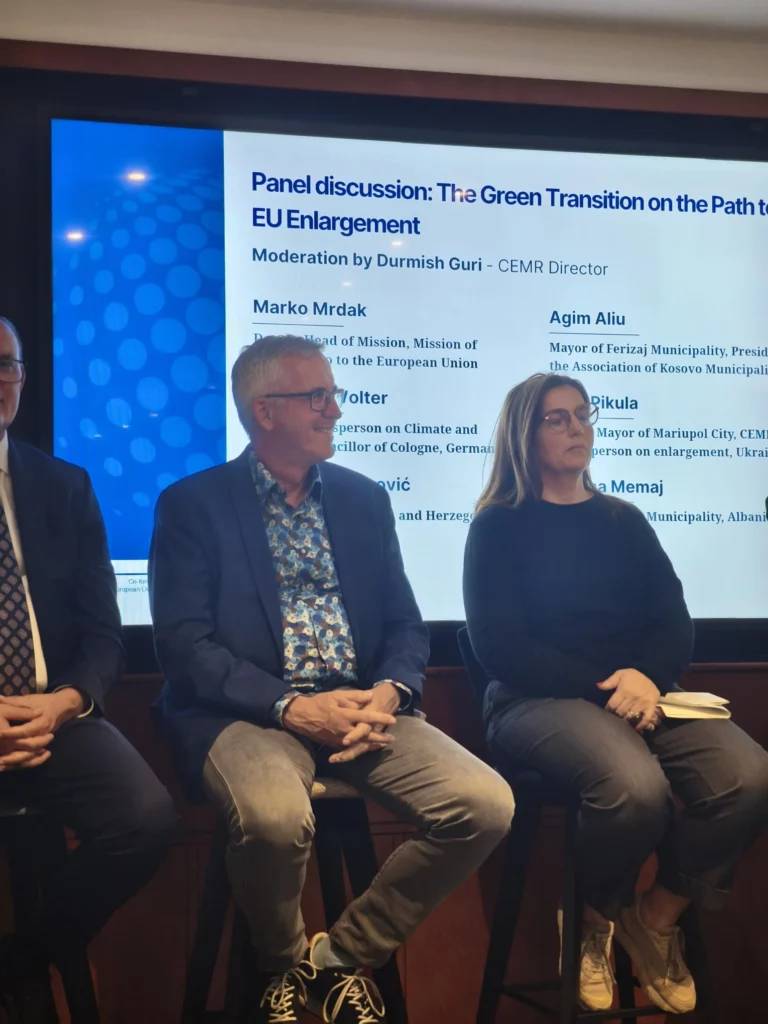
The first panel, the green transition on the path to EU enlargement, looked at how municipalities deliver policies at the heart of the EU Green Deal, from waste and water management to energy efficiency, sustainable mobility, spatial planning and climate adaptation, and what support they still need. The panel moderator, Durmish Guri, CEMR Projects Director, mentioned that “municipalities and regions are not only beneficiaries of the accession process, but essential partners in implementing the reforms needed for EU membership.”
Marko Mrdak, Deputy Head of Mission of Montenegro to the EU, stressed that “because of the narrow deadlines, local and regional governments are not always consulted as they should be, but their role is important if we want an efficient implementation of the acquis Communautaire.”
Agim Aliu, Mayor of Ferizaj Municipality, President of the Association of Kosovo Municipalities, added that Kosovo “has implemented a range of projects related to energy efficiency across the local and regional institutions.”
Andreas Wolter, the CEMR Spokesperson on Climate and Energy and Councillor of Cologne, said that “local governments must be recognised not only as implementers, but as strategic partners in shaping Europe’s green transition. Municipalities and regions should be involved from the beginning in designing climate and energy policies, not only in implementing them.”
Juliana Memaj, Mayor of Dimal, Albania, presented the case of her town, which “carried out interventions to protect the town from the flow of the Osum River, helping to prevent floods, protect the community, and increase resilience to climate risks.”
“We have developed projects to improve the energy efficiency of buildings, with a total value of around 1 million euros, aiming to reduce energy consumption and improve public infrastructure”, she added.
Milan Vukadinović, Mayor of Foča, Bosnia and Herzegovina, also followed with a regional example: “Our territory is home to Sutske National Park, the oldest national park in Bosnia and Herzegovina. Preserving these natural assets is not only a development priority for us, but also an obligation towards future generations.”
Finally, Olha Pikula, Councillor of Mariupol, Ukraine and CEMR spokesperson on EU enlargement, ended a session saying that ”we are still managing to progress on the EU accession despite the ongoing war. The biggest challenge remains in the translation of the EU commitments on the ground.”
She emphasised that Ukraine is using sustainable approaches. To do so, “we need three pillars;
1. Interconnection between the state, regional and local levels.
2. EU standards should be equal in every state but need to be tailored to every country. For instance, in Ukraine, not every community is ready now to implement, for instance, the EU Climate agenda.
3. We need to have peer-to-peer learning, experience exchange, and the supervision of the projects.”
Brain drain reduction – second challenge to the EU enlargement
The second panel, Local economic development as a tool to reduce brain drain, looked at how municipalities can create conditions for people to stay, return and invest locally, in the context of demographic decline and the upcoming European Commission Right to Stay strategy.
The debate was moderated by Marine Gaudron, CEMR Advisor on Territorial Cohesion and Local Finances, who emphasised that “competitiveness should be developed across all territories, not only in capital cities and metropolitan centres. Investments in connectivity, digitalisation, local infrastructure, entrepreneurship and skills are essential to ensure that all communities can benefit from growth and development.”
Inga Vismantienė, Vice Mayor of Akmenė, Lithuania, emphasised that “people do not stay in the region simply because they were born there. They stay because they see the opportunities there. The future cannot be built by stopping people from leaving but rather by giving people opportunities to develop. ”
Edi Majstorović, Association of Towns and Municipalities of Serbia (SCTM), stressed that “the new generation has a different understanding of the quality of life. They want a meaningful life; that’s why they don’t want to stay in smaller municipalities. Our major driver is creating new workplaces for 10 years and building the infrastructure, and we did it, and we had results.”
Irina Luncasu, Congress of Local Authorities from Moldova (CALM) expert from Moldova, shared the discovery that “have acknowledged that our diaspora can be transformed into the biggest partner of Moldova. We managed to get them involved in the local economic development.”
Finally, Erna Merdić, Mayor of Zavidovići from Bosnia and Herzegovina, stressed that ”at least 80% of the perception of the cities and how the state is successful and how government and public services are successful is through the local level.”
What comes next
The meeting closed with an outlook on LORAI activities. CEMR will help local officials turn reforms into investment roadmaps that can feed into the next Multiannual Financial Framework (MFF), through MFF Labs, country workshops starting with Albania in December 2026 and continuing in Montenegro, North Macedonia, Serbia, Bosnia and Herzegovina and Kosovo*.
The next peer exchange on enlargement will be held at the CEMR Congress in Cluj-Napoca, Romania, on 7–9 June 2027.
This document was produced with the financial assistance of the European Union and the Council of Europe. The views expressed herein can in no way be taken to represent the official opinion of the European Union or the Council of Europe.
* This designation is without prejudice to positions on status and is in line with UNSCR 1244/1999 and the ICJ Opinion on the Kosovo Declaration of Independence.
For more information, contact:

Advisor – Eastern Partnership and Geographical Dialogues