Urban Green Ghent

Ghent Green City - 2024

Urban Green Ghent: A Best Practice in Climate Resilience 


As cities around the world grapple with the mounting challenges of climate change, Ghent, Belgium, stands out as a shining example of innovation and determination. Through its transformative “Urban Green Ghent” initiative, the city demonstrates how urban areas can adapt to increasing climate risks while enhancing liveability and biodiversity. 

Turning Pavement into Opportunity 

A cornerstone of Ghent’s strategy is its ambitious plan to replace 15% of the city’s pavement with green spaces. This bold move addresses pressing climate challenges such as heatwaves, droughts, and recurrent flooding. By removing hard surfaces in public squares, parks, gardens, and streets, the city enables rainwater to naturally infiltrate the soil. This sponge-like effect mitigates the impact of heavy rainfall, helping to protect the city from flash floods. 

Watercourses and Façade Gardens 

Ghent’s commitment to a greener, more climate-resilient urban environment extends beyond de-paving. The city has reopened its watercourses, allowing natural waterways to flow freely once again. This not only improves water management but also enhances the aesthetic and ecological value of the city. 

Moreover, the promotion of façade gardens encourages residents to transform walls and small spaces into vibrant pockets of greenery. This community-driven approach fosters engagement and underscores the vital role citizens play in creating a sustainable city. 

Adapting to Climate Risks 

The initiatives under “Urban Green Ghent” are designed to tackle the growing risks of climate change. Heatwaves are mitigated through the cooling effect of increased vegetation, while green spaces enhance air quality and provide shaded areas, making the city more comfortable for residents and visitors. During periods of heavy rain, green infrastructure helps absorb excess water, reducing the strain on urban drainage systems. 

Enhancing Liveability and Biodiversity 

Beyond its climate benefits, Ghent’s green transition transforms the city into a more enjoyable and healthier place to live. Greening efforts create attractive outdoor spaces, improve biodiversity, and foster a stronger connection between residents and their natural environment. 

A Model for Other Municipalities 

Ghent’s comprehensive approach to urban greening offers valuable lessons for cities worldwide. Its success demonstrates the power of local government to lead in climate adaptation and resilience. By investing in sustainable infrastructure and engaging the community, Ghent is charting a path toward a future where urban areas are better equipped to face the realities of climate change. 

  • Explore more about Ghent’s green initiatives and their impact here

Democracy on bike

Democracy on Bike

From Cologne to Brussels: A Cyclist-Led Initiative for Climate Action and Democracy


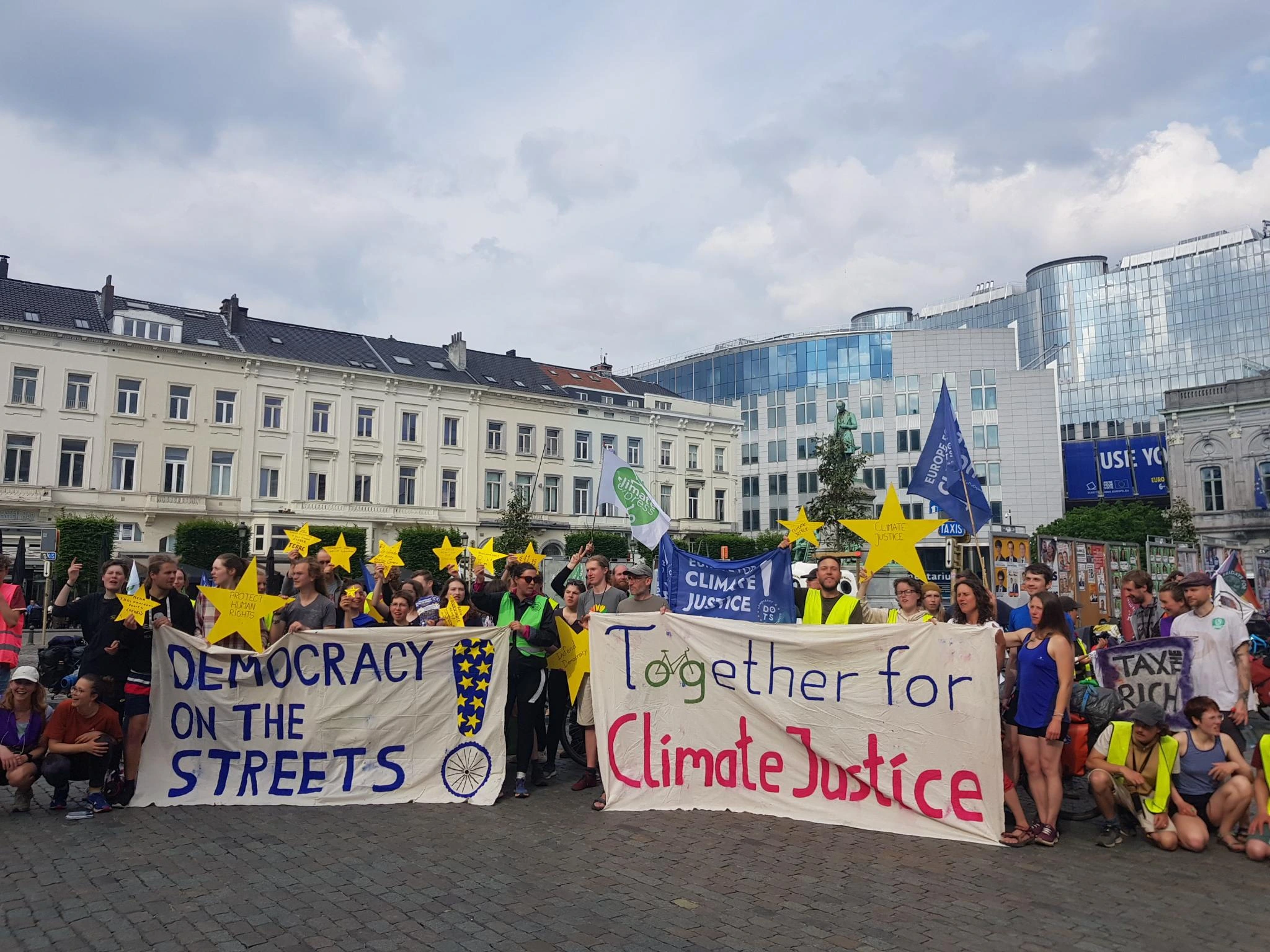
In response to growing far-right influence and environmental challenges, a group of activists from 127 cities across Europe cycled from Cologne to Brussels in a remarkable initiative called Democracy On The Streets (DOTS). This movement, which originated from the German campaign “Ohne Kerosin nach Berlin”, expanded into its first cross-border edition with a clear mission: to demand urgent climate action, protect democracy, and rally support ahead of the European elections.

From 20 to 26 May, cyclists travelled from Germany to Belgium, stopping in towns and cities along the way to raise awareness about pressing environmental issues. These activists, known as cyclo-activists, held peaceful yet visible protests throughout their journey, advocating for climate justice, human rights, and democracy. Along the route, they met with citizens and politicians to create spaces for discussion and debate on critical topics. Key moments included protests at controversial sites such as the Stop Alibaba movement in Liège, which opposes the expansion of the local airport, and a demonstration against a concrete development in the rural area of Anton, Andenne.

This initiative was notable for its grassroots, community-driven approach. Participants were hosted overnight by local residents, churches, schools, and associations, reinforcing the solidarity and communal spirit of the project. It embodied the belief that united individual actions can create meaningful change. While the peloton was loud to ensure it was seen and heard, it remained entirely pacifist, with a strong focus on delivering its message in time for the upcoming European elections.

This wasn’t just a protest; it was a powerful call to action to protect both the environment and democracy. The grand finale took place in Brussels, where even more activists joined in solidarity, amplifying the campaign’s message at the heart of European politics.

If you’d like to learn more or join the movement, visit: https://ohnekerosinnachberlin.com/inscription-bruxelles-2024-fr/

Participatory Budgeting

Participatory Budget - Youth

Participatory Budgeting for Young People in Vienna


In 2020, Vienna embarked on a groundbreaking initiative with the introduction of its ‘Participatory Children and Youth’ strategy. This forward-thinking approach aims to empower children and young people to shape their futures by becoming key decision-makers in their communities. Central to this strategy is the allocation of municipal budget funds specifically for ideas proposed by young residents. Known as the ‘Participatory Children and Youth Million’, this initiative sets aside €1 million every two years to bring these ideas to life.

Youth Participatory Budgeting

Youth participatory budgeting is designed to actively engage young people in public decision-making processes. By providing platforms for discussion, deliberation, and proposal of projects, it fosters a collaborative environment where young voices are heard and valued. This approach not only encourages dialogue but also builds a strong sense of ownership and partnership between the youth and local government.

The process begins with young people, aged 5 to 20, submitting their ideas either individually or in groups. These submissions are then reviewed in co-creation workshops where participants work with representatives from over 30 municipal departments and district offices. These collaborations ensure that ideas are both innovative and practical. For example, in 2024, a total of 226 ideas were submitted, with 215 being retained for further development.

Public outreach plays a crucial role in this process, aiming to engage not just politically active youth but a broader demographic. In Phase 2, Vienna’s city departments and district administrators review these ideas, requiring clear communication and effective integration with municipal operations. Events and clear timelines are essential to keep the process transparent and inclusive. Proposals must have a minimum budget of €50,000 and be implemented within two years.

As of the May 2024 CEMR webinar, the process had advanced to the voting stage. At this point, 49 projects were presented online for voting, allowing both individual and group preferences to shape the outcomes.

Vienna’s participatory budgeting for children and young people exemplifies a successful model of inclusive governance, demonstrating how cities can harness the creativity and insights of their youngest residents to enhance community life.

Learn more about Participatory Budgeting here

Pink boxes in Poland

Pink boxes - News 2023

Poland initative to help women access menstrual products


Access to menstrual products is still a marker of inequality in the sense that it still remains limited for certain women. This is why the Polish city of Rzeszow, a member of the Association of Polish Cities (ZMP), joined a national project: the “Pink Box” initiative.

These boxes have been used for several years in other Polish municipalities, such as Sopot and Łódź. They are usually found in libraries, parks, public transportation centers or schools; Currently, 43 schools in Rzeszow have implemented them. The pink boxes contain several types and sizes of sanitary products, from wipes to tampons to sanitary napkins. They also contain information on menstrual health and hygiene.

These boxes can be restocked by institutions or private sponsors, in accordance with the project principle: take some if you need it, leave some if you have too much.

Period poverty is a significant problem in Poland. According to a report by the Kulczyk Foundation, almost half a million people in Poland cannot afford sanitary products. In addition, 21% of students are forced to leave school due to lack of products, while 10% of them do not leave their homes during their period.

“That’s why I decided to introduce pink boxes in Rzeszów,” explained Konrad Fijołek, the mayor of Rzeszów. The pink boxes are a positive step in supporting the health and well-being of women in Rzeszów. They show that small community initiatives can have a big impact on people’s lives for minimal cost: the budget for the pink boxes is less than 600 euros.

Inclusive society 

Inclusive society - News 2023

A One-Stop-Shop for newcomers in Mechelen fosters inclusion


Twenty years ago, Mechelen suffered from one of the highest criminality rates in Belgium. Polarisation and deprivation were skyrocketing. Many middle-class families had no choice but to leave. However, little by little, as local authorities implemented inclusion policies, the situation started to evolve. Nowadays, the city is a vibrant symbol of inclusivity, with over 130 nationalities living in harmony. Innovative integration programmes are still being created, implemented and constantly improved. The “Welcome application” is one of them.

When the local authorities of Mechelen reviewed their tools supporting integration processes, they realised that people tend to use their smartphones more often, especially as they are on the move. It was then necessary to display information on a mobile-friendly platform. The Mechelen’s “Welcome App” was born.

With this smartphone app, newcomers can quickly find information about leisure, healthcare, housing, learning and social life in Mechelen. The information is provided in 9 different languages: Arabic, Dutch, English, French, Turkish, Ukrainian, Romanian, Russian, and Spanish. The app also displays a calendar with activities and a dictionary in which complicated words are explained. The app can easily be downloaded on the official website of the city of Mechelen.

With the support of the IncluCities project, the city identified an important issue that can affect the effectiveness of an app: outdated data. Indeed, as mobile apps can be tricky to manage, they sometimes tend to not be updated at all. Unfortunately, outdated information renders an app useless. Furthermore, adding new information manually is very time-consuming. These issues were resolved by developing an algorithm that simplifies the app updating process. As the city’s employees upload new information on a spreadsheet, it is automatically added to the app. Thus, the information on the mobile App will always be up-to-date, coherent and available in all languages.

To download the app, go to Mechelen’s official website.

Training Local Police

Training Police - News 2023

Training local police forces on conflict-related sexual violence in Ukraine


Sexual violence has been used as a weapon of war in conflicts since time immemorial. Tragically, there is no exception with Russian armed forces invading Ukraine. Not only are women, men and children getting sexually assaulted, but they carry with them the stigma and trauma long after.

As part of its mission, the EU Advisory Mission to Ukraine (EUAM) has been advising and supporting the civilian security sector to ensure “effective and accountable law enforcement agencies”, “a trusted judiciary”, and “prevention of secondary stigmatisation of survivors” of conflict-related sexual violence (CRSV). In addition to providing advice, the EUAM has been providing training to the police, courts and prosecutors.

In July of 2022, a Ministry of Internal Affairs academy event was organised with 50 cadets from Lviv and Donetsk Police academies to raise their awareness about gender stereotypes. The EUAM has also organised community safety dialogues in Chernivtsi, Lviv and other Western Ukrainian territories which are “aimed at enhancing trust between civil society, authorities and law enforcement through a frank exchange of views and cooperation.” Priorities identified in the dialogues include “community safety, support for internally displaced people, fighting gender-based violence and disinformation.”

More than a year after the beginning of this violent conflict, many women and girls have suffered from sexual violence whether they stayed or fled their homes. With awareness and adequate initiatives, local and regional governments can better support victims of conflict-related sexual violence.

Additional resources

2023 International Women’s Rights Day series: “Five new Charter articles illustrated through local actions”

This article is part of a series published by CEMR to celebrate 2023 International Women’s Rights Day. This series informs on impactful initiatives carried out by local and regional governments to promote gender justice.

These projects embody the updated European Charter for Equality of Women and Men in Local Life as they show how five of its nine new articles can be put into practice. Together, they represent an inspiring step towards a more gender-equal Europe.

The updated Charter is available currently in EnglishFrench and easy-to-read English versions.

Any questions regarding the update or the actions highlighted in this series can be directed to contact@ccre-cemr.org or the relevant national coordinator for the Charter in your country.

Women’s Health

Women's Health - News 2023

The City of Liverpool fosters women’s health


While it may not seem obvious at first thought, some of Europe’s local and regional governments have competencies which allow them to make impactful policies and programming around sexual and reproductive health. A case in point is the City Council of Liverpool, which has put in place an effective collaboration with the National Health Service (NHS).

In the UK, women experience poor sexual and reproductive health in a higher proportion than their male counterparts. The situation is even more dire in lower socioeconomic or deprived areas. To improve women’s access to health services in Liverpool, a network of women’s health hubs was set up “across the city’s 10 primary care networks”. This was made possible through a joint commissioning group set up between the council and local NHS.

The hubs offer a range of services from long-acting reversible contraceptives (LARCs), such as coils (IUD), contraceptive implants and injections, to cervical screening, psychosexual services and treatment for menopause and heavy periods.

As data available in 2019 illustrated, the women’s health hubs have a positive impact: the rate of LARC prescribing locally increased from 13.1 per 1,000 women to 15.2 per 1,000. Additionally, wait times have been shortened and the City estimates that the increase in LARC distribution has prevented 415 unintended pregnancies.

If this model of specific health hubs expands beyond the city’s and the country’s borders, thousands of women could be positively impacted in their health, daily life and autonomy.

Additional resources

Contraception Policy Atlas Europe 2023


2023 International Women’s Rights Day series: “Five new Charter articles illustrated through local actions”

This article is part of a series published by CEMR to celebrate 2023 International Women’s Rights Day. This series informs on impactful initiatives carried out by local and regional governments to promote gender justice.

 These projects embody the updated European Charter for Equality of Women and Men in Local Life as they show how five of its nine new articles can be put into practice. Together, they represent an inspiring step towards a more gender-equal Europe.

The updated Charter is available currently in EnglishFrench and easy-to-read English versions.

Any questions regarding the update or the actions highlighted in this series can be directed to contact@ccre-cemr.org or the relevant national coordinator for the Charter in your country.

Guide on intersectionality

Intersectionality - News 2023

From toddlers to adults: municipalities embrace intersectionality at all ages


Intersectionality and diversity are at the heart of gender equality. As identities and lived experiences of people are not merely additive but intersecting and complex, it is necessary to include these dimensions in public policies to build a more equal society. In France and Italy, two municipalities are already working on it. From a multi-format help desk to representative toys, they show us that intersectionality is a concrete and transversal matter.

Creating an anti-discrimination help desk in Bologna

The municipality of Bologna is committed and active in its pursuit of equality and justice for all, both within its own administration as well as in service of its residents.

The city created a multi-annual positive action plan to implement its equal opportunities objectives and to address inequalities linked to gender, disability, age and sexual orientation. The plan includes measures to ensure accessible documents and websites, to provide training courses, and to organise exchanges of experience.
Since 2021, Bologna has been part of a campaign promoted by Period Think Tank – Data to Count —  to allow open and public access to data measuring the impact of public policies on gender dimensions.

Bologna, in cooperation with the Regional network against discrimination in the Emilia Romagna Region, offers residents an anti-discrimination help desk service. Its purpose is to welcome, listen, guide and support victims, direct and indirect witnesses of discrimination on a racial, ethnic, or religious basis.

The help desk offers three formats to make reports and obtain advice: a permanent office is open in the Intercultural Centre Zonarelli; a telephone number is serviced during weekdays and a WhatsApp number is available to leave vocal messages at any time; finally, an online form can be filled out to make reports.

Promoting understanding and acceptance through play in Saint-Médard-en-Jalles

As part of their commitment to the European Charter for Equality, the French municipality of Saint-Médard-en-Jalles has drafted a 2022-2024 Equality action plan. The plan includes an objective to raise awareness among staff working with children, youth, and adults about non-stereotyped education.

In addition to providing trainings to staff and encouraging them to reflect on inequalities within the municipal structure itself, they take action to present models of girls, boys, women, and men that go outside the stereotyped roles children are so frequently presented with.

For example, in the structures welcoming young children, the municipality is rethinking the types of toys that are purchased to include dolls with varying skin tones, characters with disabilities, and games representing people from all walks of life.

Additional resources

2023 International Women’s Rights Day series: “Five new Charter articles illustrated through local actions”

This article is part of a series published by CEMR to celebrate 2023 International Women’s Rights Day. This series informs on impactful initiatives carried out by local and regional governments to promote gender justice.

These projects embody the updated European Charter for Equality of Women and Men in Local Life as they show how five of its nine new articles can be put into practice. Together, they represent an inspiring step towards a more gender-equal Europe.

The updated Charter is currently available in EnglishFrench and easy-to-read English versions.
Any questions regarding the update or the actions highlighted in this series can be directed to contact@ccre-cemr.org or the relevant national coordinator for the Charter in your country.


Read the study here

For more information, contact:

Gender Violence

Gender Violence - News 2023

Tackling gendered violence against elected women and staff


The issue of increasing incivility, harassment abuse and violence directed at elected representatives is not a new one. However, it is a threat that continues to grow along with the disenchantment and mistrust many citizens feel towards government and institutions.

While quite a few studies and surveys examine the issue faced by public figures, the gendered dimension of the harassment and violence that elected women face at all levels, including the local and regional, must not be ignored.

Along with the increase in women’s participation in political life, comes increasing exposure to a continuum of abuse, violence, and sexist attitudes. Some studies suggest that while women may not encounter more abuse online, the abuse that women receive is gendered in its content.

A 2020 report for the Congress of Local and Regional Authorities on Fighting Sexist Violence against women in politics at local and regional levels takes stock of the increase of incivility, insults and attacks from both peers and citizens against women who become visible in the political arena. It also gives hints as to how local and regional governments should tackle this disturbing phenomenon. If nothing is done, it may be driving women out of public life and undermining the roots of the democratic process and equal participation and representation.

Recommended actions include:
• “Raising awareness among elected representatives, council staff and citizens on violence against women in politics and its negative impact on the exercise of democratic rights;”
• “Introduc[ing]or revis[ing] codes of conduct in national assemblies, governmental bodies and institutions, explicitly prohibiting sexist speech and sexual harassment, introducing effective complaint and sanctions mechanisms and assist local and regional governments with the implementation of measures regarding sexist violence against women in politics;”
• “Conduct [ing] periodical surveys and studies and establish official statistics, at all levels of government, on the issue of violence against women in politics, including attacks perpetrated in the private sphere;”

Other tools and resources are available to women politicians to help them engage safely with social media. The UK-based non-partisan organisation Elect Her works to motivate, support and equip women in all their diversity to stand for political office in Britain. As part of their mission, they partnered up with Glitch, a charity seeking to end online abuse. Together they offer an online learning course to equip women in public office with the skills to be safer, more resilient and more confident in online spaces.

Finally, a useful guide to security on Facebook and Instagram for women in politics was produced by Meta in collaboration with the Elues Locales network. It provides practical tips on prevention and protection (passwords, pirated accounts, etc.) as well as how to moderate content and report abuse.

Additional resources

2023 International Women’s Rights Day series: “Five new Charter articles illustrated through local actions”

This article is part of a series published by CEMR to celebrate 2023 International Women’s Rights Day. This series informs on impactful initiatives carried out by local and regional governments to promote gender justice.
These projects embody the updated European Charter for Equality of Women and Men in Local Life as they show how five of its nine new articles can be put into practice. Together, they represent an inspiring step towards a more gender-equal Europe.

The updated Charter is available currently in EnglishFrench and easy-to-read English versions.

Any questions regarding the update or the actions highlighted in this series can be directed to contact@ccre-cemr.org or the relevant national coordinator for the Charter in your country.

Digital Violence

Digital violence - News 2023

The City of Munich takes on digital violence


In an effort to proactively tackle online forms of violence, the City of Munich has set out specific actions in its 2020-2024 Equality Action Plan.

The high incidence of gender-based violence that girls and women encounter in face-to-face interactions translates increasingly into the digital realm. According to EU-wide surveys carried out by the EU’s Fundamental Rights Agency 33 % of women have suffered physical and/or sexual violence since the age of 15 years; and 1 in 10 women have already experienced a form of online violence from the age of 15 onwards (EIGE 2017)

Munich has been quick to recognise that as digital media and digital communication are naturally integrated into everyday life, particularly among younger people, the distinctions between digital and physical violence is becoming less pertinent.

As part of its project on digital violence, Munich is organising a series of events bringing together experts from different fields and with various approaches to the subject in order to take stock of and understand the existing forms of digital violence. The target audience includes professionals from specialised institutions in Munich, including social services, women’s shelters, schools, police and hospitals.

The experts are invited to exchange on different topics, among which an analysis of gender and violence in the digital space, legal aspects of digital violence, prevention and intervention possibilities in terms of technical aspects and in police work.

These events, which are attended by 20 to 30 professionals, offer space to explore possibilities for prevention and intervention and to identify areas for action. It also contributes to spreading knowledge and awareness of the phenomenon which is still relatively poorly understood and not adequately measured. This is what Munich is hoping to change for the better with their actions.

The next steps following the events will be to develop strategies for preventing and addressing digital violence. One possibility to be explored is the creation of a special counselling centre at the municipality. As Munich shows the way, other municipalities will hopefully soon follow and help make the digital world safer for everyone.


Additional resources


2023 International Women’s Rights Day series: “Five new Charter articles illustrated through local actions”

This article is part of a series published by CEMR to celebrate 2023 International Women’s Rights Day. This series informs on impactful initiatives carried out by local and regional governments to promote gender justice. These projects embody the updated European Charter for Equality of Women and Men in Local Life as they show how five of its nine new articles can be put into practice. Together, they represent an inspiring step towards a more gender-equal Europe.

The updated Charter is available currently in EnglishFrench and easy-to-read English versions.

Any questions regarding the update or the actions highlighted in this series can be directed to contact@ccre-cemr.org or the relevant national coordinator for the Charter in your country.