
“Right to Stay” strategy

Right to Stay strategy news

CEMR calls for a place-based “Right to Stay” strategy

468 words
2–3 minutes

In its contribution to the European Commission’s call for evidence on the upcoming “Right to Stay” strategy, the Council of European Municipalities and Regions (CEMR) calls for a politically ambitious, place-based framework that puts local and regional governments at the centre of Europe’s response to territorial, social, economic and demographic imbalances.

For CEMR, the right to stay means that people must be able to live, work and thrive in the place of their choice: whether in a city, a town or a rural area, without being forced away by lack of public services, economic opportunity, poor connectivity or rising living costs.

This is not just a matter of territorial cohesion. It is also a question of fairness, democracy and trust in the European project. If the EU wants to respond to growing territorial inequalities, it must start by investing in the places people call home and by recognising the governments closest to citizens as strategic partners.

In its response, CEMR underlines that there can be no right to stay without access to services, housing and opportunity. Across Europe, too many territories still face shortages in healthcare, education, mobility, childcare, energy and digital infrastructure. At the same time, rising housing costs are pushing people out of cities, while many rural and shrinking areas continue to suffer from depopulation and underinvestment.

CEMR therefore calls on the EU to strengthen support for services of general interest, affordable housing and integrated territorial development. It also stresses the need to create enabling conditions for local economic opportunities in every territory, including through better transport and digital connectivity, support for entrepreneurship, and action to tackle labour shortages in key local public services.

CEMR also highlights the growing importance of climate resilience, sustainable mobility and local energy production for territorial attractiveness and energy security. Investments in adaptation, renewable energy and accessible transport must therefore be part of any credible Right to Stay agenda.

For CEMR, Cohesion Policy must be the main delivery tool of the future strategy. In the next EU budget, the Right to Stay should be recognised as a clear strategic objective, backed by strong funding, integrated territorial instruments and genuine partnership with local and regional governments in the design of national and regional plans.

CEMR also calls for the Right to Stay to be embedded in EU governance, including through the European Semester and stronger territorial impact assessments. Europe cannot continue to shape policies for territories without systematically involving the authorities responsible for delivering them.

The message is clear: the right to stay will only be real if the EU gives territories the means to remain attractive, affordable, connected and resilient. That requires political ambition, long-term investment and a genuine multilevel partnership with local and regional governments.

For more information, contact:

Statement on public procurement

Public procurement services news

Call on European institutions to safeguard public-public cooperation and in-house provision in the Revision of the Public Procurement Directives 

313 words
1–2 minutes

Public-public cooperation and in-house provision are essential tools enabling local and regional governments to organise, deliver, and manage public services directly — whether through cooperation with other public authorities or through entities under their control — without resorting to external operators.  

The Council of European Municipalities and Regions (CEMR) released a statement in which it expresses its strong opposition to calls and proposals that further restrict public-public cooperation and in-house provision in view of the upcoming Revision of the EU Public Procurement Directives.  

In this new statement, CEMR argues that public-public cooperation and in-house provision are firmly grounded in the EU Treaties, the Public Procurement Directives, and the case law of the Court of Justice of the European Union. Local and regional governments must retain the freedom to choose the delivery model that best serves their communities — including direct provision and cooperation with other public authorities.  

CEMR also takes aim at the notion that public-public cooperation or in-house provision harms competition. There is no evidence to support that claim; if anything, these models can improve efficiency, support investment, and strengthen essential public services for citizens.  

Additionally, at a time of growing geopolitical uncertainty, cybersecurity risks, and growing pressure on public services, local authorities cannot afford to lose the flexibility to organise critical services in-house or through trusted public partnerships.  

CEMR calls to the European institutions for greater legal certainty — not further restriction — in the revision of Article 12 of the Public Procurement Directive, while safeguarding the right of local and regional governments to organise public services according to local needs and democratic choices.  

To complement this information, you can also read here CEMR’s position paper setting out what local and regional governments need from the revision of the 2014 Public Procurement Directives. 

For more information, contact:

EU budget political declaration

Leaders Summit Finland 2026

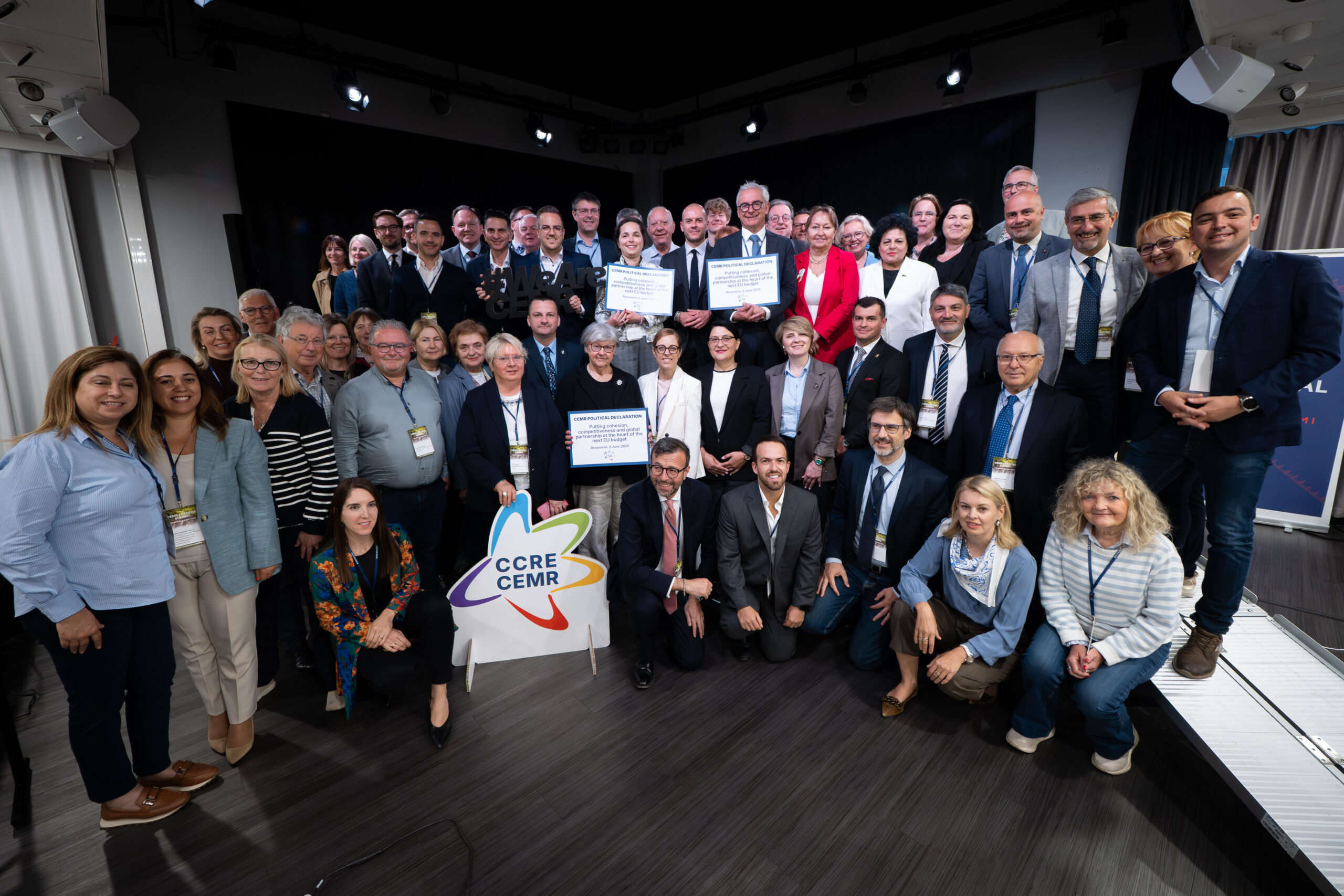
CEMR local leaders adopt a political declaration in support of an EU budget that works for every territory


Gathered in Rovaniemi on 5 June, local leaders call on the EU’s Heads of State and Government to include the European Parliament’s EU budget recommendations on multilevel governance, territorial delivery and predictable funding into their negotiations with the Council


Local leaders of the Council of European Municipalities and Regions (CEMR) Policy Committee have adopted a political declaration calling on EU Heads of State and Government to incorporate the European Parliament’s key recommendations on the next EU budget (2028-2034) into their negotiations in the European Council. The declaration, with 55 signatories, approved during the CEMR Leaders’ Summit in Rovaniemi, comes at a crucial moment in the interinstitutional discussions on the upcoming Multiannual Financial Framework (MFF).

By endorsing this declaration in support of an EU budget that works for every territory, CEMR members urge to ensure that the next long-term budget is fit for the EU ambition for cohesion, competitiveness and global partnership. Addressed to national leaders, the declaration makes the case for a budget that is place-based, predictable, and grounded in genuine multilevel governance.

A particularly significant timing

The declaration follows the European Parliament’s adoption of its interim report on the 2028–2034 EU budget on its plenary meeting of 28 April 2026 in which the Parliament set out its political priorities and will be the basis of negotiations with the Council.

As Member States meeting on 18-19 June Council will finalise their position, CEMR calls on them to take into consideration the position and proposals put forward by the European Parliament towards an EU budget that delivers competitiveness, cohesion, and trust across all territories.

Key asks of the political declaration

In practical terms, the declaration encourages Heads of State and Government to uphold the European Parliament’s key recommendations on multilevel governance, territorial delivery and predictable funding under the future National and Regional Partnership Plans (NRPP). It also calls for the continuation of territorial innovation and competitiveness tools, as well as stable and predictable support for innovation, scale-up and investment in towns, cities and regions under the future European Competitiveness Fund (ECF).

Local and regional governments are essential to turning EU priorities into concrete projects, services and investments on the ground. Among the main calls of the political declaration, it urges to preserve strong and clearly allocated funding for Cohesion Policy, which will secure key investments for economic, social and territorial cohesion in all regions.

It also insists that local and regional governments must be properly involved in the design and implementation of future NRPP.

The text further calls for the protection of integrated territorial and urban development tools, stronger administrative capacity for local and regional governments, and a more realistic approach to performance and delivery rules for long-term investment.

On competitiveness, the declaration argues that the future ECF must be accessible across all territories and better connected to local realities. It also calls on the EU to recognise local and regional governments as full partners in external action and development cooperation.

The overall message is clear: if the EU wants its next budget to produce tangible results for citizens, it must give local and regional governments the means and the role to make that happen.

CEMR advocacy campaign on the next EU budget

This action is part of CEMR’s wider campaign on the future EU budget. The campaign stresses that the decisions now being negotiated will shape the European Union’s ability to invest in people and places for the next decade. It also warns that greater flexibility in the new budget architecture must not come at the expense of safeguards for place-based investment, multilevel governance and predictable funding for towns, cities and regions.

For more information, contact:

CEMR Housing Task Force

EU housing news 2026

Affordable, sustainable, livable: what local governments need from the EU on housing 


The housing crisis has become one of the defining societal challenges of the 21st century, affecting communities across Europe: from major cities to rural areas, and reshaping social, economic, and demographic realities. Rising housing costs, homelessness, and chronic underinvestment are undermining equality, cohesion, and sustainability. Addressing this emergency requires integrated, place-based solutions that link housing with services, mobility, jobs, and quality of life. As frontline actors, local and regional governments must be recognised as key partners in Europe’s response, working with national and EU institutions to deliver affordable, sustainable, and inclusive homes for all.  
 
Europe’s housing crisis is felt most sharply where people live, work and study. On 9 April 2026, CEMR’s Housing Task Force brought together local and regional perspectives on how to measure affordability and how to respond to short‑term rentals and accelerate housing delivery.  

The discussion comes at a pivotal moment as the European Commission’s European Affordable Housing Plan has placed housing firmly on the EU agenda, and preparations are underway for an Affordable Housing Act aimed at supporting public authorities in addressing pressure in “areas under housing stress”, including through measures linked to short‑term rentals. With the European Parliament also intensifying its work on the housing crisis, the political momentum is clearly rising.  

Affordability beyond a single number 

A key takeaway following an exchange with Sandra Di Biaggio, Research and Policy Manager at ESPON for a presentation on the project Housing4All, was that affordability is multidimensional. It cannot be reduced to prices alone: income and residual income matter, but so do energy bills, mobility costs, access to services and housing quality. Participants also stressed that data gaps, including limited harmonised income data at the local level, can make comparisons difficult, reinforcing the need for placebased analysis.  

Tailor-made policy mixes 

The Task Force discussion underlined that no single instrument can fix affordability everywhere. Housing pressures vary widely from urbanisation and tourism to student demand and financialisation, alongside supply constraints such as rising costs and construction capacity. This calls for policy mixes adapted to local realities, where EU action adds value by enabling conditions (investment, legal clarity, better data, smart simplification) rather than prescribing uniform solutions.  

Shortterm rentals and local autonomy 

On short‑term rentals, participants highlighted the need for legal certainty for local governments when adopting policies on short-term rentals,  without undermining local competence. Overly rigid definitions in the norm risk limiting local capacity to act, especially if rules apply only within narrowly defined “stress areas”. At the same time, better enforcement of existing tools and clearer guidance on what is compatible with EU law could strengthen local action.  

Building faster and better. Finally, the Task Force discussed how industrialisation, standardisation and digitalisation in construction, alongside renovation, circularity and energy performance, could speed up delivery while supporting Europe’s climate objectives.  

CEMR will continue to bring local and regional perspectives into the EU debate as work progresses towards the Affordable Housing Act (expected for the end of 2026).  

Learn more about the CEMR position on Housing

For more information, please contact:  

Housing policy paper

Housing policy paper - News 2026

A local housing plan to strengthen the role of cities, towns and regions in addressing Europe’s housing challenges


Europe’s housing crisis has reached unprecedented levels, with direct consequences for citizens living in towns, cities and regions across the continent. The European Commission’s EU Affordable Housing Plan is a meaningful step forward, but it will only deliver if the full potential of local and regional governments is unlocked.

CEMR’s new position paper, “A local plan for housing”, sets out proposals to the EU Affordable Housing Plan, arguing that Europe’s ambitions will only translate into real results if towns, cities and regions are fully empowered to act.

To make this happen, CEMR identifies four priorities that must be unlocked so local and regional governments can deliver on the ground:

1. Mobilise investment where it matters most

Inadequate and unpredictable funding is one of the main barriers to expanding affordable and sustainable housing for towns, cities, and regions. Local and regional governments need long‑term investment frameworks. CEMR calls for:

  • Simpler and wider access to EU and national funding, including cohesion policy and EU budget 2028-2034 instruments, so municipalities of all sizes can plan and deliver.
  • Reforms to fiscal rules and modernisation of State aid, treating affordable and energy‑efficient housing as long‑term investment rather than ordinary expenditure.
  • Support to strengthen construction capacity and innovation, from skills to circular, climate‑resilient building and renovation.

2. Enable faster and more coherent planning to accelerate delivery

Fragmented, complex procedures delay urgently needed homes across Member States. CEMR urges EU and national authorities to:

  • Streamline planning and environmental assessments, reducing duplication while upholding strong sustainability standards.
  • Enable place‑based approaches, giving towns, cities and regions the flexibility to access land, regenerate brownfields and plan integrated, inclusive neighbourhoods.
  • Advance the single market for construction, harmonising technical standards to reduce delays, boost innovation and lower costs.

3. Improve efficiency through digital permitting

Digital permitting can bring faster renovation and new construction, but many local and regional governments lack resources to implement it. CEMR calls for:

  • Dedicated funding, training and technical assistance are needed for interoperable local–national–EU permitting systems.
  • Clearer guidance for applicants and developers will improve submission quality.

4. Activate Europe’s full potential through a real multilevel partnership

The EU Affordable Housing Plan will only succeed through genuine cooperation across levels of government. CEMR asks for:

  • Structured multilevel governance, with local and regional governments fully involved in design, implementation and monitoring.
  • Stronger municipal autonomy and legal clarity, ensuring responsibilities are matched with financing.
  • Adequated resources for the European Housing Alliance with structured participation of local and regional governments, which also serves to cooperate beyond the EU to address shared housing challenges.

Europe’s housing challenge demands swift and coordinated action. The EU Affordable Housing Plan sets an important framework, but its success will depend on how well it empowers the governments closest to citizens. By unlocking investment, planning flexibility, digital efficiency and genuine multilevel governance, Europe can move from ambition to delivery.

CEMR’s “Local Plan for Housing” offers a clear pathway: start locally, invest wisely and collaborate across levels of government. Only by working through cities, towns and regions can Europe ensure that affordable, sustainable and inclusive homes become a reality for all.

For more information, contact:

Global Europe 2028–2034

Global Europe - position paper

Local and regional governments at the heart of “Global Europe 2028–2034”: our Policy position


As the European Union prepares its next Multiannual Financial Framework (MFF) for 2028–2034, the Global Europe instrument will define the EU’s external action for the years ahead — encompassing development cooperation, humanitarian aid, enlargement support and Global Gateway. Discover PLATFORMA detailed policy position outlining how this strategic instrument should be shaped to foster sustainable global partnerships and advance inclusive governance.

At a time marked by intersecting global crises — from climate breakdown and shrinking development funds to geopolitical instability — the role of local and regional governments (LRGs) is more critical than ever. PLATFORMA’s paper is thus anchored in the belief that effective global action starts from the ground up.

Local and regional governments as co-decision-makers, implementers and partners

PLATFORMA’s position starts from a stark reality: despite their proximity to citizens and deep knowledge of local contexts, LRGs remain under-recognised in EU external action frameworks. The coalition calls for the Global Europe instrument to move beyond symbolic references to “local authorities” and embed mechanisms that genuinely empower LRGs as co-decision-makers, implementers and partners in EU external policies.

Key recommendations

The Policy Paper makes 9 key recommendations to EU decision makers:

  1. Strengthen multilevel governance in Global Europe and place local and regional governments in the driving seat of territorial development
  2. Pair flexibility and simplification with ambitious official development assistance targets, and enhance accountability and transparency mechanisms
  3. Unlock Global Gateway’s potential through the involvement of local and regional governments
  4. Foster EU delegations’ engagement with local and regional governments
  5. Recognise and empower local and regional governments as unique and effective development partners in fragile contexts
  6. Advance the localisation of the Sustainable Development Goals to achieve decarbonised societies and climate justice
  7. Involve citizens through Global Citizenship Education as a key component of decentralised development cooperation
  8. Foster inclusive and participatory local governance: empower youth, women, and disadvantaged and underrepresented groups
  9. Strengthen local governance through the EU Eastern neighbourhood and enlargement strategy

Through these recommendations, PLATFORMA aims to improve the current proposal for the Global Europe instrument, so that it fully recognises, acknowledges, and supports the contribution of local and regional governments to EU external action, notably through decentralised cooperation as a development aid modality.

PLATFORMA also calls on the European Commission to issue an updated Communication on the structured involvement of local and regional governments and their associations in the new (geo)strategic approach to EU external action.

Read the full Policy position

For more information, contact:

Amendements to the EU budget

Shaping the future of EU Cohesion Policy: CEMR’s amendments to the proposed National and Regional Partnership Plans


The EU’s place-based approach to policymaking — which recognises territorial diversity and builds on the role of local and regional governments — is under critical pressure. The European Commission’s proposal for the next Multiannual Financial Framework risks weakening this approach by centralising investment decisions and blurring the distinct objectives of EU policies with very different territorial logics.

CEMR has therefore developed targeted amendment proposals to the regulation establishing the National and Regional Partnership Plans. These proposals aim to preserve place-based policymaking across EU investments, strengthen democratic and territorial governance, and ensure that policies designed in Brussels and capitals continue to deliver concrete, long-term benefits in cities, towns and regions. 

The main messages driving CEMR amendments

1. Safeguarding cohesion as a core EU priority
CEMR calls for a stronger budgetary commitment to economic, social and territorial cohesion. Reducing the relative weight of cohesion policy — while expanding access to funds to all private actors — risks undermining public services, increasing competition for limited resources, and weakening Europe’s capacity to deliver resilient territories and communities. 

2. Putting territories and people back at the centre
Cohesion policy must work across all regions and respond to territorial diversity. Our amendments reinforce the territorial dimension of EU investments, ensuring that no region or community is left behind and that the objectives of the EU Treaties are fully respected. 

3. Making partnership and multilevel governance real
While the Commission proposal refers to partnership and multilevel governance, it lacks strong guarantees. CEMR proposes clear obligations, monitoring mechanisms and consequences to ensure that local and regional governments are genuinely involved in the design, implementation and monitoring of national plans — not merely consulted in name. 

4. Preventing over-centralisation of EU investments 
Recent experiences with the Recovery and Resilience Facility and other national plans have shown the risks of centralised approaches. CEMR therefore calls for mandatory regional and territorial chapters in national plans, ensuring place-based strategies and meaningful involvement of subnational governments throughout the programming period. 

5. Strengthening integrated territorial development 
Integrated territorial approaches — in urban and non-urban areas — bring Europe closer to citizens and have proven their value on the ground. CEMR proposes a minimum 30% earmarking of national allocations for integrated territorial development, supported by higher EU co-financing and increased pre-financing to enable local authorities to participate fully. 

6. Supporting rural areas, cities and functional territories 
Our amendments reinforce support for rural development, sustainable urban development, urban-rural linkages and functional areas. These approaches are essential to tackling demographic change, climate challenges and social inequalities in a coherent and coordinated way. 

A call for a stronger, fairer cohesion policy

CEMR’s amendment proposals are guided by a clear conviction: Europe’s resilience, prosperity and democratic strength depend on strong local and regional governments and on cohesion policy that is ambitious, inclusive and place-based

We call on the European Parliament and Member States to take these proposals seriously and ensure that the future EU cohesion policy delivers for all territories and all citizens. 

👇 We invite you to consult the full set of CEMR amendment proposals for a detailed overview of our recommendations and legal changes to the Commission’s proposal.

More information:

MFF 2028-2034 position paper

EU Budget - News 2025

A stronger Europe is built locally: CEMR publishes its position paper on the EU Budget 2028–2034


As the EU prepares its next long-term budget, the Multiannual Financial Framework (MFF) 2028–2034, CEMR calls for a clear message to EU institutions and Member States: Europe’s future strength depends on empowering its towns, cities and regions.

CEMR’s new position paper, A stronger Europe is built locally, sets out how the next EU budget can effectively support territorial cohesion, competitiveness, democracy, and resilience. In the paper, CEMR warns that while the Commission’s proposal slightly increases overall resources, it reorients priorities toward defence, security, and industrial competitiveness—often at the expense of cohesion and local development, the very pillars that bring the EU closest to its citizens.

Multilevel governance must be non-negotiable

The paper highlights a major risk of recentralisation: by granting Member States and the European Commission broader discretion in defining funding priorities, the proposal could marginalise local governments, particularly in countries with weaker multilevel governance structures.

CEMR urges the EU to reinforce partnership mechanisms across all programmes—especially within the National and Regional Partnership Plans (NRPP), the European Semester, the European Competitiveness Fund (ECF) and the Global Gateway. Stable, well-resourced local and regional governments platforms are essential to tailor EU investments to realities on the ground.

Cohesion at the heart of Europe’s transformation

CEMR stresses that cohesion is a treaty-based objective and must remain central. The paper calls for:

  • Mandatory regional and territorial chapters in all Partnership Plans
  • Increased budget allocation for the single integrated funding instrument proposed by the EU Commission, “The Fund”
  • A mandatory 30% earmark for sustainable territorial development, including 15% for urban development
  • A safeguarding mechanism to protect local governments’ access to funds when national governments fail to meet conditionalities
  • Strengthening ESF+ (European Social Fund) for cohesion, youth and inclusion

Without these guarantees, Europe’s green, digital, and social transitions risk leaving entire territories behind.

Competitiveness and connectivity must acknowledge territorial reality

While competitiveness is a top EU priority, CEMR notes that the Commission’s budget proposal overlooks the territorial dimension. Cohesion and competitiveness are two sides of the same coin, and local and regional governments’ role in driving local and regional economic development should be recognised.

CEMR paper also calls for biodiversity and nature restoration to become explicit priorities in the European Competitiveness Fund (ECF) and urges simpler access to ECF, Horizon Europe, and the Connecting Europe Facility (CEF)—especially for smaller municipalities. It also stresses the need to include urban mobility as a strategic CEF priority.

Democracy and enlargement: supporting the foundations of Europe

With rising polarisation, disinformation, and harassment of local politicians, the position paper urges the EU to strengthen local democracy, support civic participation, and fund democratic resilience—including Global Citizenship Education and support for local media.

On enlargement, CEMR calls for local and regional governments to play a central role in the accession process of candidate countries, backed by stronger capacity-building and dedicated resources.

Read the full position paper here

For more information, contact:

Our reaction to the Agenda for cities

Twinning Report - News

CEMR welcomes the publication of the EU Agenda for Cities and the renewed recognition of local and regional governments as essential partners in delivering Europe’s priorities


The publication of the Agenda for Cities marks an important step towards strengthening the urban dimension of EU policies. It does acknowledge the key role of local and regional governments in implementing 70% of EU legislation, and the importance therefore to better inform and associate local governments in the preparation of European legislations. But the agenda falls short of answering the “ambition” level announced by President Ursula von der Leyen in her mission letter to Executive Vice President Raffaele Fitto.

Beyond a catalogue of policy areas where cities play an important role, and a list of initiatives already implemented by the European Commission, several elements will require clarification and improvement to ensure the Agenda truly delivers solutions for cities of all sizes and contribute to better policy making by transparent and representatives partnership with local and regional governments at European level. 

The Agenda for cities is just one piece of the puzzle 

While the EU Commission states that the Agenda applies to cities of all sizes, as well as suburbs and towns, the continued reliance on the Eurostat definition of “urban centres” (50,000+ inhabitants) risks leaving much of Europe behind. As we have seen with the implementation of the European Innovative action, the Eurostat definition has become the minimum population criteria in calls for proposals directly managed by the European Commission. This approach may inadvertently exclude small and medium-sized municipalities, which make up the majority of local governments and are at the heart of delivering EU policies.  

But beyond the Agenda for Cities, CEMR regrets that this initiative has not been enshrined in a broader more comprehensive territorial development strategy for Europe. As set out in our position paper Towards an inclusive EU agenda for cities of every size and context, an effective EU Agenda must reflect the full territorial diversity of the EU and avoid reinforcing urban–rural divides.  

A welcome recognition of cities’ role, but structured multilevel governance is still missing 

CEMR welcomes the acknowledgement of local and regional authorities as key implementers of EU legislation. However, the governance model proposed in the Agenda still relies heavily on ad hoc consultations, including the reference to the June 2025 Implementation Dialogue, which lacked transparency and representativity. 

We reiterate the need for a permanent, structured and inclusive multilevel governance mechanism involving local and regional governments and their representative associations at national and European level. This is essential for shaping, not only implementing, EU policies. In this respect, associations representing local and regional governments at European but also national level must be the go-to partners for the European Commission, to ensure representativity and legitimacy of their consultation processes.  

When mentioning the preparation of the “National and Regional Partnership Plan” for the EU budget post 2027, the Commission states that structured multilevel dialogue will be key feature in the preparation and implementation of the plan, but did not include any binding measure to ensure this is the case. CEMR also made concrete recommendations to secure the involvement of local and regional governments in preparation of these plans. 

Better Implementation must become a priority of the EU Agenda 

It is positive that the Agenda includes some specific support under a new “EU Cities platform” for capacity building, innovation and participation in dialogue. It will be important that this support offer is not restricted to few cities but available to all subnational governments.  
CEMR calls in particular for a dedicated Better Implementation pillar as part of the EU Urban Agenda with: 

  • Governance and competence impact assessments for all new EU proposals, 
  • capacity-building resources in the reforms pillar of the next MFF, 
  • regular and inclusive implementation dialogues, 
  • and a one-stop-shop integrating all support tools for subnational governments. 

These elements are indispensable for translating EU ambitions into real local outcomes.  

Funding: more clarity, but uncertainties remain 

We welcome the launch of the new EU City Portal, which can help cities navigate funding opportunities more easily. At the same time, the future EU Facility – to be directly managed by the European Commission raises questions about the future of existing programmes (EUI and URBACT) and on governance, accessibility, and safeguarding participation of smaller municipalities. To unlock the full potential of local governments, the EU must deliver simpler, fairer and better-aligned funding, as outlined in our position paper.  

Promising measures in the agenda, if they remain accessible to all

CEMR welcomes new initiatives announced in the Agenda, including: 

  • “potential” access to the European Competitiveness Fund for clean transition and industrial decarbonisation, as well as for resilience, security and defence 
  • High and technical levels consultations of urban stakeholders 
  • strengthened support for capacity building, including on public procurement, 

While cities are encouraged to adopt the “mission approach” it remains unclear whether that is mere suggestion or whether it will come with a new call and potential funding for these “Mission Cities”. 

These measures can help cities accelerate the green and digital transitions—as long as access is equitable and not restricted to larger or well-resourced municipalities. 

Our final message 

Today’s publication is a milestone for Europe’s urban future. But an EU Agenda for Cities must be inclusive, territorially balanced and grounded in genuine multilevel governance. CEMR stands ready to work with the European Commission, Member States, and its member national associations to ensure that this Agenda becomes a truly transformative framework—one that delivers for cities, towns and regions of every size and context

For more information, contact:

Digital local and regional governments

Digital transition - News 2022

How Europe’s municipalities and regions can drive an inclusive, secure and people-centred digital transformation


Local and regional governments are at the heart of Europe’s digital transformation. As the public authorities closest to citizens, they deliver services such as healthcare, education, transport, social support and broadband deployment, all increasingly shaped by EU digital legislation. Their role is essential to ensure that digitalisation remains inclusive, sustainable and accessible to everyone. Yet many local and regional governments still face major obstacles: unequal access to digital infrastructure, insufficient financial and human resources, cybersecurity risks, and widening gaps in digital skills.

Across Europe, disparities in connectivity and digital access disproportionately affect rural and remote areas, low-income households and vulnerable groups. These inequalities threaten territorial cohesion and limit citizens’ ability to participate fully in digital society. To make digital public services truly accessible, digital solutions must follow inclusive design principles and remain complemented by in-person service options for those who cannot or prefer not to use digital channels.

Cybersecurity has become an increasing concern as local authorities manage sensitive public data and critical infrastructure, often without sufficient expertise or funding to meet growing EU requirements such as those under the NIS2 Directive. Smaller municipalities, in particular, lack the resources to implement robust cybersecurity measures, respond to incidents or comply with complex regulatory frameworks. Reinforced cooperation, simplification of rules and sustainable financial support are essential to strengthen local resilience.

Skills development remains another pressing challenge. To implement new EU digital policies, including those related to artificial intelligence, interoperability and data governance, local administrations need staff trained to oversee digital systems, maintain human oversight, and ensure ethical, transparent and fair use of technologies. At the same time, strengthening digital literacy among citizens through lifelong learning and community-based initiatives helps build trust, inclusion and participation. Cooperation between municipalities and across regions also accelerates innovation and avoids fragmentation by enabling the exchange of best practices and common solutions.

A Call for Stronger EU Support

To ensure a fair, secure and inclusive digital transition, CEMR calls on European institutions to reinforce investment in digital infrastructure, especially in underserved regions; provide technical and financial support for accessible digital public services; maintain non-digital access to essential services during the transition; facilitate public-private partnerships to expand connectivity; and offer tailored guidance, capacity-building and long-term funding to help local and regional governments strengthen their cybersecurity and digital skills. Europe’s digital future depends on empowering the actors closest to citizens: its municipalities, cities and regions!

Read the position paper here

For more information, contact: