Ten years of cities taking climate action

Circular Cities and Regions Initiative - image

Celebrating a decade of driving local climate action in sub-Saharan Africa

The Covenant of Mayors in Sub-Saharan Africa (CoM SSA) is the “regional covenant” of the Global Covenant of Mayors for Climate & Energy (GCoM). It is a bottom-up and voluntary initiative that invites cities to define and meet ambitious and realistic energy and climate targets.

Launched in 2015 and funded by the European Commission, CoM SSA was initially led by the Council of European Municipalities and Regions, in partnership with African and European city networks, national associations of local governments, and civil society organisations.
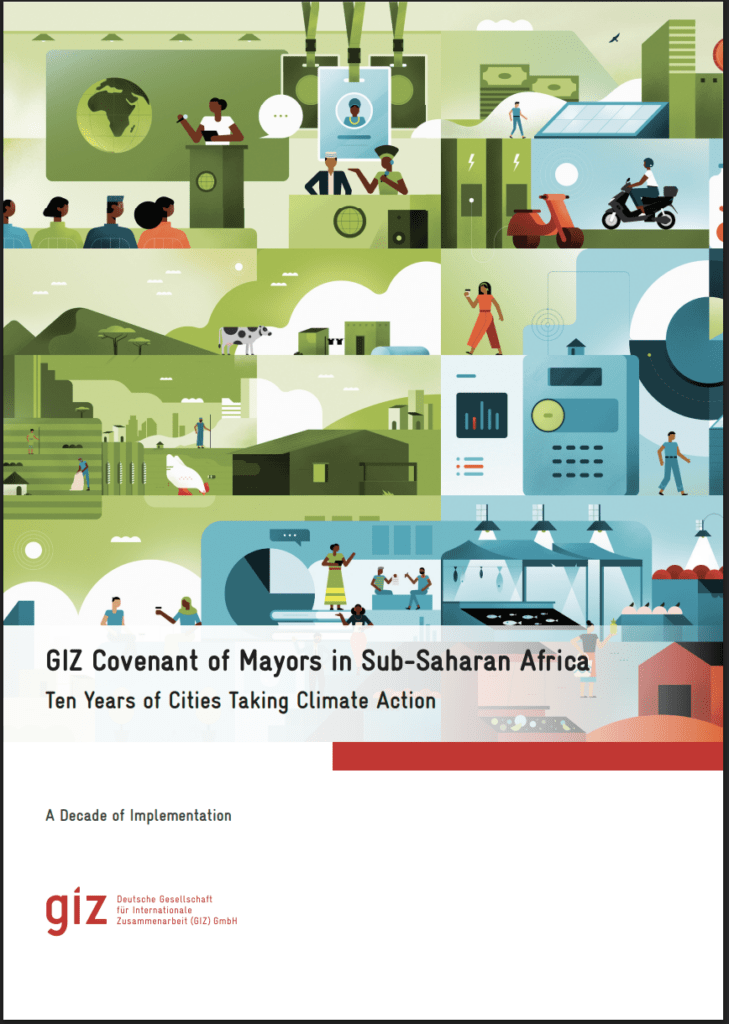
To mark this decade, the new publication A Decade of Implementation, produced by GIZ in the framework of CoM SSA, brings together reflections from cities, institutional partners, donors and long-standing experts. Combining strategic perspectives with concrete city examples, it documents how more than 400 local governments, representing over 166 million people, have moved from climate planning to implementation and investment. The publication highlights key milestones and results achieved over the past ten years, including the development of the Sustainable Energy Access and Climate Action Plans (SEACAP), support for project preparation for cities, and an increasing focus on implementation, investment and impact.

Over the past decade, CoM SSA has shown that local climate and energy actions can only be effective and sustainable when it is anchored in political ownership and supported by strong associations of local governments and city networks. By empowering mayors and local leaders, and by facilitating peer exchange and collective representation, the initiative has enabled cities to move from commitments to concrete action.

The publication includes a contribution from CEMR, authored by the Director of Projects and Programmes, Durmish Guri, reflecting on the role of national associations of local and regional goverments and networks in anchoring the Covenant politically and ensuring its sustainability, a message that remains highly relevant as reflections on the future of the Covenant of Mayors continue, including in Europe.

“We therefore call upon funders, governments and partners to continue investing in CoM SSA. Anchored in local realities and supported by diverse partnerships, it stands as a cornerstone of climate resilience in Sub-Saharan Africa.”
Durmish Guri, Director of Projects & Programmes, Council of European Municipalities and Regions (CEMR)
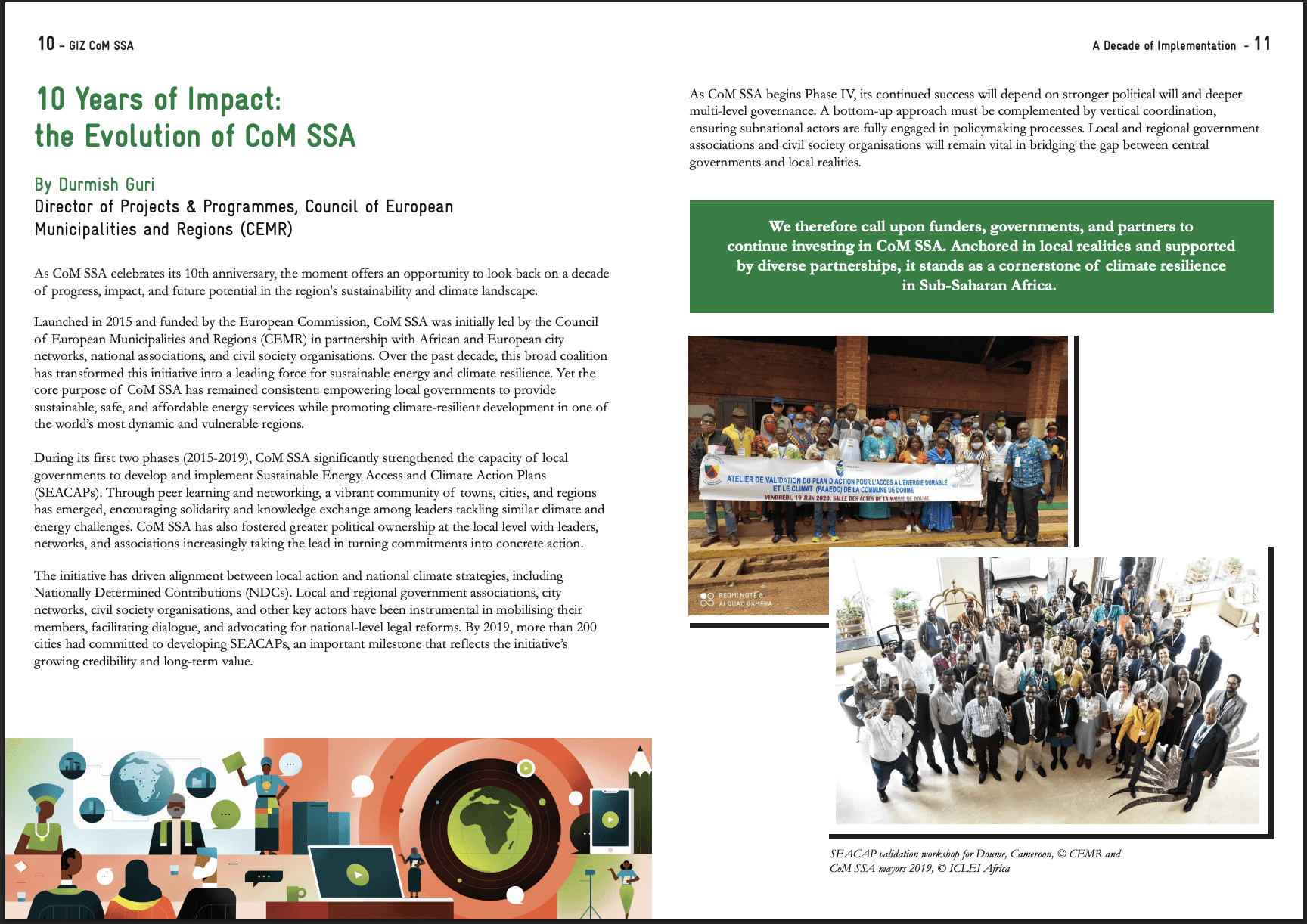
Deutsche Gesellschaft für Internationale Zusammenarbeit (GIZ) GmbH, GIZ CoM SSA – 10 Years of Cities Taking Climate Action, p.10-11.

We would like to thank our partners — Climate Alliance, Energy Cities, Environment Development Action in the Third World (ENDA), French Agency for Environment and Energy Management (ADEME), ICLEI – Local Governments for Sustainability (World Secretariat and Africa), International Association of French Mayors (AIMF), Portuguese Energy Agency (ADENE), Sustainable Energy for Africa, and United Cities and Local Governments Africa (UCLG Africa) — for their invaluable collaboration and commitment.

For more information, contact:

Building climate-ready cities in Africa 

Sub-Saharan Africa - News Section

Lessons from the Covenant of Mayors in Sub-Saharan Africa on strengthening local capacity for energy access and resilience


The Covenant of Mayors in Sub-Saharan Africa (CoM SSA) has, over its first four years, shown that local leadership is essential in tackling climate change and improving energy access. Supported by the European Union and global partners, the initiative empowers municipalities to design and implement Sustainable Energy Access and Climate Action Plans (SEACAPs), tailored to their contexts. 

Developing Local Capacity 

One of the clearest lessons is the importance of involving African partners early and consistently. Contextualising European approaches to local realities in Sub-Saharan Africa has proven key to success. Peer-to-peer learning, including informal exchanges like WhatsApp groups, has strengthened communities of practice and allowed cities to share knowledge beyond language and geographic barriers. 

At the same time, challenges remain. Sparse data, limited technical expertise, and difficulties in political continuity have slowed progress. Travel barriers, connectivity issues, and shifting national dynamics have highlighted the need for more flexible and innovative support structures. The presence of local intermediary organisations, universities, NGOs, or research centres has emerged as critical in anchoring capacity and ensuring sustainability beyond donor cycles. 

Successes and Lessons 
Despite obstacles, CoM SSA has enabled cities such as Bouaké, Dakar, and Tsévié to make tangible progress on emissions inventories and resilience planning. The development of SEACAP guidelines, adapted through extensive consultation, provided a framework that cities could build upon. Simplified tools and hands-on training helped municipalities overcome initial hurdles, while regional workshops fostered solidarity and collective ambition. 

The first phase of CoM SSA demonstrates that building climate resilience in African cities requires time, trust, and resources. Moving forward, stronger capacity-building, continuous peer exchanges, and deeper involvement of local support organisations will be vital. With growing international momentum on climate action, this initiative has laid the groundwork for a long-term transformation: cities that are not only more resilient but also better equipped to deliver sustainable energy for all. 

Read the study here 

For more information, contact: 

Evaluation of Covenant of Mayors in Africa

African Cities - News

Evaluating the Covenant of Mayors in Sub-Saharan Africa: added value, progress, and lessons for the future 


Since its launch in 2015, the Covenant of Mayors in Sub-Saharan Africa (CoM SSA) has become a major initiative supporting African cities in their response to climate change and in improving access to clean energy. Funded by the European Union and co-financed by Germany and Spain, CoM SSA is part of the Global Covenant of Mayors for Climate and Energy. Today, more than 200 cities across 36 Sub-Saharan countries have signed up, committing to long-term climate and energy action through Sustainable Energy Access and Climate Action Plans (SEACAPs). 

Programme Achievements 
The final evaluation highlights both the relevance and scale of the initiative. With Africa’s rapid urbanisation, CoM SSA’s focus on local governments is crucial. The programme has successfully engaged hundreds of municipalities, surpassing its target of 200 signatories, and has provided significant capacity building through technical assistance and workshops. Cities especially valued peer exchanges, which created strong networks for sharing experiences and best practices. 

Pilot projects showed mixed results: while some cities advanced quickly with draft SEACAPs, others faced delays due to political instability, lack of technical expertise, or limited direct involvement of city administrations. Still, the overall added value of the initiative is clear: it created political ownership, improved local technical skills, and promoted sustainable energy and climate planning at the local level. 

Key Lessons and Recommendations 
The evaluation also draws important lessons for the future. Greater alignment between local SEACAPs and national climate strategies is needed to ensure impact. Capacity building remains a priority, requiring more technical staff on the ground and support from local organisations to guarantee continuity. Better coordination with other international programmes is recommended to avoid duplication of efforts. Finally, fostering multilingual platforms for experience-sharing among cities will strengthen the CoM SSA community and enhance learning across regions. 

The Covenant of Mayors in Sub-Saharan Africa has proven its relevance and value by mobilising hundreds of cities and building local capacity for climate action. While challenges remain, the initiative has laid a strong foundation for Phase III, where scaling up, deepening vertical integration with national governments, and securing sustainable financing will be key. CoM SSA is now well-positioned to continue empowering African municipalities as central actors in the global fight against climate change. 

Read the study here 

For more information, contact: 

Adapting to climate in Africa 

Africa - Project News

How African cities are assessing climate risks and building resilient futures 


As climate change accelerates, African cities face mounting threats to their infrastructure, economies, and public health. Rising sea levels, water scarcity, disease outbreaks, and food insecurity are just some of the growing challenges. In response, many local governments across the continent are taking voluntary steps to adapt and strengthen territorial resilience. 

Adaptation is more than reacting to extreme weather, it means preparing for long-term climate impacts and turning risks into development opportunities. This involves adjusting policies, infrastructure, and urban practices to reduce vulnerability and protect communities. 

A recent methodological review explores how African cities are assessing the local effects of climate change and using that knowledge to shape their adaptation strategies. Actions range from bioclimatic architecture to reduce indoor heat, to shifting agricultural practices, protecting water resources, and diversifying tourism away from climate-vulnerable coastlines. 

Importantly, cities must ensure that adaptation and mitigation plans are aligned. Involving the same stakeholders in both processes supports integrated planning and more coherent climate action. 

This work reflects a growing commitment among African cities to lead the way in climate adaptation by studying local risks, acting early, and building more sustainable urban futures. 

Read the study here 

For more information, contact:

Financing climate action in African cities

Sub-Saharan Africa - News Section

Innovative approaches to funding sustainable urban transformation in Sub-Saharan Africa


Cities across Sub-Saharan Africa are increasingly vulnerable to climate change, with two-thirds considered at “extreme risk”. Yet, these same cities, particularly smaller and secondary urban areas, also hold significant potential to drive sustainable development. Through the Covenant of Mayors in Sub-Saharan Africa (CoM SSA), local governments are acting by developing Sustainable Energy Access and Climate Action Plans (SEACAPs) and seeking ways to finance their implementation. 

Building on years of support, the CoM SSA initiative is now focused on helping cities move from planning to implementation, particularly by unlocking access to climate finance. This includes support in understanding the finance landscape, preparing robust projects, and building partnerships with funders and investors. 

A recent publication highlights solutions adopted by cities to finance SEACAPs, from reducing planning costs through inter-municipal cooperation to using public-private partnerships, risk-sharing mechanisms, and community-based funding models. 

Key lessons include: 

  • Diversifying financial sources improves resilience and reduces dependency. This includes crowdfunding, climate funds, local capital markets, and private investment. 
  • Empowering communities through pooled resources, microfinance, and participatory planning ensures sustainability and buy-in. 
  • Using digital technologies helps cities manage climate action more efficiently and affordably. 

These examples illustrate that while challenges remain, Sub-Saharan African cities are making progress in creating bankable, inclusive, and resilient climate solutions, paving the way for sustainable urban futures. 

Read the study here 

For more information, contact:  

Climate finance in Sub-Saharan Africa 

Sub-Saharan Africa - News

Helping Sub-Saharan African cities access funding to deliver local climate and energy action plans


Sub-Saharan African cities are on the frontlines of the climate crisis. Rapid urbanisation has increased their exposure to climate risks and greenhouse gas emissions. To address this, signatories of the Covenant of Mayors in Sub-Saharan Africa (CoM SSA) are developing Sustainable Energy Access and Climate Action Plans (SEACAPs). These plans aim to foster low-carbon, resilient development while ensuring access to sustainable energy. 

However, limited access to climate finance remains a major hurdle. Many local governments lack the necessary knowledge and tools to navigate the complex landscape of climate-related funding. A new publication addresses this gap by mapping out available financing instruments, eligibility criteria, and technical considerations tailored to Sub-Saharan cities. 

While a range of climate finance sources exists, most are not directly accessible to local authorities, often requiring intermediaries such as national governments or development banks. To close this gap, national institutions must improve coordination, provide direct financial support, and create enabling environments for private investment. Mechanisms like Subnational Development Banks and dedicated national climate funds are also key to improving financial flows at the local level. 

Development partners and the international community play a critical role by offering technical assistance for project planning, design, and implementation. With stronger multilevel cooperation, cities across the region can increase their access to climate finance and accelerate the delivery of their SEACAPs, driving both climate resilience and sustainable development. 

Read the study here 

For more information, contact:  

Climate action in African cities 

Africa - Press

Lessons from the Covenant of Mayors in Sub-Saharan Africa on energy, adaptation and resilience 


The Covenant of Mayors in Sub-Saharan Africa (CoM SSA) is a landmark initiative launched by the European Union in 2015 to strengthen local governments’ response to climate change, promote access to clean energy, and build long-term urban resilience. With over 200 signatory cities and a strong support network of partners, the initiative has empowered local authorities to develop Sustainable Energy Access and Climate Action Plans (SEACAPs) based on their own priorities and challenges. 

At a concluding workshop held in Cape Town, participants from pilot cities, non-funded signatories, and local experts gathered to reflect on their experiences, share lessons learned, and chart the way forward for climate action at the local level. 

A bottom-up approach to climate action 
The CoM SSA approach is rooted in the understanding that cities, especially in Sub-Saharan Africa, are uniquely positioned to implement climate policies that are both ambitious and inclusive. Through support in planning, training, technical assistance and data collection, cities were equipped to address three central themes: mitigation, adaptation and access to affordable energy. 

Energy access remains one of the region’s most pressing challenges, with only 32% of the population having access to electricity. Yet despite low carbon emissions compared to global averages, African cities are disproportionately vulnerable to the impacts of climate change. This makes the integration of climate and development priorities not only desirable, but essential. 

Key lessons from the ground 
The workshop highlighted a set of practical insights for future projects: 

  • Climate planning must be institutionalised across all levels of government to ensure continuity and avoid fragmentation. 
  • Political backing is vital: champions within local councils can significantly boost project success. 
  • Data collection is fundamental, but often difficult. Cities need targeted support to overcome technical and bureaucratic hurdles. 
  • Stakeholder inclusion, especially at the early stages, is key to making plans locally relevant and actionable. 
  • Behaviour change within institutions and communities is as important as infrastructure investment. 
  • Training local officials and developing tailored communication strategies are essential to securing long-term buy-in. 
  • Journalists and the media can play a crucial role in building public understanding, but they also need to be supported and trained. 

The transition to low-carbon, climate-resilient cities in Sub-Saharan Africa is urgent, and the CoM SSA programme has laid a solid foundation for this transformation. However, participating cities stressed that they are not ready to continue alone. Continued support for capacity-building, funding, and guidance through the next phases of SEACAP implementation is essential. 

To meet global climate goals and reduce inequality, both bottom-up and top-down approaches must work together. Local governments need stronger backing from national authorities and the international community to bridge the gap between policy ambition and service delivery. 

Ultimately, the experience of CoM SSA cities shows that climate action in Africa must be collaborative, context-specific, and inclusive, because the future of climate resilience lies in empowering those who are closest to the challenge. 

Read the study here 

For more information, contact: 

Financing climate action in Africa

Africa - News Section

New guide helps African cities unlock funding to implement their sustainable energy and climate plans 


As cities across Sub-Saharan Africa face mounting climate threats, they are also increasingly expected to lead the response. Rapid urbanisation, vulnerability to extreme weather, and growing emissions underscore the urgent need for robust local climate action. Yet financing remains a critical hurdle. 

To address this, a new publication supported by the Covenant of Mayors in Sub-Saharan Africa (CoM SSA) offers a practical overview of climate finance options available to local governments. It focuses on helping cities develop and implement their Sustainable Energy Access and Climate Action Plans (SEACAPs), a cornerstone of the CoM SSA initiative. 

While numerous funding mechanisms and instruments exist, from global climate funds to development grants and blended finance models, many remain inaccessible to local authorities. Complex application processes, lack of technical capacity, and a mismatch between financing requirements and city realities are key barriers. 

The publication identifies actionable pathways forward. Among them: 

  • Clearer guidance on eligibility and technical criteria for accessing major funding streams. 
  • Support for project preparation, including technical assistance and capacity building. 
  • The need for intermediary institutions, such as subnational development banks, to channel finance to the local level. 
  • Improved national frameworks to enable direct municipal access to funds and attract private sector investment. 
  • Community-based and innovative financing models, such as cooperatives, crowdfunding, and microfinance, to mobilise local capital. 

The guide also encourages governments and donors to strengthen partnerships with local authorities, recognising their key role in meeting national and global climate goals. 

Ultimately, the success of SEACAP implementation depends not only on access to finance but also on inclusive planning, local ownership, and sustained political will. Empowering cities with the tools and resources to act will be essential for climate resilience and sustainable development across the region. 

Read the study here 

For more information, contact: 

Talanoa for climate action 

Covenant of Mayors in Africa - News

Inclusive dialogues in Africa driving cooperation to strengthen and raise ambition of national climate commitments 


Urban areas contribute up to 70% of global greenhouse gas emissions and are highly vulnerable to climate impacts. Cities in Africa, already hotspots of climate risk, are therefore central to achieving the goals of the Paris Agreement. Recognising this, the Cities and Regions Talanoa Dialogues have emerged as an innovative approach to align national, subnational, and international actors in raising climate ambition. 

The concept of Talanoa, originating in Pacific Island traditions, emphasises open, inclusive, and participatory dialogue. First introduced in the UNFCCC process at COP23, it provides a safe space for stakeholders to reflect, share experiences, and identify pathways forward. ICLEI, together with the Global Covenant of Mayors and UN-Habitat, launched the Cities and Regions Talanoa Dialogues in 2018 to bring this ethos into climate policy discussions. 

By the end of 2018, more than 60 dialogues in 40 countries were held, including eight in seven African countries, convening local leaders, youth organisations, investors, and development agencies. These dialogues addressed three guiding questions: 

  1. Where are we? – assessing current national and local commitments. 
  1. Where do we want to go? – linking climate action to SDGs and urban development policies. 
  1. How do we get there? – identifying joint models for financing, governance, and implementation. 

In Africa, the Talanoa ethos resonated strongly. Participants pointed out similar local traditions of collective storytelling and decision-making, such as oxungt in Namibia. This cultural grounding reinforced the importance of making global frameworks relevant to local realities. 

Key lesson: for NDCs to be both credible and ambitious, regular multi-level engagement is essential. National governments must work hand in hand with municipalities, regional authorities, and civil society to mobilise the technical, financial, and policy resources required for implementation. 

The Talanoa Dialogues in Africa have shown that inclusive storytelling is not just a cultural tradition, it is a practical pathway to more ambitious climate action. 

Read the study here 

For more information, contact: