
CEMR’s annual Green Day explores how cities and regions contribute to delivering a resilient and competitive Europe
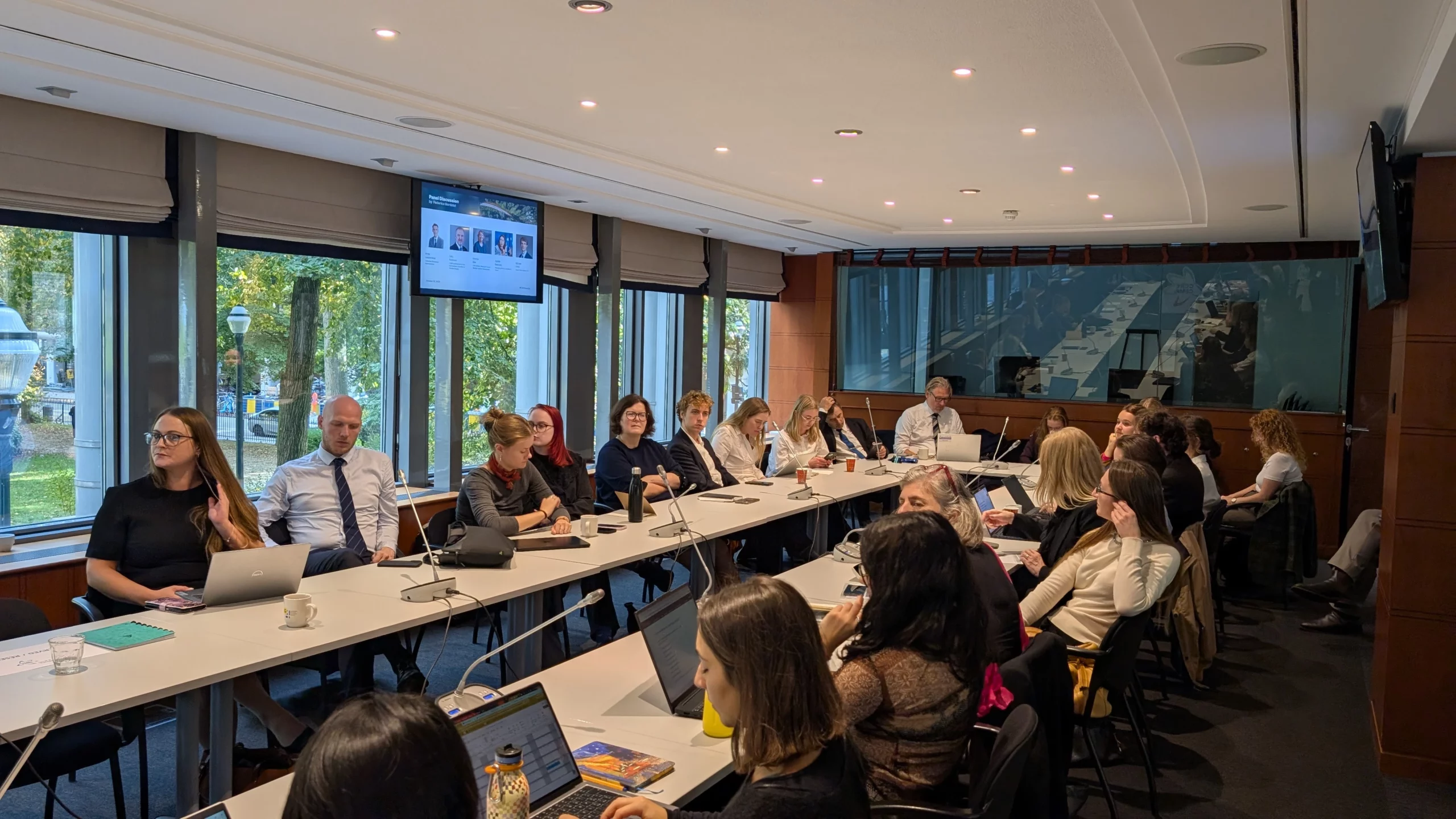
CEMR hosted this year’s edition of the CEMR Green Day, a discussion in Brussels on how to balance climate ambition and green competitiveness and what this implies to local and regional governments. The event, which took place on 15 October, brought together policymakers, climate specialists and analysts to answer what the EU’s shift from climate ambition to green competitiveness means for towns, cities and regions. Together they explored how resilience, adaptation, resource efficiency, decarbonisation and clean mobility can be embedded in territorial competitiveness.
The panel: How can we balance the EU Climate Agenda’s ambition and resilience
Negotiations on files such as the Industrial Accelerator Act, launched under the Clean Industrial Deal, show how the ambitions of the European Green Deal are increasingly framed through competitiveness, industrial capacity and economic security. For local and regional governments, that shift raises questions about opportunities and risks, and about the conditions they need to turn ambition into implementation.
CEMR Secretary General Fabrizio Rossi opened the session with the reinforcement of the core CEMR message that “the territories will be attractive only if we are working on resilience. There is no competitive Europe without strong, resilient and empowered territories.” Federica Bordelot, CEMR Director of Policy and Impact, moderated the discussion and reiterated that “green transition and competitiveness should go hand in hand, and green transition can actually support competitiveness objectives.”
The panel brought together Arnas Liauksminas from the Lithuanian Permanent Representation, representing the upcoming Council Presidency; Gary Robinson, CEMR Spokesperson for Environment and Councillor of Shetland Islands; Aurélie Beauvais, Managing Director of EuroHeat & Power; Michael Forte, Senior Policy Adviser at E3G; and Kirstine Bille, a member of the Committee of the Regions and of the Municipal Council of Syddjurs.
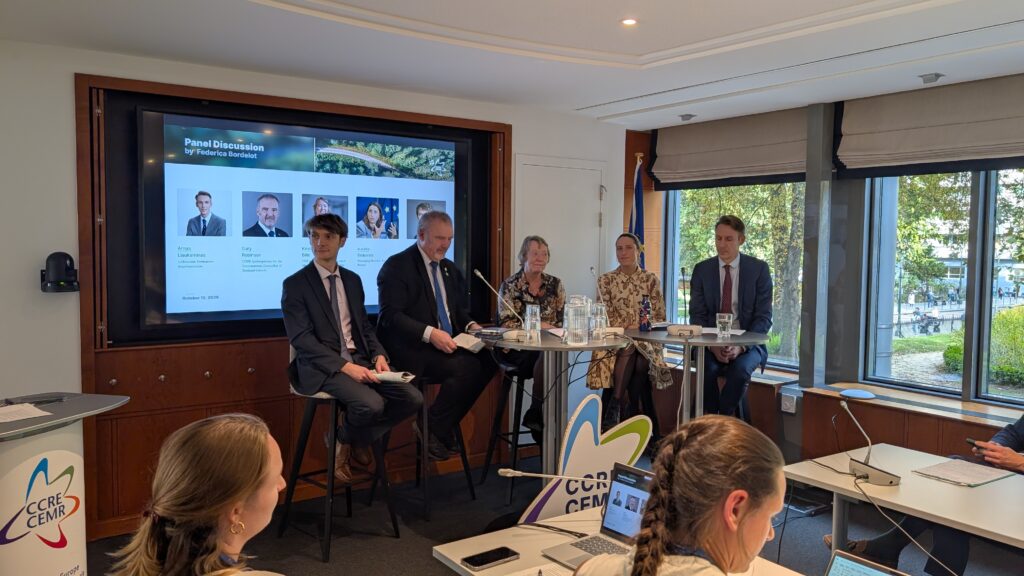
When asked about the plans of the Lithuanian Presidency, Liauksminas highlighted that they will work on the MFF, resilience, water, circular economy or ETS revision. He also added that municipalities are dealing directly with these issues on the ground, but they are not always heard in the debate in Brussels. “We are therefore pleased to cooperate with you ahead of the Presidency”, he concluded.
Gary Robinson, CEMR Spokesperson for Environment and Councillor of the Shetland Islands, mentioned the connectivity issues in the Shetland Islands and stated that “place-based policies start from the strengths of different territories: new technologies in industrial regions, renewable energy in rural areas, or on islands.”
Aurélie Beauvais from EuroHeat & Power presented the case for district heating and cooling. According to Beauvais, “to make it work for municipalities and for Europe, we need to solve the big two challenges of the transition: flexibility and security of supply; and affordability”. “District heating and cooling networks offer a very robust answer to those challenges”, she stated.
Kirstine Bille, member of the Committee of the Regions and the Municipal Council Member of Syddjurs Municipality, reiterated that we need to speak about the green transition because it stays in the background behind competitiveness. “We have an issue with energy security. We have to invest in local renewable energy, look at energy efficiency, work on the transition to a circular economy and ensure efficient district heating” – she added.
Finally, Michael Forte, the Senior Policy Adviser at E3G, drew on recent research from the think tank evidencing that the local and regional governments are the implementors of the EU Climate agenda and resilience practices while being left with little agency of decisive power. He highlighted three conditions that need to be met as a collective responsibility of the European institutions. “We need clear responsibilities, institutional and technical capacity, and the coordination within territories and across levels of government to be much more structured and formalised”, he said.
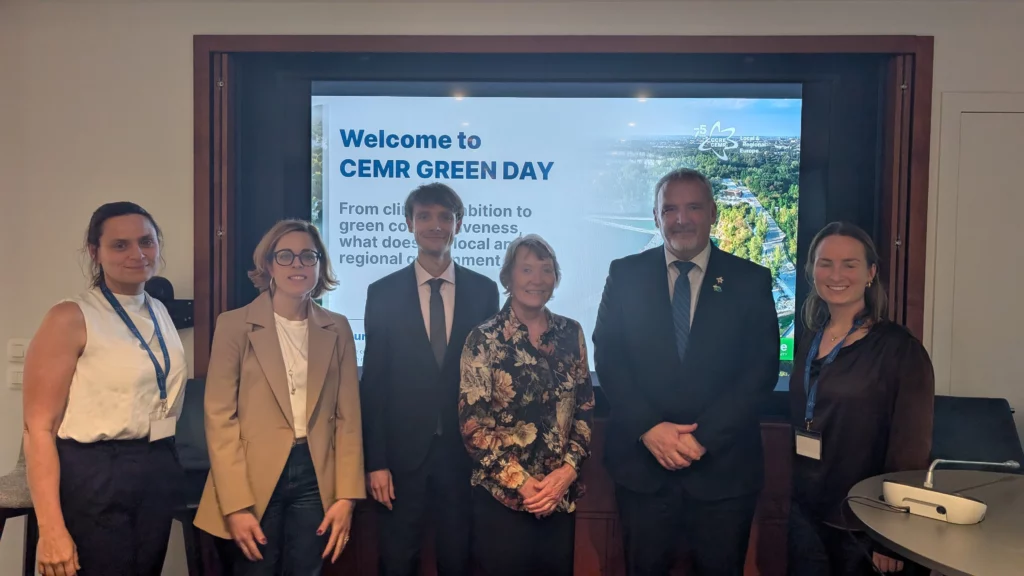
Territorial spotlights: competitiveness in local practice
In the second part of the event, members showed how local and regional action already links green policy to economic and social benefits.
A particularly interesting example was Arnhem. This Dutch city has built 17 circular bridges, reusing materials from other bridges, a swimming pool and old sheet pile walls. Circularity is a leading objective of its procurement strategy, supported by its own depot for raw materials. Arnhem is shifting from choosing materials based on design to designing based on the materials available. It aims for 25% circular building in 2025 and 50% by 2030, alongside a 55% cut in CO₂ emissions against 1990 and 50% less use of virgin materials.
For more information, contact:

Advisor – Environment and mobility