International Women’s Day

International Women's Day - News 2023

International Women’s Day: Let’s talk about human rights!


Dr. Claudia Schöning-Kalender, Member of the SPD-parliamentary group in Mannheim City Council (Germany) and chair of the CEMR Standing Committee for Equality calls on EU institutions to “effectively translate words into action” on gender equality.

Women feature prominently in Greek mythology as heroines, goddesses, and warriors. The reality for them in ancient Greece was that they had few rights and were largely deprived of political voice and agency. This incongruity doesn’t prevent ancient Athens from being frequently cited as the cradle of democratic societies despite the lack of equal rights and representation for half of its people. Throughout history, women have been considered as second-class citizens and even denied their humanity.

Times have changed since Ancient Greece, but it would be mistaken to think that development for the better is straightforward or linear. Europe has been through terrible wars and progress is frequently punctuated by setbacks in social and political life. This is sadly true for women’s rights as well.

In the course of history, we also witness that there is no unique development in all nation-states. Have a look at Switzerland: towards the end of the 19th century, it was the country where ambitious women went to study and obtain university degrees. Despite being a safe haven for women searching to gain knowledge, women’s full suffrage was granted in Switzerland only in 1971. That is almost 80 years after New Zealand, 65 years after Finland and 50 years after many current EU Member States.

Looking at history helps to understand that the development of women’s rights in our European countries doesn’t follow a simple logic of always getting better in terms of more acceptance and more equal rights. It happens in some fields and it doesn’t in others. And this is not only true when looking at Switzerland’s history, it goes for all European countries.

We have come a long and successful way in many countries in terms of equal rights for men and women in Europe, including political rights. But it is only quite recently that the disparity between women and men in decision-making has come to be viewed as a challenge to democracy. At the close of the UN’s first world conference on women in Mexico in 1975, a then-adopted action plan stated that the increased and equal participation of women at all levels of decision-making would speed up development and foster peace.

It took the international community another 20 years to assert the fact that women’s rights were an integral part of human rights and to promote specific actions accordingly to ensure respect for these rights. That was done in 1995 at the 4th World Conference on women held in Beijing.

Two decades later, UN Member States committed to Sustainable Development Goal 5 “Achieve gender equality and empower all women and girls”, a dedicated objective among the 17 SDGs to be achieved by 2030, as well as a cross-cutting thread underpinning all these Global Goals.

Equality at risk

Unfortunately, challenges and catastrophes put equality and human rights at risk. In situations of disaster and war, such as the current war in Ukraine or the recent devastating earthquakes in Syria and Turkey, the burden of keeping life going on overwhelmingly falls on women. It is mainly them who protect and feed their families, serving their communities. How is it then that they are so easily overlooked, abandoned and abused, in such circumstances?

Added to the exploitation and sexual violence perpetrated against women in crisis and conflict situations, there is an astounding lack of awareness of their hygienic, reproductive and childcare needs. To address these challenges effectively and sustainably, it is imperative that women’s voices are heard and that women have an equal seat at the table. It is they who know what the stakes are and who can chart the proper course towards safety, peace and prosperity. That is not to say that the burden of righting the world’s wrongs is upon the shoulders of women, but that we cannot continue as we have for so long, neglecting the experience, expertise and potential of 50% of the population.

My question is: how can it be that in the European Union where nine in ten people think that promoting gender equality is important to ensure a fair and democratic society (Special Eurobarometer 465, 2017), it is not more effectively translated into action?

As local elected officials, we call for the swift adoption of the current proposal for a Directive combatting gender-based violence, decisive for European women, but also for the ones fleeing wars and disasters and finding refuge in our municipalities. We also count on MEPs to embrace these issues in their upcoming innovative humanitarian aid strategy, following the new Chapter 39 of the CEMR European Charter for Equality of women and men in local life.

As countless news articles show and we, as citizens, witness, it doesn’t matter if a woman is rich or poor, lesbian or straight, non-disabled or disabled, young or old, cisgender or trans, just being seen as or perceived as a woman exposes one to discrimination or be treated as less than human. Putting this to an end is a foremost duty of European governments and civil society organisations that refer to any democratic traditions in Europe. Athena or Aphrodite may maybe part of a fabled past, but all over the globe, their battles are not a myth.

This article was first published on Euractiv.

Women in Ukraine

Women in Ukraine - News 2022

Courage and resilience have no gender, says Chernihiv city councillor


On the occasion of a workshop “Amplifying the voices of Ukrainian Women in post-war recovery” organised by Cities Alliance, CEMR was represented by Nataliia Kholchenkova, a member of the Chernihiv city council – a city besieged by Russia for 39 days in the spring of 2022. On this occasion, an interview was conducted by Cities Alliance with Nataliia Kholchenkova to discuss the city’s efforts to recover from war and the role women are playing in this recovery.

Chernihiv was besieged by Russia for 39 days in the spring of 2022. Since then, a recovery and reconstruction process has started. Could you please share the city’s experiences during and after the siege? How has the city tried to address the recovery issues, including the trauma and the loss that people have experienced?

Chernihiv is a city in the north of Ukraine. It is circa 100 km from the border with Russia and Belarus. From the very beginning of the war, the city was under attack. Chernihiv acted like a shield against Russian forces on the way to Kyiv. It was due to the resistance of our citizens that the enemy could not proceed. The city was not occupied, but it was blockaded from all sides and under heavy shelling for almost 40 days.

Due to this, Chernihiv was heavily ruined and damaged. Our only bridge that connected the city with Kyiv and the rest of Ukraine was destroyed. This meant we could not receive any humanitarian support and brought the city close to a humanitarian crisis. The city was without power, gas, and water for circa two weeks, and it was a really hard time for us.

The most terrible thing is that many residents were killed. Almost every day we received news that our neighbours, our friends, our relatives were killed due to the war. One of the main problems was how to bury people. Under constant shelling, we had no possibility to bury the bodies. There were no medicines available for some time, and we received information that some residents died because they could not get treatment for their chronic diseases.

I would like to emphasise the unity, bravery and resilience of all residents who supported each other and shared any available products and medicines. There was no hesitation on how to act: Men got the ammunition and weapons and went to join the armed forces or the local territorial defence units, and women did everything possible to support them with supplies, food, medicines, clothes, and so on.

What infrastructure and services were destroyed and most affected? How did the city adapt to the lack of them?

Because of the Russian invasion, social and critical infrastructure and residential housing were heavily damaged. Circa 850 multi-story buildings were partially damaged, while 150 multi-story buildings were heavily damaged due to direct hits from shelling. Five buildings were destroyed. About 2,000 private houses were damaged, and of those, 600 were totally destroyed.

People shared everything with each other, including housing, but the worst part was that there were no shelters. We were not prepared for the war. When the war started, we used simple basements in buildings or spaces underground to shelter. These were the places where we had to live, because we were under constant shelling, and we had no opportunity to even go find food. It was really dangerous.

As for critical infrastructure, we had to live for circa two weeks with no water. The city has a central water supply system that was damaged. Of a total of five pumping stations, two were totally destroyed and two were damaged. The whole city with almost 300,000 residents could not get water and the sewage system did not work. The heating system also did not work. The weather was cold with temperatures below zero degrees [Celsius] and some peaks of minus seven degrees. Also, there was no power and no possibility to use any electrical equipment. We could not call or get the news from the TV or the internet, so we were disconnected in the shelter just with the company of people. But we had to survive somehow.

How did people start living again? How did the recovery efforts start?

During the siege, a lot of residents tried to leave the city. It was a great risk and there were many cases of civilians killed while trying to leave because there was no humanitarian corridor or organised conditions to leave the city. There were cases of cars with signs indicating children and families on board that were shelled by the enemy. It was very dangerous, but people had to leave because it was also dangerous to stay in the city.

Before the war, we had circa 284,000 residents, and in the middle of March, there were circa 70,000 left. After the enemy left, during summer, people started returning to the city. In September we had about 220,000 residents back in the city. Of course, it was up to the local government to ensure the provision of all kinds of recovery measures and services. This also incentivised citizens to come back.

How was the process of livelihood recovery carried out when residents started coming back? With the majority of men going to combat, did women take up new or different roles?

I would like to emphasise the role of local authorities in the recovery process. We had to make quick decisions. The first priority was to repair multi-story buildings and housing for people to have a roof over their heads, and to repair the water supply and heating systems to be ready for autumn and winter. It was a great multitasking effort to provide all services at the same time, and it is still an ongoing process. After these interventions, we also started building shelters because we had to ensure the safety of our citizens. We equipped educational institutions and multi-story buildings with real shelters including ventilation and bio toilets.

One other very important action was the reopening of schools and the provision of offline education. We understood that parents wanted their children to get an education in schools, and this was the factor that motivated people to return. Now we have combined both offline and online education. We also worked to reopen kindergartens. All kindergartens were equipped with shelters so that when the alarm started, the children could be safe. Restoring education facilities was also a main condition for people to continue to work. If kindergartens do not work, we mothers and parents must be with the children at home.

As for livelihoods and jobs, it is still a big issue for us, because our industries and enterprises were located in the suburbs, which were the most heavily shelled areas. Many businesses relocated to more secure regions in the west of Ukraine, and the number of people without jobs unfortunately increased.

A lot of men went to the front line, while a lot of women had to take care of children. It is very difficult to combine work with childcare at home. This is still a problem, although there has been some progress at the community level. We have some women’s organisations that provide support; however, it is still very hard to get new jobs due to the many enterprises that closed or relocated. As we are on the border and with the war still ongoing, it is hard to persuade investors or businesses to start new activities in the region. So yes, it is a problem for all residents, but it is even more complicated for women.

Our task as local authorities are to provide economic support and to create the conditions for businesses to return and invest again in our city. We are now trying to cooperate with international partners to attract investors for future projects. These international partnerships are a good signal for our residents. It shows that they will have a future.

What has been the role of civil society and local organisations in the last months of reconstruction? Did women take up new roles in these organisations?

I would like to emphasise the role of volunteer organisations, many composed of women. These women provided a huge support to suffering people by delivering humanitarian aid, gathering supplies and food for our armed forces, and helping with childcare and education.

The role of education is very important. It is a great psychological support and aid for our children who have to endure this terrible war. The war has not only caused physical injuries but also psychological trauma to all residents, especially women. For women, it has been more complicated because they have a lot of pressure to keep their children safe and healthy while also having a job. In the case of war, this responsibility and pressure has doubled or tripled. So, the role of women has been incredible.

One more thing that I can say for sure is that bravery and resilience have no gender, and that women are acting as leaders on all front lines and battlefields: educational, cultural, and health.

You mentioned psychological trauma. Are there mental health programmes that have been started by the city or local organisations to support the healing process for the city and its residents?

Yes, we have municipal programmes under the Department of Social Politics and a service for people who remain alone. We also have ongoing partnerships with international organisations that are part of the UN. At the same time, with the war still ongoing and with the constant threat of new shelling, women feel like they do not yet have time for psychological aid and to take care of their health. It is our task as local governments to ensure that they are not only healthy physically, but also psychologically. We still have to persuade them that we should also pay attention to ourselves and our mental condition and that we should be healthy for our children, colleagues, men, and the city.

How is the situation now in Chernihiv? What does the city need the most at the moment?

We have managed to advance the recovery and the restoration of some services. There are less and less power outages. We have provided schools and all critical infrastructure with generators to prevent power outages, and we have helped businesses also get generators. We are organising activities for children. More has to be done. Street lighting, for instance, is still not working due to power saving, and around 5 pm it is dark already in the streets.

What the city needs the most right now is financial support to cover larger-scale reconstruction. With the municipal budget, we have repaired the small and medium-sized damage to buildings, but we cannot cover the repair of heavy damages. For instance, the next project we would like to implement is the reconstruction of two water pumping stations, but we cannot cover that with the local government budget. This is also an issue with the damaged public transport system. We would like to incorporate new European technological solutions and innovations to create a better future for our residents and to improve their quality of life.

I can definitely say that women’s participation in all kinds of activities and decision-making processes in our country is stronger now than it was before due to cooperation with, and examples of, international and women’s organisations. It is a part of our European integration process and it is very important for us to continue with such cooperation processes. It gives us strength and spirit to unite as women following the example of the European Union, where there are many strong women in politics, economy and business. We should continue in this direction.

Nataliia Kholchenkova is the Head of the International Relations and Investments Department of Chernihiv City Council. Since 2020, she has also been Head of the Permanent Deputy Commission on Regulations, Legality, Corruption, Freedoms and Rights of Citizens and Prevention of Corruption and Head of the Deputy Association “For Equal Rights and Opportunities” of Chernihiv. She holds a PhD in the speciality of Secondary Education from T.H. Shevchenko National University “Chernihiv Collegium”, where she was also an Associate Professor. She is a member of the board of the Chernihiv Women’s Union and a member of the Association of Ukrainian Cities (AUC) and the Council of European Municipalities and Regions. She is the PLATFORMA spokesperson for AUC.

International Women’s Rights Day

International Women’s Rights Day - News 2023

International Women’s Rights Day 2023: Five new Charter articles illustrated through local actions


To celebrate 2023 International Women’s Rights Day, CEMR is publishing a series of impactful initiatives carried out by local and regional governments to promote gender justice. These projects embody the updated European Charter for Equality of Women and Men in Local Life as they show how five of its nine new articles can be put into practice. Together, they represent an inspiring step towards a more gender-equal Europe.

The updated Charter is a result of several years of reflection and collaboration which started in 2021 on the occasion of its 15th anniversary. The nine new articles cover and expand on the following topics: sustainable development, cyber violence, violence against elected representatives, intersectionality, flexible working, digital inclusion, sexual and reproductive health rights, climate change and gender-responsive civil preparedness and disaster response.

The over 2,000 commitments to the Charter made by territories in 36 European countries prior to 2023 remain valid. The existing signatories are, however, invited to renew their commitment to the Charter by adopting the new articles and integrating them into their future equality action plans as relevant. Any new commitments to the Charter will be to the updated text, from January 2023 and in function of the availability of the text in local languages.

While the updated Charter has been translated into 28 languages, the transcriptions are still undergoing a quality check with the national coordinators of the Charter in CEMR’s network. They will be posted to the online Observatory and CEMR’s website once they are approved.

The updated Charter is available currently in EnglishFrench and easy-to-read English versions.

Any questions regarding the update or the actions highlighted in this series can be directed to contact@ccre-cemr.org or the relevant national coordinator for the Charter in your country

War on Ukraine first declaration

European local and regional leaders reaffirm solidarity with Ukraine and call for peace, justice, and reconstruction.


On the first anniversary of Russia’s full-scale invasion of Ukraine, local and regional leaders across Europe renew their strongest support for Ukraine, its people, and its democratic institutions. 

Condemning Aggression 
The war has brought devastation to civilians, elected representatives, and essential infrastructure. The abduction of Ukrainian mayors and the ongoing detention of five of them highlight the assault on democracy and the rule of law. These acts are condemned in the strongest terms, with urgent calls for the immediate release of the detained leaders. 

Solidarity and Support 

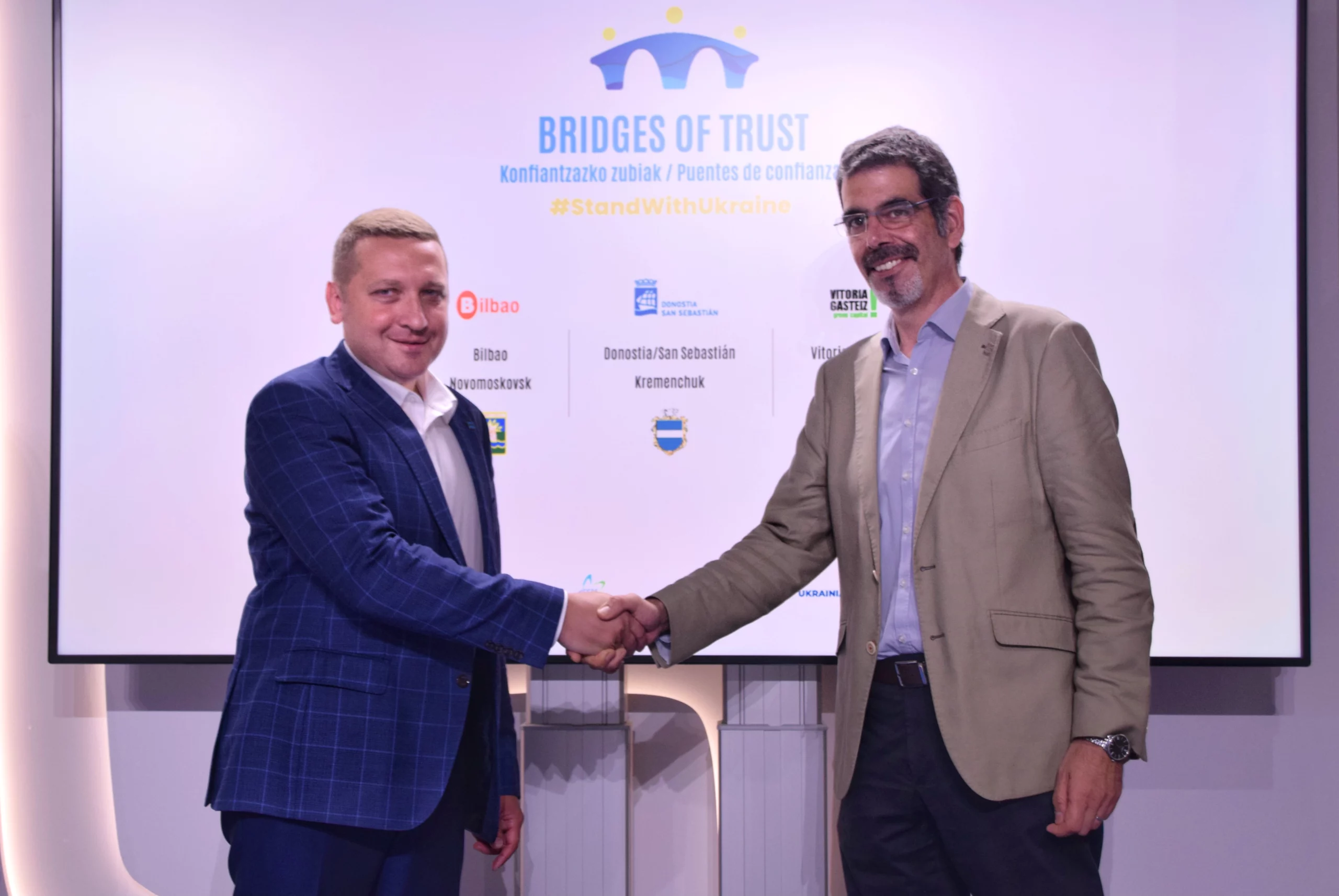
Local and regional governments across Europe stand firmly by Ukraine. Partnerships such as the Bridges of Trust project, the Eastern Partnership programme, and the European Alliance of Cities and Regions for the Reconstruction of Ukraine are mobilising resources, expertise, and cooperation. These initiatives are not only helping communities recover but also preparing Ukraine for its future as a full member of the European Union. 

Shared Values 
This declaration is a reminder that Europe’s foundations rest on peace, democracy, and respect for international law. As the war continues, European leaders join the international community in reaffirming Ukraine’s sovereignty and territorial integrity, and in urging the Russian Federation to end its illegal war. 

A year into this unjustified conflict, the commitment of Europe’s municipalities, cities, and regions is unwavering: to stand with Ukraine, to defend shared values, and to contribute to rebuilding a peaceful, democratic future. 

Read the declaration here 

For more information, contact: 

Release of Ukrainian Mayors

Mayors in Ukraine - News 2023

CEMR stands behind Ukraine and calls for the release of captured mayors


On the occasion of the one-year anniversary of the beginning of the Russian aggression in Ukraine, the Council of European Cities and Regions (CEMR) demands the release of five abducted Ukrainian mayors. 

In a statement released by CEMR’s Secretariat, the CEMR president Gunn Marit Helgesen strongly condemns the violation of Ukraine’s sovereignty: “One year after Russia’s full-scale invasion of Ukraine, let me reiterate my steadfast support for our Ukrainian peers, especially for the detained local leaders.” 

Gunn Marit Helgesen reminds us of the abduction of Ukrainian local government representatives: “Over the past year, 35 Ukrainian mayors have been abducted and five are still being held by Russian forces. Targeting local elected representatives is an attack on the very foundations of our Europe, a Europe rooted in respect for the rule of law and freedom. There can be no free Europe without a free Ukraine”.

In light of the anniversary, CEMR also released a declaration (ENFRUA) reiterating its full support of Ukraine and its people. The organisation denounces the violence targeting innocent civilians, but also the local and regional elected representatives that are being held captive: “We reaffirm our full commitment to supporting the Ukrainian people and local and regional elected representatives in their path to victory and reconstruction.” CEMR therefore joins the international community that firmly supports the sovereignty and territorial integrity of Ukraine and calls upon the Russian Federation to stop its illegal war.

Financial and humanitarian help

In the last year, CEMR and other partner organisations have continuously shown their support for Ukraine. To do so, they have taken many actions. Amongst them is the mobilisation of humanitarian aid. One of the partner organisations, the Association of Towns and Communities of Slovakia (ZMOS) allocated €50,000 in humanitarian aid. ZMOS also sent thousands of packages of various medical supplies, such as bandages, plasters, gauze compresses, and disinfectants, as well as thousands of packages of personal hygiene kits and emergency sleeping bags.

Other members of CEMR, municipalities and regions, Non-Governmental Organisations, and citizens have offered their financial help, too. One of the smallest municipalities in Estonia, the municipality of Tõrva, transferred €10,000 from its local budget and collected more than €2,000 euros from citizens to support their twin city in Ukraine – Baranivka. 

Welcoming refugees

The municipalities also helped by taking in refugees from war-torn Ukraine. CEMR and European municipalities and regions have coordinated their efforts to assist them as effectively as possible. Providing housing, opening schools to Ukrainian children, navigating the administrative processes and teaching the refugees new languages proved to be essential. 

The city of Tbilisi made public transport free for all Ukrainian citizens, along with all municipal services and cultural, sports and educational centres. In addition, the municipality organised a blood donation campaign. 

Helpful initiatives and partnerships 

Showing support by maintaining existing partnerships and creating new ones was another step taken by some European municipalities. Within the Bridges of Trust initiative, the district municipality of Ukmergė in Lithuania signed a partnership agreement with the Ukrainian Korosten municipality to strengthen their relationship.

The mayor of Korosten Volodymyr Moskalenko praised the partnership: “Each of our conversations comes down to the question ‘How can we help you?’” According to him, “the city has found true friends”. 

What about the future? 

Because the Russian attack has left many Ukrainian cities in ruins, reconstruction is going to be key in the coming years. Some efforts are already underway, but as most of them are organised on a regional level, CEMR is asking its members for support and further help for Ukraine. 

By fully supporting CEMR’s flagship partnership initiative with Ukrainian municipalities that are currently implemented with the support of the U-Lead with Europe programme, other local associations can help with the rebuilding process in Ukraine and further develop international cooperation at the municipal level.

Global Goals for Cities network for sustainability and development

RFSC - News 2022

It’s finished! The Global Goals for Cities pilot network is complete!


Across Europe, the 19 cities in the network visited each other, learned from each other and developed their integrated action plans together, to better implement the Sustainable Development Goals in their strategic urban planning.

To ensure the achievement of the 2030 Agenda and the 17 goals it sets, cities are key players. With more sustainable cities, we can ensure a better planet. This is why URBACT and CEMR supported the creation of the Global Goals for Cities pilot network, aiming to accelerate progress towards achieving the Sustainable Development Goals. In this network, 19 cities were selected and showed their commitment to localizing the SDGs.

Our 19 cities also organised or participated in national and international events to present and share their experience and results.

To better understand how cities contribute to the SDGs, cities used the Sustainable Cities Reference Framework among other URBACT tools, allowing them to analyse gaps and priorities in their local strategies, identify the best actions to progress on the selected objectives and thus help build their integrated action plans and integrate the SDGs into their long-term urban strategies.

Finally, the network has developed a learning toolkit on the Global Goals for Cities*, available online, so that cities can better locate and implement the SDGs in their local strategies.

Call for Tender

Bridges of Trust Branding - News 2024

Looking for external expertise to develop partnerships in France and Spain


CEMR is looking for an external expert external expertise to create and develop partnerships between Ukrainian municipalities and local governments in France and Spain.

Deadline to apply: 07 March 2023

For more information, have a look at our call for tender.

Youth Matters

Youth Matters - News 2022

Youth Matters: A Step-by-Step Booklet for Building a Strong Youth Council


Youth councils enable young people to better understand democracy and take an active part in it. Unfortunately, many cities do not have a long tradition in this area and may even struggle to create and operate a youth council. Therefore, the Norwegian Directorate for Children, Youth and Family Affairs (Bufdir) and the Association of Local and Regional Authorities (KS) decided to jointly organize a workshop for young counsellors and, from this, to create a brochure for an almost “turnkey” youth council.
The youth councils of Karasjok, Alta and Hammerfest came together in the summer of 2022 to learn more about how to organize effectively, train their recruits and participate more actively in local governments.
The organisers felt it was important to exchange their different experiences so as not to have to start from scratch. Bufdir decided to focus on the participation of young people in public affairs because this is enshrined in the rights of the child and Article 104 of the Norwegian Constitution.


Don’t neglect young people
The workshop received the approval of Karasjok Deputy Mayor John Nystad. He emphasizes the importance of having a youth council in his municipality and hopes to cooperate more with young people in his municipality in the future. Mr Nystad believes that for young people’s wishes to become reality, local politicians must fully support them. The main thing is not to neglect issues that concern young people, he thinks.
During the workshop, the youth councillors shared their knowledge and exchanged advice on how to run a youth council. They advised speaking up more, contacting public administrators, following the calendar of political meetings in their municipality, and cooperating with “adult” politicians.
They also reminded us not to forget diversity and representativeness when it comes to recruiting new committed members. As Deputy Mayor Nystad said, everyone has the right to express themselves. Therefore, raising issues cooperatively with other residents keeps everyone better satisfied.

We never stop learning

Henriette Alexandra Mielonen, a member of the newly established youth council in Karasjok, expressed her satisfaction with the workshop: “It was informative.” She acknowledges that they didn’t know much about running a board before, but meeting more experienced members from other organisations helped them enormously.
“It’s always helpful to understand how others approach work,” she says; it was the old Alta council that gave them a lot of ideas. “We didn’t know we could contact the media if we were unhappy,” she adds.
But as Ms Mielonen reminds us, we never stop learning. This is why the Association of Local and Regional Authorities (KS) has produced a new brochure summarizing the learnings from the workshop. They think this brochure could help other youth councils and make their experience easier.


The brochure is available in Norwegian and English.