CEMR activity report 2025

Impact Community - Head banner

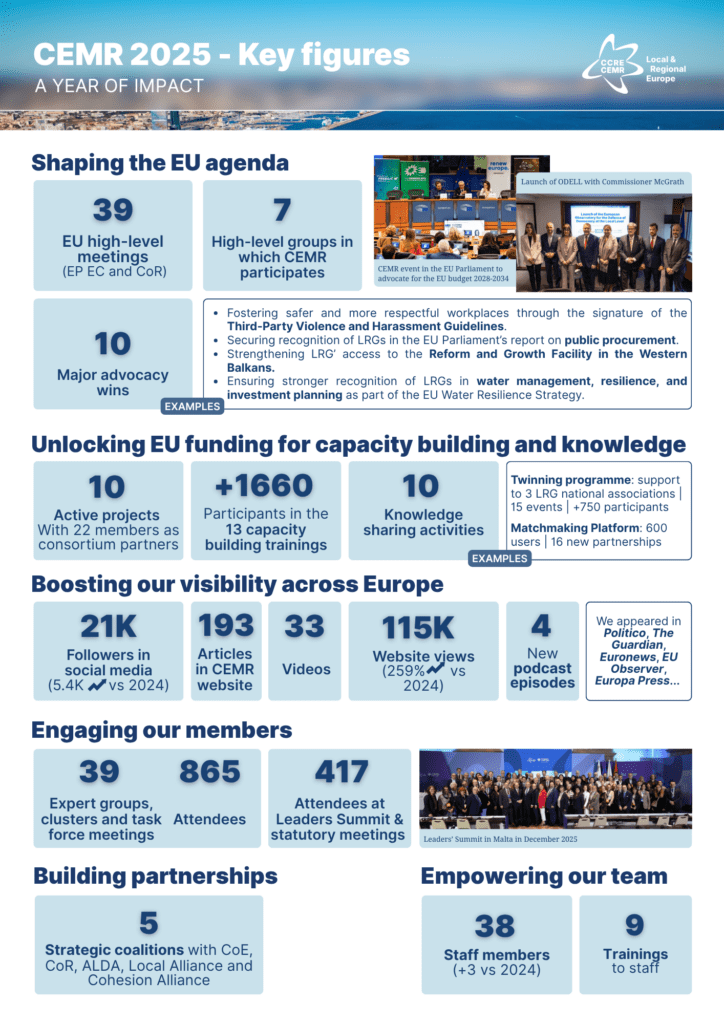
What was CEMR’s impact in 2025?


The year 2025 was a period of many activities and a great impact at the local and international levels.

We are truly grateful to our members, partners and donors for their continued trust, commitment and collaboration throughout that year.

Local and regional governments are essential to tackle Europe’s most urgent and day-to-day challenges, and through CEMR, we have worked together to ensure that European local voices remain present, heard, and influential in EU and global debates.

Check CEMR’s activity report 2025 below:

For more information, contact:

CEMR Statutes

Local leaders - webpage banner

The legal framework guiding CEMR’s mission and governance


The Statutes of the Council of European Municipalities and Regions (CEMR) set out the legal foundation, mission, and governance structure of the organisation. They define how CEMR operates as an international non-profit association based in Brussels and outline its role in representing local and regional governments across Europe.

At the heart of the Statutes is CEMR’s core mission: to protect and strengthen the autonomy of local and regional governments, promote democratic governance, and support their participation in European and international decision-making. Through advocacy, cooperation, and knowledge exchange, CEMR works to ensure that the voice of cities and regions is heard at the European level.

The document also explains how the organisation is structured and governed. The Policy Committee acts as the main decision-making body, setting strategic priorities and approving budgets, while the Executive Bureau oversees the implementation of decisions and the day-to-day direction of the organisation. The President provides political leadership and representation, and the Secretary General manages the daily operations of the Secretariat.

Membership is open primarily to national associations of local and regional governments that share CEMR’s objectives and democratic values, with additional categories for observers and honorary members.

Overall, the Statutes provide the legal and organisational framework that enables CEMR to work collectively with its members to strengthen local democracy and cooperation across Europe.

For more information, contact:

CEMR code of conduct  

Building a safe, respectful, and inclusive environment at all CEMR events and activities 


The Council of European Municipalities and Regions (CEMR) is committed to ensuring that all of its activities, from high-level conferences to informal meetings, take place in an environment that is professional, respectful, and free from harassment, violence, or discrimination. 

The CEMR Code of Conduct establishes a clear, zero-tolerance approach to inappropriate behaviour. It applies to CEMR staff, members of national associations, elected representatives, and third parties who participate in CEMR events, whether in person or online. 

Harassment and discrimination can take many forms, verbal, psychological, physical, or sexual. They may be isolated incidents or systematic behaviours. Regardless of form or setting, such conduct undermines personal dignity and professional integrity and will not be tolerated. 

To ensure effective protection, the Code of Conduct outlines: 

  • Reporting procedures: Incidents can be reported verbally or in writing at any time, without fear of reprisal. Immediate steps will be taken to stop misconduct. 
  • Investigation mechanisms: An independent investigative committee, balanced in gender and composition, will review allegations within 30 days and recommend remedies or sanctions. 
  • Confidentiality guarantees: All parties’ rights and privacy will be respected, with strict confidentiality during proceedings. 
  • Remedies and sanctions: Depending on severity, actions may range from mediation and warnings to exclusion from events or referral to public authorities when criminal offences are suspected. 

CEMR has also introduced trustworthy persons, specially trained staff who act as first points of contact for colleagues facing stress, conflict, or abusive behaviour. They provide guidance, mediate issues, and ensure that concerns are raised constructively and confidentially. 

This Code is a public document, intended not only as an internal standard for CEMR but also as a model that can be adapted by other organisations. By adopting it, CEMR reaffirms its commitment to safeguarding dignity, equality, and inclusivity in every sphere of its work. 

Read the code of conduct here 

For more information, contact: 

Empowering local Europe since 1951  

Democracy, diversity, and sustainability at the heart of CEMR 


Since its founding in 1951, the Council of European Municipalities and Regions (CEMR) has worked to promote a peaceful, democratic, and united Europe. Rooted in local self-government and citizen participation, CEMR brings together municipalities, counties, and regions across 41 countries, giving local democracy a strong voice at European and international levels. 

Our Values 

CEMR stands on three core pillars: 

  • Local democracy: Protecting municipal autonomy, human rights, and the rule of law. 
  • Sustainability: Guiding action through the United Nations’ Global Goals. 
  • Diversity: Promoting gender balance, inclusiveness, and respect for differences. 

With a team of 40 professionals in Brussels, representing a dozen nationalities and speaking 15 languages, CEMR embodies the European mosaic it serves. 

A History of Local Leadership 

CEMR was born in 1951 when 56 mayors from six countries gathered in Geneva to lay the foundations of a united Europe from the bottom up. Their early efforts focused on town twinning, fostering reconciliation through exchanges and cultural ties. Today, with some 20,000 twinnings across Europe, this remains the continent’s most widespread form of cooperation. 

CEMR also pioneered the push for local autonomy, adopting the European Charter of Municipal Liberties in 1953, which later inspired the Council of Europe’s European Charter of Local Self-Government. 

In 1984, CEMR officially added “Regions” to its name, reflecting its advocacy for decentralisation and the growing importance of regional governance. 

What We Do Today 

CEMR’s mission is organised around four “Ps”: People, Places, Planet, and Partnerships

  • Advocacy: Representing local and regional interests to the EU, the Council of Europe, OECD, and the United Nations. CEMR works to ensure that 70% of EU laws affecting municipalities and regions take account of local realities. 
  • Knowledge: Sharing expertise and producing ground-breaking studies on local democracy, equality, climate action, migration, and finance. 
  • Partnerships: Leading externally funded projects on sustainable development, integration, climate, and democracy, including initiatives such as PLATFORMA, IncluCities, and the Covenant of Mayors. 
  • Communication: Reaching citizens, members, and global partners through campaigns, media work, and digital platforms. 

Looking Ahead 

Marking its 70th anniversary in 2021, CEMR reflected on past achievements while preparing for future challenges. In an age of polarisation, climate change, and digital transformation, the organisation continues to champion local democracy as the bedrock of peace and progress. 

As former CEMR President Valéry Giscard d’Estaing once urged Europe’s young people: “Today, power is there for the taking! It is the power to act, to bring on the future and to organise it.” 

Read the study here 

For more information, contact: 
National associations in Europe

Discover how national associations unite and represent Europe’s 100,000 towns and regions 


Europe is home to approximately 100,000 municipalities, provinces and regions, each embedded in its national political system yet also interconnected across borders. But who represents them? Who ensures their voices are heard by national and European institutions? 

To answer these questions, the Council of European Municipalities and Regions (CEMR) has published a new study delving into the vital but often overlooked world of national associations of local and regional governments. 

Since its creation in 1951, CEMR has championed local democracy, subsidiarity and citizen participation. At the heart of this mission are its member associations, 60 in total from 41 European countries, who work every day to represent the interests of towns and regions. 

Based on a survey conducted among 58 member associations, the publication sheds light on the structure, function and political weight of these associations, also known as LRGAs (Local and Regional Government Associations). 

Organised into five chapters, the report explores: 

  1. Who they represent – the types and numbers of municipalities and regions linked to each association. 
  1. How they are structured – their legal status, governance, staffing and membership models (voluntary or mandatory). 
  1. What they do – including advocacy with national authorities, knowledge sharing, training for elected officials, and support for policy implementation. 
  1. Their legislative influence – assessing how and when they are consulted in national law-making. 
  1. Their European and international role – detailing their involvement in CEMR, the EU institutions and global agendas such as the UN’s Sustainable Development Goals. 

The second part of the study offers a country-by-country overview of all member associations, providing a practical “identity card” for each organisation. 

This study offers a rare and valuable insight into the backbone of local democracy in Europe: the national associations that bring together municipalities and regions, giving them a common voice. Though often under-recognised, these associations play a vital role in shaping effective governance, ensuring policies are informed by local realities and that decisions taken at higher levels reflect citizens’ everyday needs. 

Strengthening the structure, recognition and influence of these associations is more than a technical issue, it’s a democratic imperative. From local services to national reforms and European cooperation, their contribution is essential for building resilient, inclusive and well-governed communities across the continent. 

Read the study here 

For more information, contact: 
CEMR rules of procedure

Leaders Summit - Oslo News

Ensuring transparent, balanced, and effective governance within CEMR


The Council of European Municipalities and Regions (CEMR) operates through a structured and transparent governance framework designed to ensure fair representation, accountability, and effective decision-making across its network. The Rules of Procedure set out how the organisation functions, from membership and institutional structures to decision-making processes and financial management.

CEMR membership is open to national associations of local and regional governments that meet defined criteria. Clear procedures guide applications, cooperation between members within the same country, and the handling of fees, ensuring both inclusiveness and organisational coherence.

The organisation is governed by key statutory bodies, including the Policy Committee, Executive Bureau, and Financial Management Committee. These bodies are responsible for political direction, operational oversight, and financial supervision. Particular attention is given to balanced representation, especially gender equality, reflecting CEMR’s commitment to inclusivity and the principles of the European Charter for Equality of Women and Men in Local Life.

Decision-making processes are designed to be democratic and transparent. Meetings are convened with advance notice, voting procedures are clearly defined, and mechanisms are in place to ensure accountability, including rules on quorum, proxy voting, and financial compliance.

CEMR’s functioning is further supported by committees, expert groups, and spokespersons who contribute to policy development and represent the organisation externally. The Secretary General plays a central role in managing the Secretariat, implementing strategic priorities, and ensuring the smooth running of daily operations.

Financial governance is ensured through structured fee systems, oversight by the Financial Management Committee, and regular auditing. At the same time, cooperation with European and international organisations strengthens CEMR’s role in promoting local and regional self-government globally.

Overall, the Rules of Procedure provide a solid foundation for CEMR’s work, ensuring that the organisation remains democratic, representative, and effective in supporting local and regional governments across Europe.

For more information, contact: