In Gdańsk, the Ukraine Recovery Conference confirmed the importance of local and regional governments in Ukraine’s recovery and EU accession
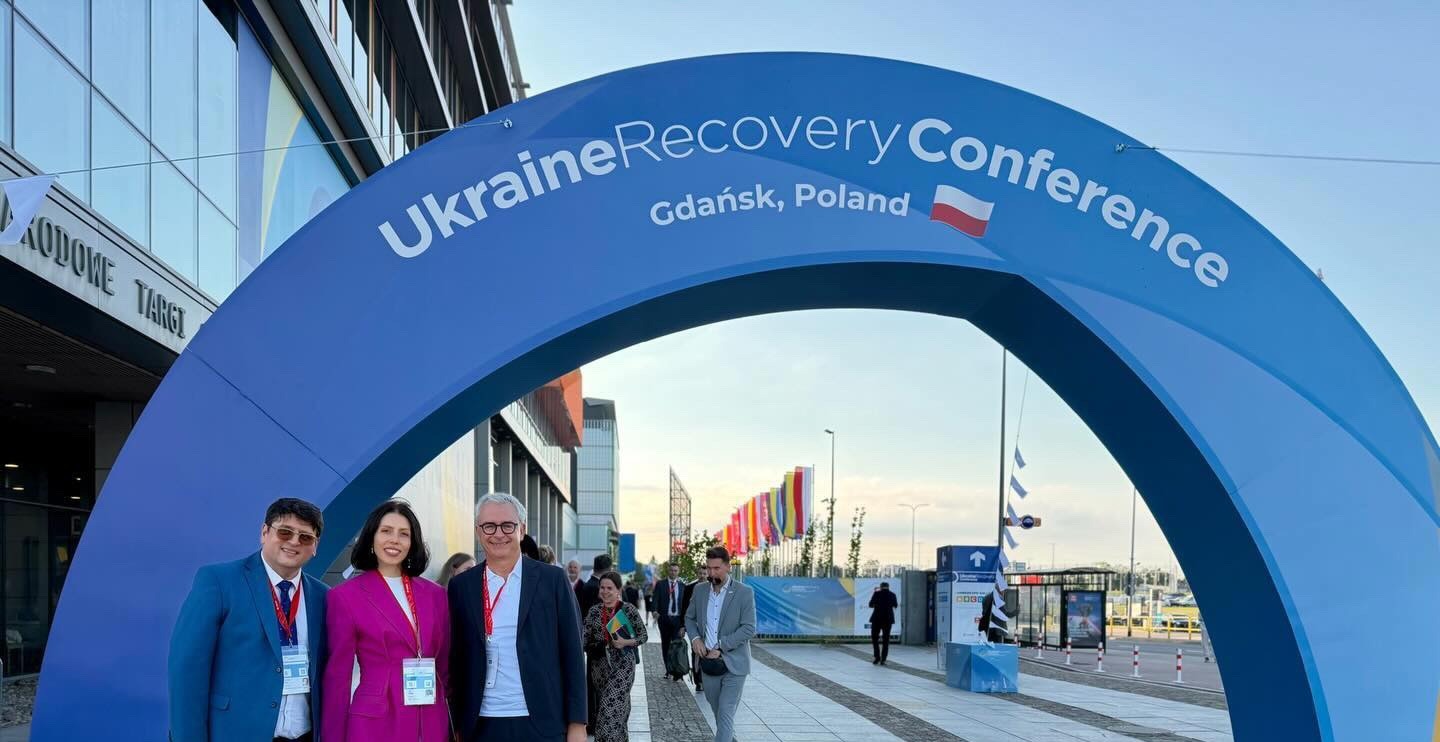
The Ukraine Recovery Conference (URC 2026), co-hosted by Poland and Ukraine, took place in Gdańsk on 25 and 26 June 2026. Being one of the largest international gatherings dedicated to bolstering international support for the country’s reconstruction, as well as catalysing investments for Ukrainian businesses and local governments, this edition brought together more than 5,000 participants.
Heads of state, ministers, donors, and international organisations converged in the Polish city to address the most relevant challenges to Ukraine’s future: energy, critical infrastructure, logistics, and, for the first time, security capabilities.
The Council of European Municipalities and Regions (CEMR) participated in the URC2026 representing the secretariat of the European Partnership Hub (EPH), which facilitates the Bridges of Trust (BoT) Community. Two years after the launch of the Matchmaking Platform at URC 2024, and one year after, the launch of the European Partnership Hub (EPH) – hosted by CEMR – at URC 2025 to facilitate the BoT Community actors active in international municipal cooperation with Ukraine, CEMR was present at URC 2026 with a dedicated booth showcasing the collective efforts of the BoT Community and best practices in international municipal cooperation with Ukraine.
CEMR contributed to the local and regional dimension of the conference and thus carried a specific voice, that of local and regional governments. CEMR President Christoph Schnaudigel represented the organisation throughout the two days conference together with Olha Pikula, CEMR Spokesperson on Enlargement and Deputy Mayor of Mariupol City Council, and Oleksandr Vasylenko, Head of the Cherkasy District Council and First Vice-President of the Ukrainian Association of Rayon and Oblast Councils (UAROR).
A joint statement and a call for coordination
On the eve of the conference, the European Alliance of Cities and Regions for the Reconstruction of Ukraine gathered its 100 members to endorse a joint statement setting out concrete priorities for donor action and Ukraine’s EU integration. As a founding member of the Alliance, CEMR contributed directly to this collective effort. Oleksandr Vasylenko, represented CEMR during the political-level Alliance meeting.
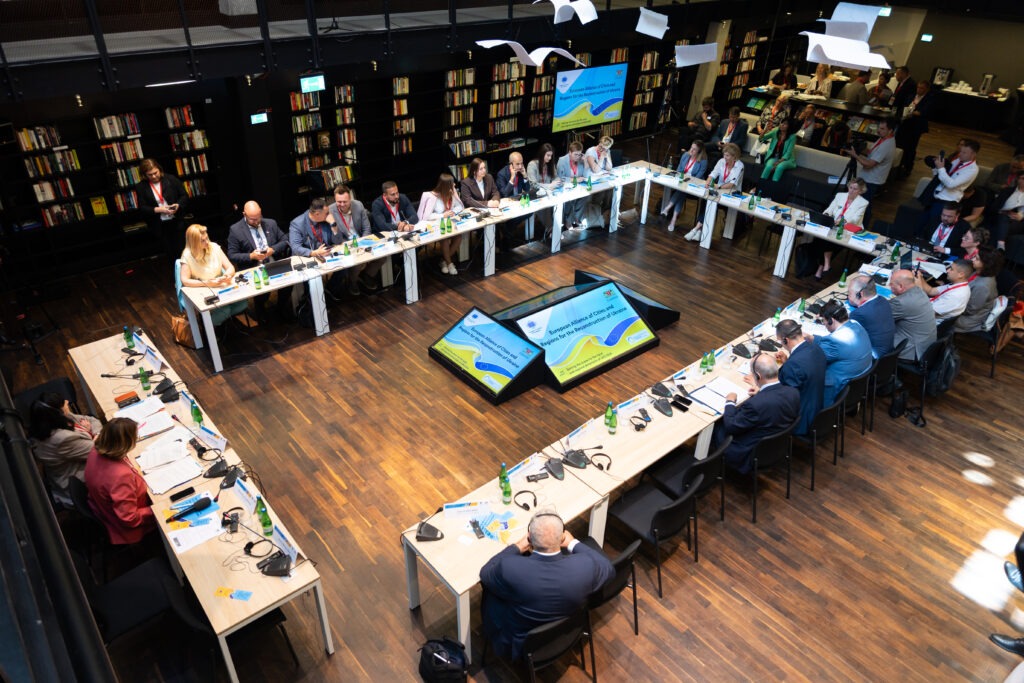
In his statement, he emphasised: “The Bridges of Trust Community, facilitated by the European Partnership Hub and supported by U-LEAD with Europe, is a successful example of practical cooperation and joint efforts of various actors across Europe. All of these actors deliver tangible results in partnership building and capacity development demonstrating the diversity and potential of municipal cooperation.”
The statement recognises that Ukrainian towns, cities and regions have been at the core of the country’s resilience since the start of the full-scale invasion, providing emergency response, maintaining infrastructure, and acting as operational hubs for humanitarian assistance, all whilst preparing for a sustainable future. It calls on institutional partners to treat local and regional governments as strategic partners and integral decision-makers in reconstruction governance, and urges donors to allocate ring-fenced, transparent funding for local and regional development, including direct access to finance and dedicated technical assistance.
Critically for CEMR and the EPH, the statement underlines the potential of municipal cooperation with Ukraine and calls for a reinforcement of existing coordination structures, including the Alliance itself and the BoT Community facilitated by the EPH, and to foster links between local needs, funding opportunities, and the tools already established to support peer-to-peer partnerships such as the Matchmaking Platform.
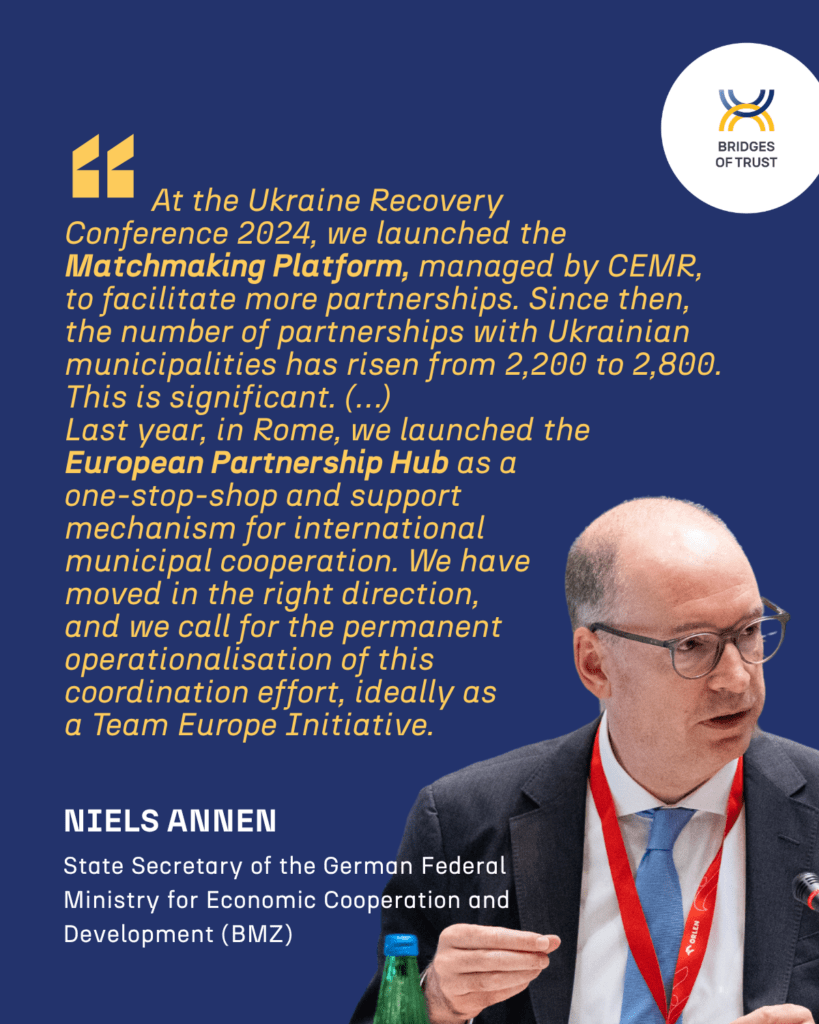
Niels Annen, State Secretary in the German Federal Ministry for Economic Cooperation and Development, recognised in his intervention the significant increase of international partnerships with Ukrainian municipalities in the last years: “We have moved in the right direction, and we call for the permanent operationalisation of this coordinated effort.”
Together with Muriel Lacoue-Labarthe, Special Envoy of the President of the French Republic for Ukraine’s Recovery and Reconstruction, he announced the launch of a new funding line for multi-partner cooperation involving municipalities from Germany, France, Poland and Ukraine.
Meetings and exchanges at the European Partnership Hub booth
The EPH booth was more than a presence at the conference. Positioned alongside partners from the Committee of the Regions, Eurocities and the Polish Association of Cities, it became a point of convergence for Ukrainian and European partners, hosting a series of exchanges that moved between the political and the technical, the bilateral and the collective.
CEMR President Christophe Schnaudigel met with Aleksandra Dulkiewicz, Mayor of Gdańsk, for a focused conversation on the next Multiannual Financial Framework and the persistent need to ensure that local and regional governments have a genuine seat at the European table. The discussion touched on the importance of coordinated messaging across CEMR, the Committee of the Regions, and city networks, with Ukraine’s recovery and the potential of municipal partnerships running as a thread throughout.
A particularly significant exchange took place between CEMR President Christoph Schnaudigel and Oleksandr Vasylenko, Head of the Cherkasy District Council and First Vice-President of the Ukrainian Association of Rayon and Oblast Councils (UAROR). The two sides explored future prospects of cooperation, covering institutional ties, peer-to-peer exchanges, and support for local self-government. The conversation also engaged with a structural question that matters enormously for Ukraine’s governance: the clarity of competences assigned to rayons and oblasts as the country pursues rebuilding and decentralisation.
CEMR President Christoph Schnaudigel also met with Vitali Klitschko, Mayor of Kyiv, Ukrainian Deputy Minister Oleksii Riabykyn, and Olha Pikula, CEMR Spokesperson on Enlargement and Deputy Mayor of Mariupol City Council, alongside representatives of the BoT Community and partner organisations.
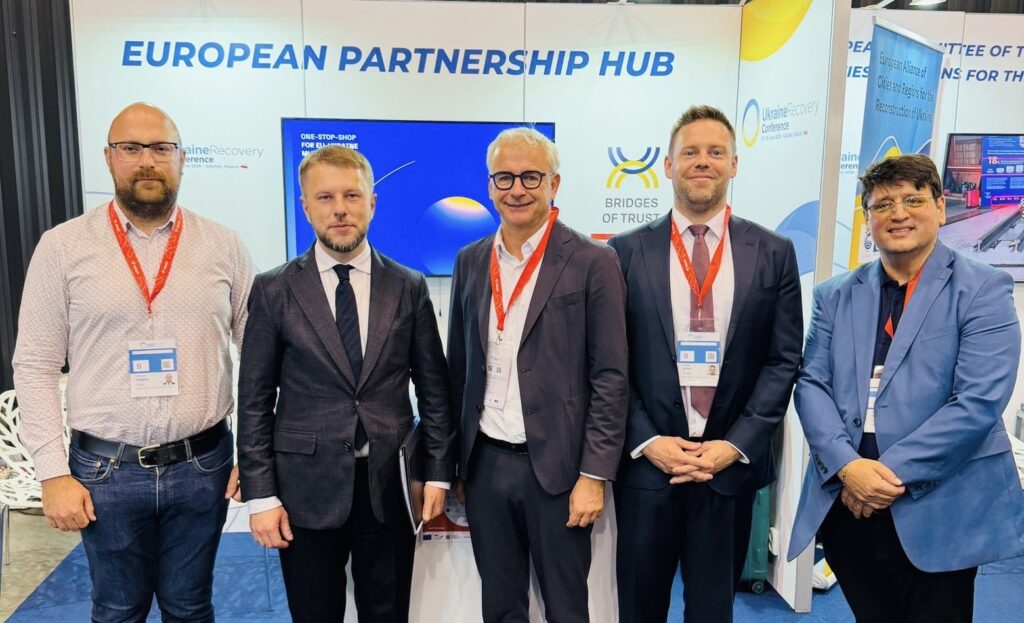
The Director General of Expertise France, one of the key actors within the BoT Community, also visited the EPH stand. The exchange focused on the value of mapping and evaluating existing partnerships, and on the EPH’s role as a coordination structure that helps avoid duplication and fragmentation among international actors. Within the framework of the Global Gateway, the EPH was put forward as a model for building coherent, multi-stakeholder engagement in partner countries.
On the technical side, CEMR’s Director of Projects and Programmes Durmish Guri met with Astrid Kohl, newly appointed Programme Director of U-LEAD with Europe. The meeting was an opportunity to reflect on the results of this partnership: what began as a project has grown into a genuine community of actors committed to Ukraine’s recovery, decentralisation, and EU accession. That trajectory owes much to the sustained support and long-standing cooperation of U-LEAD with Europe, without which the BoT Community and the EPH would not be what they are today.
URC 2026 has shown a strong commitment to the local and regional dimension in the reconstruction of Ukraine, by the organising City of Gdansk as well as by the various associations and networks represented. Side events and exchanges at the EPH booth provided insights into the practical work of municipal partnerships, their opportunities and challenges. CEMR will use this feedback to improve the services of the EPH even further and to shape the future of municipal cooperation with Ukraine with partners from the BoT Community.
CEMR will continue working with its members and partners to ensure that local and regional governments remain central actors in shaping Ukraine’s future, as the institutions closest to the people that reconstruction is ultimately for.
About the next Ukraine Recovery Conference 2027
At the end of URC 2026 in Gdańsk, Estonia announced it will take over as host of the next Ukraine Recovery Conference, to be held in Tallinn in 2027, succeeding Poland’s role as organiser. The Prime Minister of the Republic of Estonia, Kristen Michal, confirmed the news, framing support for Ukraine’s reconstruction as directly tied to European security, and said Estonia intends to build on the momentum generated in Gdańsk. The Estonian Minister of Foreign Affairs, Margus Tsahkna, described Ukraine’s rebuilding as Europe’s largest economic project of the coming decade, spanning infrastructure, democratic institution-building, and EU integration. Estonia also plans to draw on the Nordic-Baltic Eight (NB8) cooperation format to pool regional expertise and resources in organising the 2027 conference.
For CEMR and the EPH, this transition sets the horizon for the next phase of municipal cooperation with Ukraine, building on the commitments and coordination structures reinforced in Gdańsk.
For more information, contact:

Project officer – Communications & Events