EU Delegation study

Mindcraft study on EU Delegations 2026

EU Delegations engagement with local and regional governments: what will it take to make that cooperation more systematic?

447 words
2–3 minutes

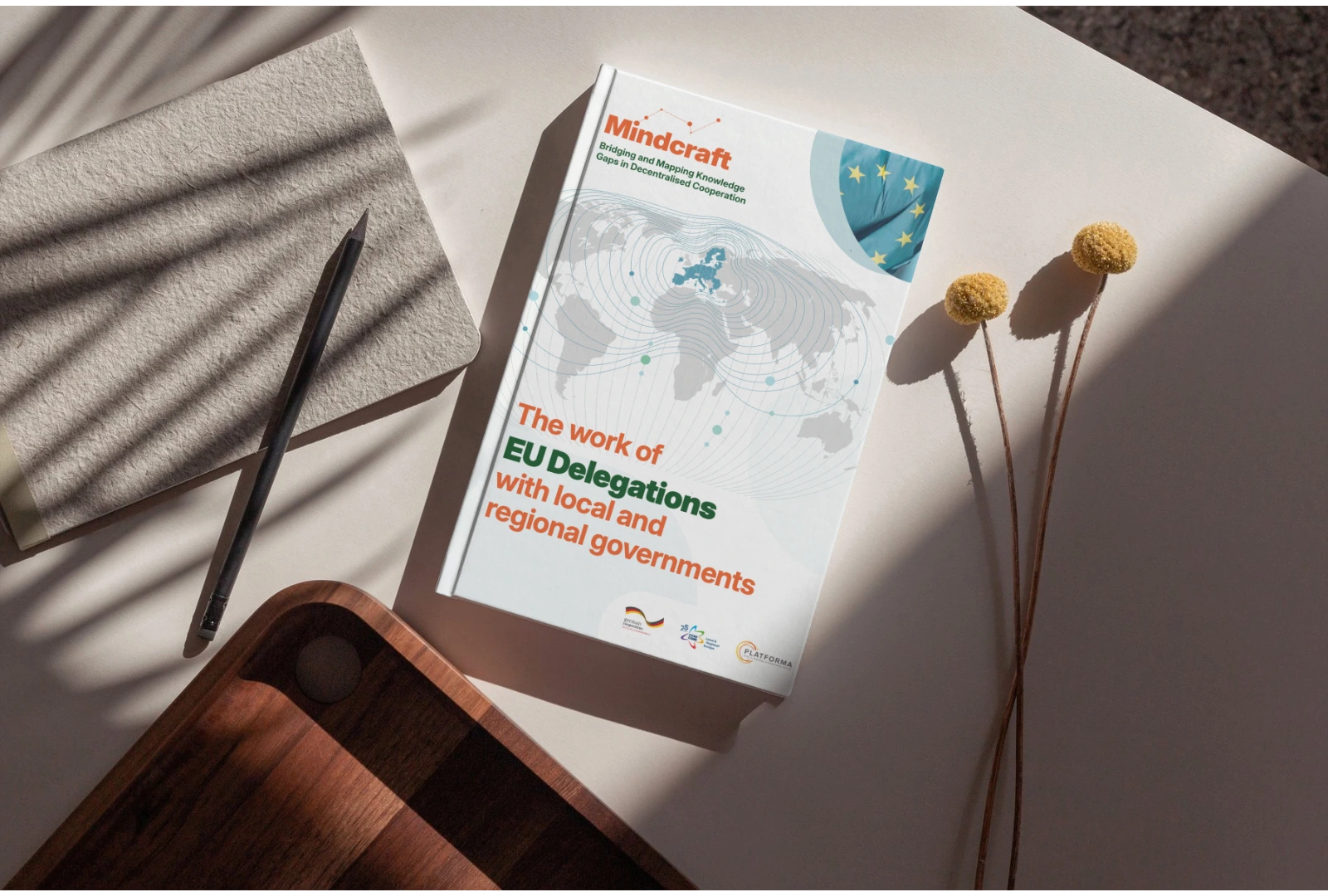
“The Work of EU Delegations with Local and Regional Governments” is a new Mindcraft publication, following on from the report published by PLATFORMA in 2021. Since 2021, the EU’s external action framework has undergone significant change. Under the Neighbourhood, Development and International Cooperation Instrument (NDICI) Global Europe and the Global Gateway strategy, EU international cooperation has moved towards a more geographic, investment-driven approach, with growing emphasis on the localisation of development cooperation.

This new study examines to what extent and how EU Delegations (EUDs) engage with Local and Regional Governments (LRGs) and their associations (LRGAs) in the partner countries. It is based on a 2025 survey of 40 EUDs worldwide and, interviews with five of them in Chad, Guatemala, Madagascar, Nepal and Zambia, as well as additional exchanges with EU Member States development cooperation agencies.

 Key findings:

  1. Enabling environment is key for LRG engagement. 62.5% of surveyed EUDs assessed the decentralisation in the partner country as favourable, and 57.5% support decentralisation efforts. Examples across partner countries show that support to local governance and public finance management helps LRGs engage in territorial development and EU-funded initiatives, though access to finance and the preparation of bankable projects remain persistent challenges.
  2. LRG engagement in EU international cooperation remains uneven and rather limited. 57.5% of surveyed EUDs stated they engage with LRGs and LRGAs under the NDICI-Global Europe, while 20% stated they engage with them under the Global Gateway strategy. EUDs point to the lack of a right framework for structured cooperation as an obstacle. 69.2% consider that a specific budget line for LRGs would help.
  3. LRG engagement can be valuable in fragile contexts. Among EUDs working in fragile settings, 76.4% consider that engaging with LRG would facilitate their work.
  4. Decentralised cooperation remains generally underused.  Illustrative examples of partnerships between European and partner-country LRGs, along with cooperation through LRGAs and their international cooperation structures, show real potential to strengthen local governance and support the localisation of EU initiatives but require greater visibility and emphasis.
  5. There is an ongoing need to strengthen EUDs capacities to work with LRGs. Only 30% of surveyed EUDs reported having received specialised training or support for engaging with LRGs, which were assessed useful for understanding territorial approaches to local development.

These findings come at a timely moment, as negotiations on the 2028–2034 Multiannual Financial Framework, including its proposed Global Europe Instrument, are underway. CEMR-PLATFORMA calls for a clear engagement framework, dedicated funding mechanisms for LRGs, and stronger support for decentralised cooperation as a route to shared development goals.

Read the full publication, available in:

  • English
  • French (available soon)
  • Spanish (available soon)
  • German (available soon)

For more information, contact:

European Partnership Hub: EU-Ukraine ‘one-stop-shop’

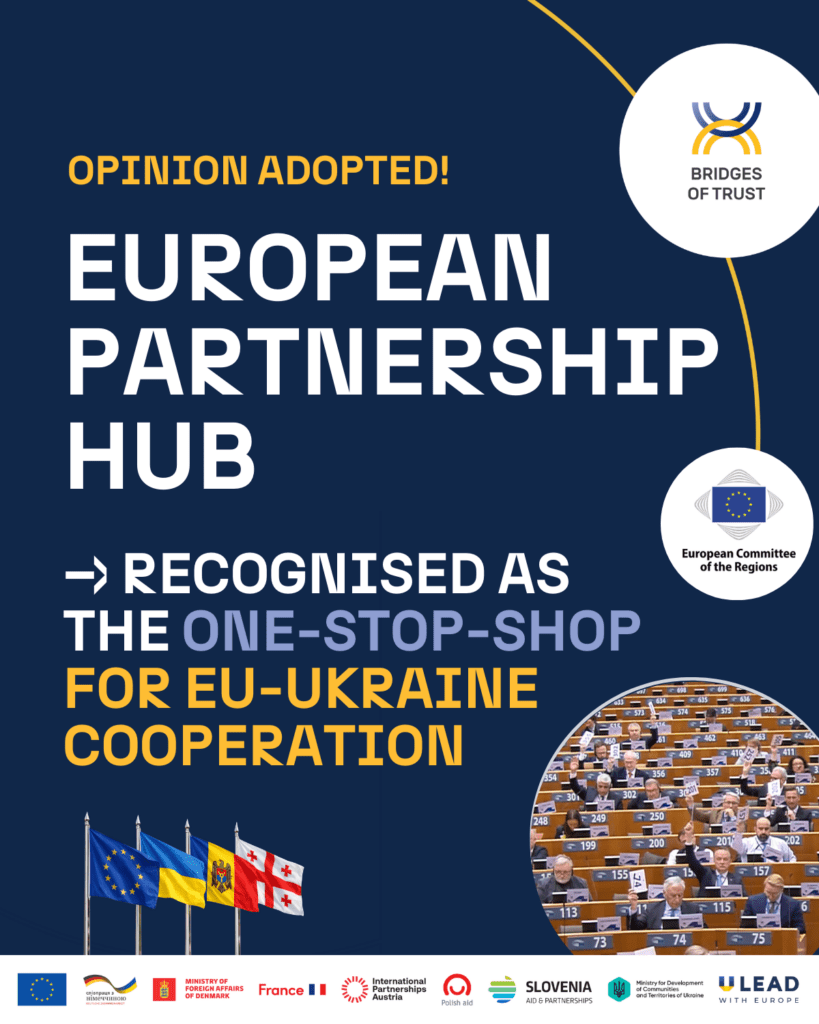
Last week, the European Committee of the Regions (CoR) adopted in Plenary the ‘Enlargement package 2025 – Ukraine, Moldova & Georgia’


The European Committee of the Regions (CoR) has adopted an amendment explicitly recognising the European Partnership Hub (EPH) as the “one-stop-shop” for cooperation between local and regional governments in Ukraine and the EU. The Hub was launched at the 2025 Ukraine Recovery Conference, following the Joint Statement of the European Alliance of Cities and Regions for the Reconstruction of Ukraine.

Hosted by CEMR, which already drives EU–Ukraine municipal partnerships through Bridges of Trust, the Matchmaking Platform, and SUN4Ukraine, the Hub coordinates and connects initiatives within the Bridges of Trust Community. It facilitates exchanges, provides information, and organises joint meetings to align efforts, build synergies, and support municipalities with the skills needed for recovery, cooperation, and EU accession.

Six other amendments reinforcing the role of local and regional governements in the EU enlargement

The final text of the CoR also includes six amendments tabled by CoR members Māris Zusts and Gints Kaminskis and suggested by the Latvian Association of Local and Regional Governments (LALRG), in close cooperation with PLATFORMA.

The amendments aim to reinforce a central political message: EU enlargement will only succeed if it is rooted in local and regional levels, resilient to hybrid threats, and democratically endorsed by citizens. In this opinion, decentralisation, multilevel governance, gender equality, and combating foreign information manipulation are framed as essential components of sustainable enlargement.

Cooperation with local governments 

The adopted amendments further stress the need for public support through cooperation with local governments, especially in Ukraine’s post-war context, advocating for awareness campaigns and media engagement to foster acceptance of candidate countries. Democratic resilience and integrity are further prioritised, particularly through strengthened anti-corruption measures at all government levels. Transparency in public procurement is highlighted, especially regarding reconstruction efforts.

Concerning Moldova, the amendments commend reform progress but express concerns over foreign interference (FIMI) during the 2025 elections, advocating for resilience measures and support for independent media.

The amendments also support local governments in Georgia amidst democratic backsliding, emphasising ongoing cooperation to maintain dialogue and democratic governance as the country navigates its EU accession path.

Looking ahead

These amendments place local and regional governments at the heart of EU enlargement, recognising that lasting impact, resilient democracies, and strong communities depend on their active role. 

The next step is for the European Parliament, Council, and Commission to take these recommendations into account for their respective work on enlargement.
CEMR together with PLATFORMA and their partners will continue to advocate, coordinate initiatives, and foster exchanges, to strenghten the role of local and regional governments.  

The European Partnership Hub is supported by the European Union and its member states through U-LEAD with Europe.

For more information, contact:

Funding opportunities for Ukraine 

Ukraine's recovery - News

EU and Member State programmes supporting municipalities in Ukraine’s recovery and cooperation with European partners 


In the face of Russia’s invasion and its devastating social and economic consequences, European Union and Member State funding programmes have become lifelines for Ukrainian municipalities. These mechanisms provide not only financial support but also technical expertise and institutional backing, helping local authorities address urgent needs, rebuild services, and strengthen community resilience. 

This guide was developed by the Council of European Municipalities and Regions (CEMR), in cooperation with the U-LEAD with Europe Programme and CEMR’s National Associations, under the Bridges of Trust initiative. It brings together key funding opportunities available to both Ukrainian and European municipalities, offering a practical starting point for collaboration and joint recovery projects. 

The initiatives highlighted stem from training sessions organised with Ukrainian and European partners. These covered project design and development, EU funding instruments, and the implications of Ukraine’s EU accession process. By leveraging existing EU programmes, municipalities can reinforce partnerships, promote local growth, and deliver tangible benefits for their citizens. 

Recognising Ukraine’s strategic path towards EU membership, the European Commission has committed to extending funding mechanisms to Ukrainian municipalities, ensuring they can access resources alongside their European peers. In addition, the Ukraine Facility Programme (2024–2027) is being developed as a central financing instrument for recovery and development. 

To support applicants, the guide provides practical resources: 

  • CEMR’s Guide on 2021–2027 EU Funding, explaining how to use the Funding and Tender Portal and submit strong project proposals. 
  • The PLATFORMA Handbook for local leaders and civil servants, offering step-by-step guidance on preparing applications, managing partnerships, and implementing EU-funded projects. 

As a living document, this guide will continue to be updated with new funding streams and opportunities. It seeks not only to provide access to financial resources but also to strengthen trust and cooperation between Ukrainian and European municipalities, laying the foundations for a shared European future. 

Read the study here 

For more information, contact: