
Sustainable heating and cooling solutions at the local level
At a time when seasons are shifting and the impacts of climate change are becoming increasingly visible, local and regional governments are on the front line of building resilient and affordable heating and cooling systems.
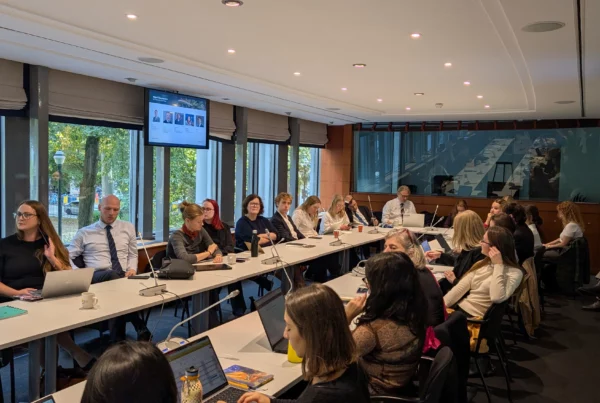
The latest Covenant of Mayors Webinar, held on 23 September 2026, bringing together its community and CEMR members, gave an overview of the latest EU policy developments on heating and cooling and aimed at exploring how to translate the latter into practice.
The discussion highlighted past and upcoming Commission initiatives, inspiring examples from European territories, national policies for the heating transition, as well as the needs and realities faced by local and regional governments (LRGs). The dialogue went far beyond technical solutions, given that heating and cooling impact the environment, public health, social inclusion, economic competitiveness, urban planning and education.
The most suitable solution
Opening the webinar, Andreas Wolter, Member of the Cologne City Council, in Germany and CEMR Spokesperson for Climate and Energy, highlighted the need for an integrated approach to energy planning. He called for decarbonised heating and cooling to strengthen European energy independence, boost long-term competitiveness and achieve climate targets.
He stressed both the need to work with associations to develop practical solutions and the LRGs’ role in identifying renewable and low-carbon solutions and facilitating communities’ access to finance. In addition, he shared examples of successful initiatives such as waste-heat systems and river-water heat pumps. Andreas Wolter underlined the need for stable and predictable funding, along with the need for place-based planning processes.
Towards decarbonised and affordable heating and cooling
Heidelinde Adesam, from DG ENER of the European Commission, presented the links between the EU policy framework on electrification and heating and cooling. With heating and cooling accounting for 50% of Europe’s energy consumption, the sector remains a major concern.
In addition, she showcased the Commission’s Electrification Action Plan, which integrates measures for the heating and cooling transition. The plan focuses on future-oriented clean and affordable initiatives, waste heat recovery, district heating and cooling, financing and planning.
Looking ahead, the European Commission will launch new initiatives in 2027, including an EU Waste Heat Initiative, a Cooling and Heating Action Plan and Local Heating and Cooling Plans Guidance
National perspectives from Portugal, Slovenia and the Netherlands
Paulo Machado, from the city of Guimarães in Portugal, presented the 2026 European Green Capital’s plan to decarbonise the heating sector. He put the spotlight on zero-carbon buildings where heating systems depend on passive measures combined with active measures fully electrified. He also brought up different projects to show that, despite the presence of protected buildings, new construction and renovation projects can consider sustainable heating and cooling as part of the plan.
Mateja Bitenc, from the city of Maribor in Slovenia, presented the process of drafting and implementing a heat strategy and action plan. She illustrated the role of municipalities through Maribor’s municipal cooling action plan, which includes public awareness, protection guidelines, education and training, cool public spaces, and green infrastructure. Among the lessons learned, she highlighted community involvement, tree species selection, and the creation of a municipal working group.
Cilou Bertin, representing VNG, the Association of Dutch Municipalities and a CEMR member, showcased how the Netherlands are working on decentralised heating and cooling planning. She reiterated the crucial role of municipalities for successful implementation. She discussed the need for new decentralised legislation, which presents both benefits (comprehensive approach, implementation of social goals, citizen and business engagement) and challenges (financial conditions, municipal organisational adaptation, transition from private to public, grid congestion).
As discussions turned to the future of EU heating and cooling policy, participants were invited to share their needs and expectations for an ideal heating and cooling EU policy that works in practice.
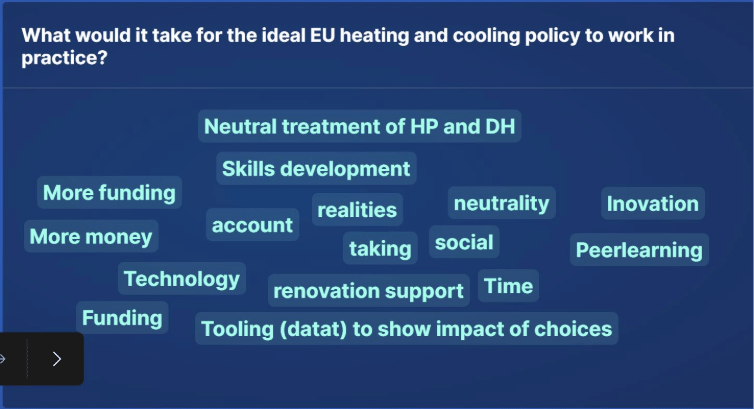
* The ideas of the participants on what it would take for the ideal EU heating and cooling policy to work in practice.
The recording of the webinar is available here. CEMR will continue to build on this discussion and contribute to upcoming policy debates, including the post-2030 framework, with a focus on supporting effective and sustainable heating and cooling solutions at the local level.
For more information, contact:

Policy Officer – Climate and Energy