How to unlock EU funds

EU financing opportunities - News

A guide to help local and regional governments navigate 2021–2027 funding opportunities and prepare successful proposals 


Accessing European Union funding can be complex, especially for municipalities and regions unfamiliar with project management procedures. To address this challenge, the Council of European Municipalities and Regions (CEMR) has developed a guide within its new External Funded Activities (EFA) Platform. The guide provides practical support for members, including information on funding opportunities, thematic priorities, and tips for writing strong proposals. 

The current Multiannual Financial Framework (MFF) 2021–2027, boosted by Next Generation EU, represents the EU’s largest-ever budget, totalling €2 trillion. More than half is dedicated to research, innovation, digitalisation, and climate action, while one-third supports cohesion policy. For local and regional governments (LRGs), this translates into significant opportunities to finance projects across diverse fields. 

The guide outlines how to navigate the Funding and Tenders Portal, the central entry point for EU calls. It explains how applicants can: 

  • Search funding opportunities and partners; 
  • Check eligibility; 
  • Submit proposals online; 
  • Manage reporting and compliance requirements. 

It also provides advice on preparing successful project proposals. Key recommendations include aligning projects with EU policy goals, ensuring sustainability and impact, and selecting experienced, committed partners. Strong project teams, clear narratives, and realistic budgets are critical for success. 

Finally, the guide emphasises capacity-building. CEMR encourages municipalities to build internal expertise, engage with partners early, and take advantage of available training and support services. 

By simplifying complex procedures, the CEMR guide aims to empower local and regional authorities to fully tap into EU funds and deliver projects that advance Europe’s priorities, from green transition to digital innovation. 

Read the study here 

For more information, contact: 

Call for Proposals EUI

BoT Expertise - News 2023

First Call for Proposals EUI – Innovative Actions


Eligible authorities are invited to submit project proposals in the framework of the first EUI – Innovative Actions (EUI-IA) Call for Proposals. For this Call for Proposals, an indicative budget of EUR 50 million ERDF is allocated.

Each project can receive up to a maximum of EUR 5 million ERDF co-financing and project implementation should take place within a maximum period of 3,5 years.

For more information and to apply don’t hesitate to check out the website and the seminars that will take place until the end of the year.

Ukraine Recovery

Solidarity with Ukraine - News 2022

‘Together we can do more’ – Dobrobat NGO


“For the city of Irpin, which stopped the enemy army on its approaches to Kyiv and was the most affected by hostilities in the region, “Dobrobat” volunteers have long since become not just reliable partners, but true friends.” This is how the mayor of Irpin, Oleksandr Markushyn, described the volunteer movement Dobrabat and its importance to his community.

On June 19, a Memorandum of Cooperation was signed between the city of Irpin, represented by its mayor and the funders of Dobrobat, Victor Andrusiv and Rostyslav Smirnov. Since then, over 30 houses have been repaired and saved thanks to the work of Dobrabat’s volunteers who are cooperating with the city’s communal services.

“When half of the city is destroyed, and there are simply no funds to attract commercial construction companies in the local budget, the work of Dobrobat volunteers is worth its weight in gold for us. And if we talk about it on the scale of a country that is at war, then even more so! Funds should now go to defense to protect against the aggressor!”

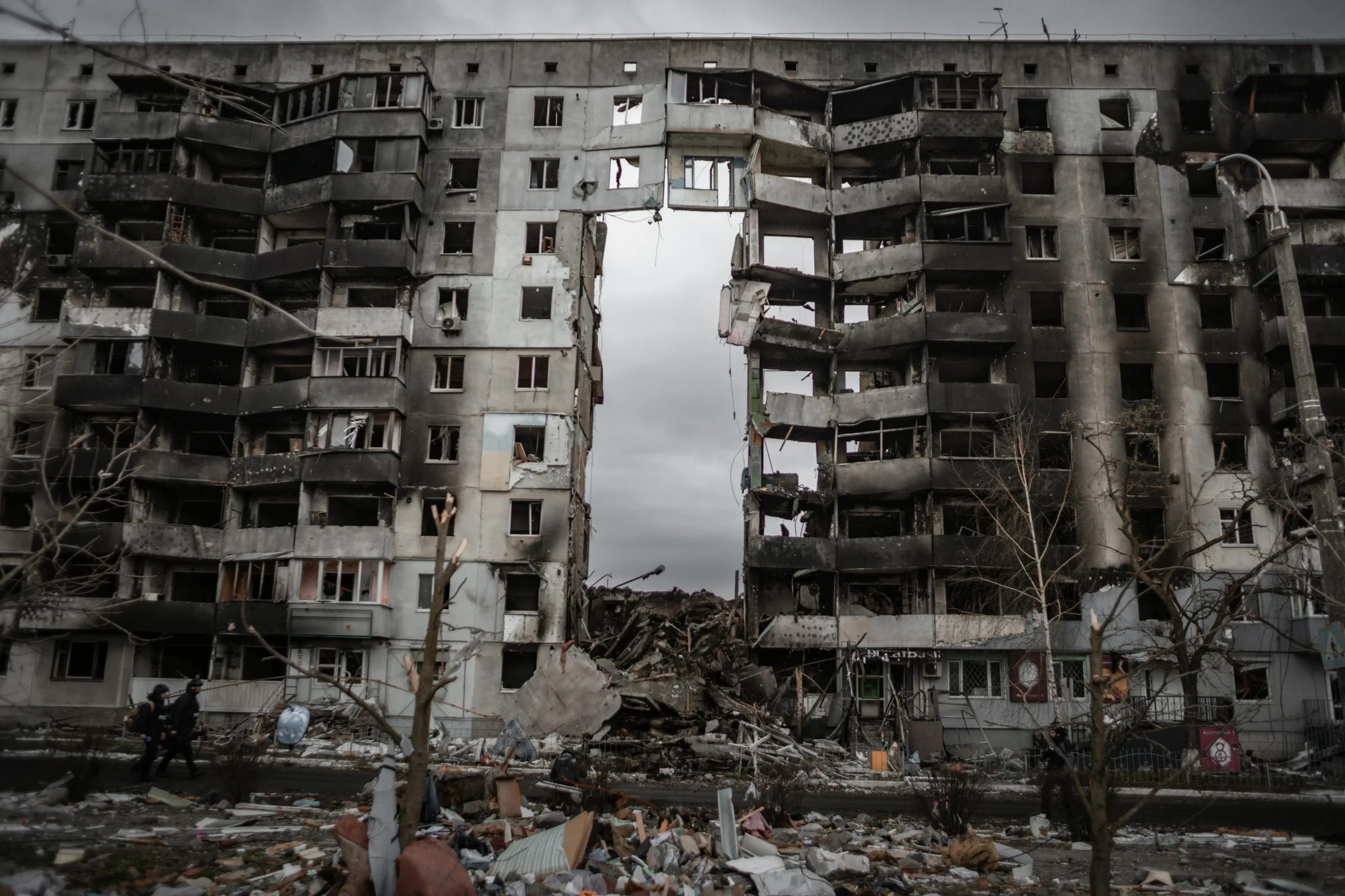
Dobrobat is a volunteer movement rebuilding homes and infrastructure in liberated cities that have been destroyed by the invading Russian forces. Volunteers remove debris and renovate buildings to make them inhabitable again. Besides the obvious practical benefits, the project carries a strong symbolic meaning of national unity harnessing Ukrainians’ grassroots horizontal organisation and mutual help. The Dobrobat volunteers are a bridge between the state and the Ukrainians who are suffering due to hostilities, as they work with both the state institutions and local authorities. For instance, in Yahidne village, they are restoring 22 houses in partnership with the Ministry of Territories and Communities Development of Ukraine. On July 13, 2022, Prime Minister Denys Shmyhal visited the village of Yahidne and praised Dobrobat’s support in the restoration of residential buildings and infrastructure.
The Dobrobat volunteers have already helped the Ukrainians in 30 settlements of Chernihiv, Sumy, Kharkiv and Kyiv regions (repaired windows, roofs, doors, and removed debris on the territories of hospitals, schools, kindergartens, parks, and private houses). Today Dobrobat has received 37,000 applications from volunteers from all over the country who are ready to come to the liberated cities to work there. From those, they have engaged 7,000 volunteers who are helping the reconstruction of their country as well as learning a new trade that can help them in the future. Despite the already 300 trips that have been organized within four months, requests from settlements are still flooding in.

To be as effective as possible, a map was developed to register private and public buildings that need to be repaired, with detailed pictures and estimated work. This map is available in English to widen the potential of donors for the organisation that deeply needs financial and logistic support. To ensure transparency they will provide a report on how the donated funds have been used with photos of the renovated building. Every donor knows exactly what their donation helped restore.

Training Academy

Meeting - News section

Local leaders explore how to mobilise sustainable finance at local and regional level


More than forty local and regional leaders gathered on Friday (21 October) to learn more about sustainable finances during CEMR’s training academy.

Terms like “sustainable finance” or “Taxonomy” are part of the everyday Brussels jargon and are now trickling down to the local and regional levels. After the Paris Agreement in 2015, the European Commission launched an ambitious Sustainable Finance action plan for financing sustainable growth in 2018. At the heart of it is the EU Taxonomy, a classification instrument which attempts to define “sustainable” economic activities. In addition, private and public enterprises like municipal utilities will have to disclose environmental, social and governance information (so-called ESG factors) and report on the Taxonomy alignment.

The training provided territorial leaders basic scientific knowledge about the concept of sustainable finance. It explained the EU’s sustainable finance framework, focusing on the EU Taxonomyand explored the role of local and regional governments in mobilising climate finance. The participants also shared best practices and funding opportunities for projects and sustainable financial products.

In addition to a panel on the regulatory architecture of sustainable finance, participants had the opportunity to discover the OECD subnational climate finance hub which offers local and regional governments insightful data and a self-assessment tool. Finally, representatives from the European Investment Bank and MuniFin, a Finish municipal credit institution, showcased projects which were enabled by sustainable financial products like energy efficiency renovations of 622 houses in the French region of Picardie.

According to the OECD Subnational Government Climate Finance Hub, local and regional governments accounted for 63% of total climate –significant public expenditure in 2019. However, the local and regional elected representatives stressed the need to take more into consideration the limited technical, administrative capacities in municipalities and regional administrations. A clear and understandable regulatory framework as well as more technical assistance by experts would be necessary to implement sustainable projects to fully align public investments with the Paris Agreement.

You are interested in the subject and in Brussels? Join us on 10 November for our event: Local Finances in Europe – Unlocking investments for sustainable and resilient societies. Our study on Local Public Finances and the Green Transition will be launched, followed by a high-level policy debate on the EU economic governance framework. Register here!

Solidarity with Ukraine

Mayors in Ukraine - News 2023

Bridges of Trust partner-municipalities, Fastiv and Druskininkai, meet in person for the first time


On 3-7 October 2022, a delegation from Fastiv municipality in Kyiv region travelled to Lithuania to visit their Bridges of Trust partner-municipality Druskininkai.

The two partners first met in November 2021 through the Bridges of Trust project, implemented by CEMR, PLATFORMA and supported by the U-LEAD with Europe Programme. Following online bilateral meetings and presentations of municipalities, the visit to Druskininkai was organized to meet in person.

The visit had the following main goals:

  • physically meet the partners for the first time;
  • discover the best practices of the Druskininkai partner municipality with a strong focus on rehabilitation;
  • discuss the possibility of a joint project in the field of rehabilitation and the future of the cooperation.

According to Yuliia Kazakova, medical director of the Fastiv hospital, paediatrician, and Head of the project “Psychological and medical assistance to children and their families affected by the War”:

“For me personally, the visit to Lithuania, to the picturesque town of Druskininkai, has been important, because of the incredible support of the European community and of every Lithuanian. Once again it strengthened my confidence that Ukraine is not alone, we are part of the European family, prosperity and well-being await our country.

From a professional point of view, I express my sincere gratitude to my Lithuanian medical colleagues. Their experience in providing complex rehabilitation services to adults and children will help us in organizing the rehabilitation of our own children and their families suffering from war. I hope that future cooperation and joint projects between Fastiv and Druskininkai municipalities will be fruitful and effective.”

To this, the Secretary of the Fastiv City Council, Liudmyla Rudiak, stressed his confidence in the utility of such visits to rehabilitate Ukrainian cities:

“I can confidently say that I received a lot of motivation to use the acquired knowledge for the development of our community. The Druskininkai team shared their experience in the field of rehabilitation, social, youth, and educational initiatives. It is clear that good project management and access to European funds make it possible to develop and expand the capabilities of the local self-government. Special thanks to Druskininkai for the hospitality, openness, willingness to cooperate and support Ukraine.”

The partners are now exploring opportunities to apply for EU funding to support a joint project in the sphere of healthcare and rehabilitation.

EU Green Capital

Environment - News section

Which cities will be the European Green Capital 2024?


Which cities will be the European Green Capital and the European Green Leaf 2024? Discover the winners at the Awards Ceremony on 27 October, hosted by the City of Grenoble. 

The European Commission’s (European) Green Capital Award, recognises and rewards local efforts to improve the environment, and thereby the economy and the quality of life in cities. The Award is given each year to a city, which is leading the way in environmentally friendly urban living. The Award encourages cities to commit to ambitious goals for further environmental improvement.

Youth employment

Youth employment - News

European towns struggle to retain youth, fight unemployment


While youth unemployment across the bloc has decreased compared to last year, European towns are struggling to remain attractive to young people.

Youth unemployment in the EU is currently at 13.8% and has decreased compared to last year, but the rate varies from region to region, with the highest number of unemployed young people in the regions of Southern Europe.

In the Portuguese municipality of Mourão, a small town near the border with Spain, the youth unemployment rate is at 24.6%.

According to Mayor João Fortes, while many young people would like to stay, they end up moving to other cities where they find more job opportunities, such as Evora, Porto or Lisbon.

Ageing towns

“I really would like them to come [back] because we are ageing so much that we need young people to build their own projects, their own family,” Fortes told EURACTIV.

Other mayors are raising similar concerns regarding the impact of demographic changes on their municipalities.

Alexandros Paschalis, deputy mayor of Edessa, a small Greek town with a 45% overall unemployment rate, said the “city is getting older and older.”

“Most of the people who go to study don’t have the opportunity to come back to do the work they study for,” he said at a conference organised during the EU Regions Week, adding that local authorities often lack the tools to address youth unemployment.

The city of Klaipėda on the Lithuanian coast is also facing a similar challenge to retain local youth.

According to mayor Vytautas Grubliauskas, “the goal is not to stop them, but to do everything so they can come back.”

Building infrastructure

In Grubliauskas’ view, to reduce unemployment and retain young talents, regions and cities need to be “attractive from the infrastructural point of view.”

“It is not enough to only create jobs, we also need to have the adequate conditions in place,” including infrastructure to compensate for lower salaries, he said.

Youth unemployment in Klaipėda is lower than the European average and the overall unemployment rate, with just over 8% of the population between 16 and 29 years of age out of a job.

The mayor said the municipality is “approaching these challenges in a good way,” for instance cooperating with universities and NGOs. The city has also created a funding mechanism to attract specialists in the areas most affected by labour shortages, such as IT technicians, doctors, and teachers.

In his view, cities and regions have the responsibility to make sure both the city infrastructure and choice of jobs are attractive to young people. At the same time, he said professional guidance is critical to help young people understand their talents.

Training

At the EU level, the Commission is promoting vocational training to fill gaps in the labour market and give young people the skills needed to find employment.

However, the problem “cannot be solved in six months,” according to Andrea Glorioso, policy officer at the European Commission.

“Education policy takes a lot of time, in order to see the effect we need to have a bit of patience,” he said.

Meanwhile, the municipality of Mourão is trying to address the problem locally, giving young people the opportunity to carry out work experience in the municipality.

The idea is for them to develop competences the municipality does not have and for which it has to rely on external consultants.

“Why not try to teach these kids how to do it?” Fortes said.

“It will require time, obviously, but after that time perhaps we’re going to have the inside resources to manage these kind of tasks.”

This article was first published by EurActiv. Real the whole text.

Pact for the Future

UCLG - News section

​​UCLG Congress adopts the ‘Pact for the Future’


Mayors, local and regional leaders from across Europe have adopted the ‘Pact for the Future‘, a key strategic document defining UCLG’s priorities from 2022 to 2028. 

The visions and aspirations reflected in the Pact will be shaped into actionable commitments throughout 2023 and serve as the strategic vision for the World Organisation in the coming years. Motions presented by all members will further deepen the policy visions and serve as a reference to the inputs of the whole local and regional government constituency represented by the Global Taskforce. 

Three political leaders have been appointed as Ambassadors for the Pact for the Future: Ada Colau, Mayor of Barcelona as Ambassador for the Future of People; Anne Hidalgo, Mayor of Paris as Ambassador for the Future of the Planet; Yücel Yilmaz, Mayor of Balikesir as Ambassador for the Future of Government. 

France-Ukraine Solidarity

Bridges of Trust Branding - News 2024

The France-Ukraine Local Solidarity Forum: Together we are stronger!


On the 19th of October, more than 100 participants took part in the Local Solidarity Forum jointly organised by the Council of European Municipalities and Regions (CEMR), PLATFORMA, Association of French Mayors (AMF) and the U-LEAD with Europe Programme.

Twinning and partnerships between Local and Regional Governments were at the centre of the discussions. Cooperation is the only way to bring about Ukrainian reconstruction.

Join un on 28 October, from 09:00 to 12:00 CEST, for the Bridges of Trust Forum to learn more about partnerships between Ukrainian and EU local governments!