EU budget political declaration

Leaders Summit Finland 2026

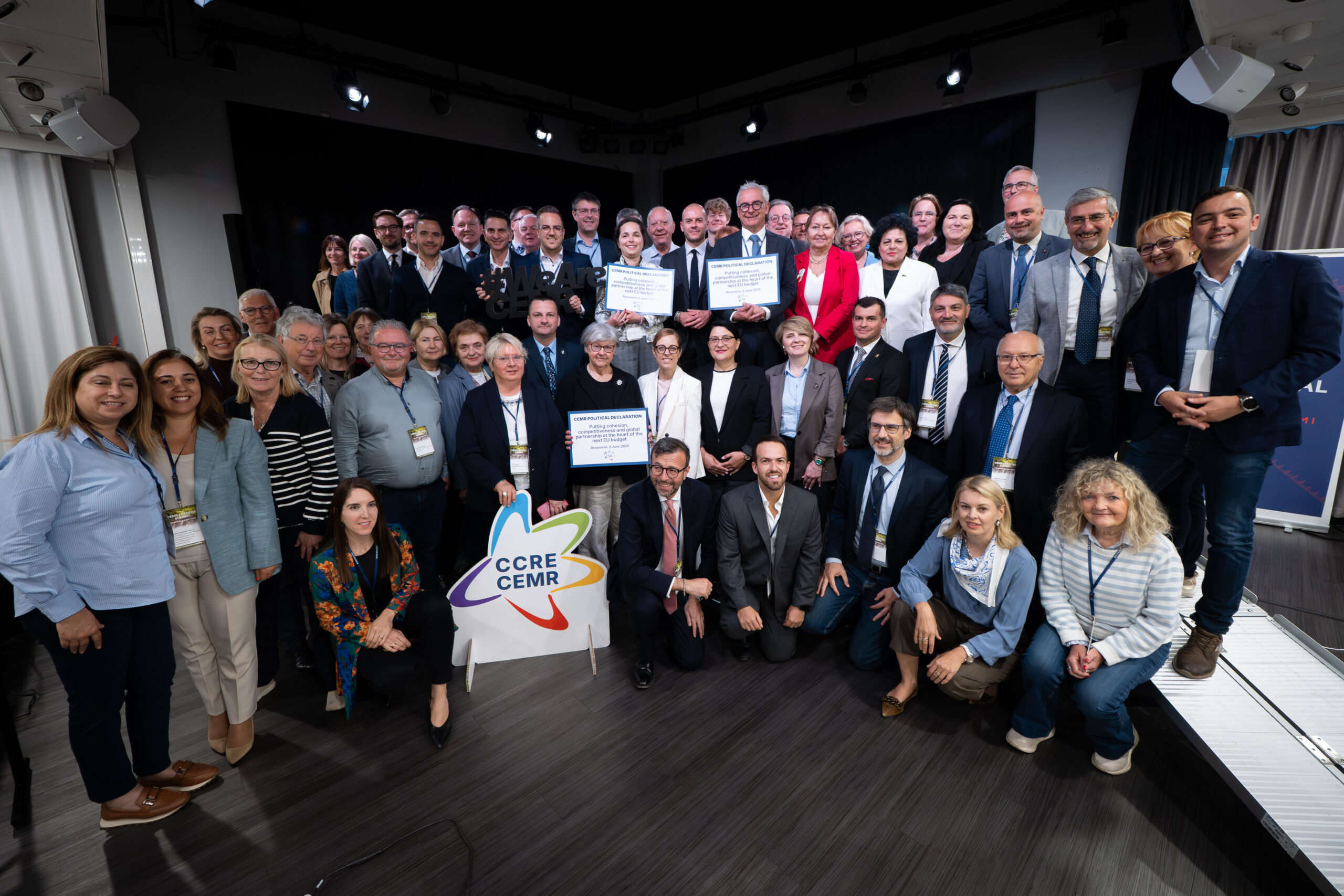
CEMR local leaders adopt a political declaration in support of an EU budget that works for every territory


Gathered in Rovaniemi on 5 June, local leaders call on the EU’s Heads of State and Government to include the European Parliament’s EU budget recommendations on multilevel governance, territorial delivery and predictable funding into their negotiations with the Council


Local leaders of the Council of European Municipalities and Regions (CEMR) Policy Committee have adopted a political declaration calling on EU Heads of State and Government to incorporate the European Parliament’s key recommendations on the next EU budget (2028-2034) into their negotiations in the European Council. The declaration, with 55 signatories, approved during the CEMR Leaders’ Summit in Rovaniemi, comes at a crucial moment in the interinstitutional discussions on the upcoming Multiannual Financial Framework (MFF).

By endorsing this declaration in support of an EU budget that works for every territory, CEMR members urge to ensure that the next long-term budget is fit for the EU ambition for cohesion, competitiveness and global partnership. Addressed to national leaders, the declaration makes the case for a budget that is place-based, predictable, and grounded in genuine multilevel governance.

A particularly significant timing

The declaration follows the European Parliament’s adoption of its interim report on the 2028–2034 EU budget on its plenary meeting of 28 April 2026 in which the Parliament set out its political priorities and will be the basis of negotiations with the Council.

As Member States meeting on 18-19 June Council will finalise their position, CEMR calls on them to take into consideration the position and proposals put forward by the European Parliament towards an EU budget that delivers competitiveness, cohesion, and trust across all territories.

Key asks of the political declaration

In practical terms, the declaration encourages Heads of State and Government to uphold the European Parliament’s key recommendations on multilevel governance, territorial delivery and predictable funding under the future National and Regional Partnership Plans (NRPP). It also calls for the continuation of territorial innovation and competitiveness tools, as well as stable and predictable support for innovation, scale-up and investment in towns, cities and regions under the future European Competitiveness Fund (ECF).

Local and regional governments are essential to turning EU priorities into concrete projects, services and investments on the ground. Among the main calls of the political declaration, it urges to preserve strong and clearly allocated funding for Cohesion Policy, which will secure key investments for economic, social and territorial cohesion in all regions.

It also insists that local and regional governments must be properly involved in the design and implementation of future NRPP.

The text further calls for the protection of integrated territorial and urban development tools, stronger administrative capacity for local and regional governments, and a more realistic approach to performance and delivery rules for long-term investment.

On competitiveness, the declaration argues that the future ECF must be accessible across all territories and better connected to local realities. It also calls on the EU to recognise local and regional governments as full partners in external action and development cooperation.

The overall message is clear: if the EU wants its next budget to produce tangible results for citizens, it must give local and regional governments the means and the role to make that happen.

CEMR advocacy campaign on the next EU budget

This action is part of CEMR’s wider campaign on the future EU budget. The campaign stresses that the decisions now being negotiated will shape the European Union’s ability to invest in people and places for the next decade. It also warns that greater flexibility in the new budget architecture must not come at the expense of safeguards for place-based investment, multilevel governance and predictable funding for towns, cities and regions.

For more information, contact:

Global Europe 2028–2034

Global Europe - position paper

Local and regional governments at the heart of “Global Europe 2028–2034”: our Policy position


As the European Union prepares its next Multiannual Financial Framework (MFF) for 2028–2034, the Global Europe instrument will define the EU’s external action for the years ahead — encompassing development cooperation, humanitarian aid, enlargement support and Global Gateway. Discover PLATFORMA detailed policy position outlining how this strategic instrument should be shaped to foster sustainable global partnerships and advance inclusive governance.

At a time marked by intersecting global crises — from climate breakdown and shrinking development funds to geopolitical instability — the role of local and regional governments (LRGs) is more critical than ever. PLATFORMA’s paper is thus anchored in the belief that effective global action starts from the ground up.

Local and regional governments as co-decision-makers, implementers and partners

PLATFORMA’s position starts from a stark reality: despite their proximity to citizens and deep knowledge of local contexts, LRGs remain under-recognised in EU external action frameworks. The coalition calls for the Global Europe instrument to move beyond symbolic references to “local authorities” and embed mechanisms that genuinely empower LRGs as co-decision-makers, implementers and partners in EU external policies.

Key recommendations

The Policy Paper makes 9 key recommendations to EU decision makers:

  1. Strengthen multilevel governance in Global Europe and place local and regional governments in the driving seat of territorial development
  2. Pair flexibility and simplification with ambitious official development assistance targets, and enhance accountability and transparency mechanisms
  3. Unlock Global Gateway’s potential through the involvement of local and regional governments
  4. Foster EU delegations’ engagement with local and regional governments
  5. Recognise and empower local and regional governments as unique and effective development partners in fragile contexts
  6. Advance the localisation of the Sustainable Development Goals to achieve decarbonised societies and climate justice
  7. Involve citizens through Global Citizenship Education as a key component of decentralised development cooperation
  8. Foster inclusive and participatory local governance: empower youth, women, and disadvantaged and underrepresented groups
  9. Strengthen local governance through the EU Eastern neighbourhood and enlargement strategy

Through these recommendations, PLATFORMA aims to improve the current proposal for the Global Europe instrument, so that it fully recognises, acknowledges, and supports the contribution of local and regional governments to EU external action, notably through decentralised cooperation as a development aid modality.

PLATFORMA also calls on the European Commission to issue an updated Communication on the structured involvement of local and regional governments and their associations in the new (geo)strategic approach to EU external action.

Read the full Policy position

For more information, contact:

Amendements to the EU budget

Shaping the future of EU Cohesion Policy: CEMR’s amendments to the proposed National and Regional Partnership Plans


The EU’s place-based approach to policymaking — which recognises territorial diversity and builds on the role of local and regional governments — is under critical pressure. The European Commission’s proposal for the next Multiannual Financial Framework risks weakening this approach by centralising investment decisions and blurring the distinct objectives of EU policies with very different territorial logics.

CEMR has therefore developed targeted amendment proposals to the regulation establishing the National and Regional Partnership Plans. These proposals aim to preserve place-based policymaking across EU investments, strengthen democratic and territorial governance, and ensure that policies designed in Brussels and capitals continue to deliver concrete, long-term benefits in cities, towns and regions. 

The main messages driving CEMR amendments

1. Safeguarding cohesion as a core EU priority
CEMR calls for a stronger budgetary commitment to economic, social and territorial cohesion. Reducing the relative weight of cohesion policy — while expanding access to funds to all private actors — risks undermining public services, increasing competition for limited resources, and weakening Europe’s capacity to deliver resilient territories and communities. 

2. Putting territories and people back at the centre
Cohesion policy must work across all regions and respond to territorial diversity. Our amendments reinforce the territorial dimension of EU investments, ensuring that no region or community is left behind and that the objectives of the EU Treaties are fully respected. 

3. Making partnership and multilevel governance real
While the Commission proposal refers to partnership and multilevel governance, it lacks strong guarantees. CEMR proposes clear obligations, monitoring mechanisms and consequences to ensure that local and regional governments are genuinely involved in the design, implementation and monitoring of national plans — not merely consulted in name. 

4. Preventing over-centralisation of EU investments 
Recent experiences with the Recovery and Resilience Facility and other national plans have shown the risks of centralised approaches. CEMR therefore calls for mandatory regional and territorial chapters in national plans, ensuring place-based strategies and meaningful involvement of subnational governments throughout the programming period. 

5. Strengthening integrated territorial development 
Integrated territorial approaches — in urban and non-urban areas — bring Europe closer to citizens and have proven their value on the ground. CEMR proposes a minimum 30% earmarking of national allocations for integrated territorial development, supported by higher EU co-financing and increased pre-financing to enable local authorities to participate fully. 

6. Supporting rural areas, cities and functional territories 
Our amendments reinforce support for rural development, sustainable urban development, urban-rural linkages and functional areas. These approaches are essential to tackling demographic change, climate challenges and social inequalities in a coherent and coordinated way. 

A call for a stronger, fairer cohesion policy

CEMR’s amendment proposals are guided by a clear conviction: Europe’s resilience, prosperity and democratic strength depend on strong local and regional governments and on cohesion policy that is ambitious, inclusive and place-based

We call on the European Parliament and Member States to take these proposals seriously and ensure that the future EU cohesion policy delivers for all territories and all citizens. 

👇 We invite you to consult the full set of CEMR amendment proposals for a detailed overview of our recommendations and legal changes to the Commission’s proposal.

More information:

MFF 2028-2034 position paper

EU Budget - News 2025

A stronger Europe is built locally: CEMR publishes its position paper on the EU Budget 2028–2034


As the EU prepares its next long-term budget, the Multiannual Financial Framework (MFF) 2028–2034, CEMR calls for a clear message to EU institutions and Member States: Europe’s future strength depends on empowering its towns, cities and regions.

CEMR’s new position paper, A stronger Europe is built locally, sets out how the next EU budget can effectively support territorial cohesion, competitiveness, democracy, and resilience. In the paper, CEMR warns that while the Commission’s proposal slightly increases overall resources, it reorients priorities toward defence, security, and industrial competitiveness—often at the expense of cohesion and local development, the very pillars that bring the EU closest to its citizens.

Multilevel governance must be non-negotiable

The paper highlights a major risk of recentralisation: by granting Member States and the European Commission broader discretion in defining funding priorities, the proposal could marginalise local governments, particularly in countries with weaker multilevel governance structures.

CEMR urges the EU to reinforce partnership mechanisms across all programmes—especially within the National and Regional Partnership Plans (NRPP), the European Semester, the European Competitiveness Fund (ECF) and the Global Gateway. Stable, well-resourced local and regional governments platforms are essential to tailor EU investments to realities on the ground.

Cohesion at the heart of Europe’s transformation

CEMR stresses that cohesion is a treaty-based objective and must remain central. The paper calls for:

  • Mandatory regional and territorial chapters in all Partnership Plans
  • Increased budget allocation for the single integrated funding instrument proposed by the EU Commission, “The Fund”
  • A mandatory 30% earmark for sustainable territorial development, including 15% for urban development
  • A safeguarding mechanism to protect local governments’ access to funds when national governments fail to meet conditionalities
  • Strengthening ESF+ (European Social Fund) for cohesion, youth and inclusion

Without these guarantees, Europe’s green, digital, and social transitions risk leaving entire territories behind.

Competitiveness and connectivity must acknowledge territorial reality

While competitiveness is a top EU priority, CEMR notes that the Commission’s budget proposal overlooks the territorial dimension. Cohesion and competitiveness are two sides of the same coin, and local and regional governments’ role in driving local and regional economic development should be recognised.

CEMR paper also calls for biodiversity and nature restoration to become explicit priorities in the European Competitiveness Fund (ECF) and urges simpler access to ECF, Horizon Europe, and the Connecting Europe Facility (CEF)—especially for smaller municipalities. It also stresses the need to include urban mobility as a strategic CEF priority.

Democracy and enlargement: supporting the foundations of Europe

With rising polarisation, disinformation, and harassment of local politicians, the position paper urges the EU to strengthen local democracy, support civic participation, and fund democratic resilience—including Global Citizenship Education and support for local media.

On enlargement, CEMR calls for local and regional governments to play a central role in the accession process of candidate countries, backed by stronger capacity-building and dedicated resources.

Read the full position paper here

For more information, contact:

Our reaction to the Agenda for cities

Twinning Report - News

CEMR welcomes the publication of the EU Agenda for Cities and the renewed recognition of local and regional governments as essential partners in delivering Europe’s priorities


The publication of the Agenda for Cities marks an important step towards strengthening the urban dimension of EU policies. It does acknowledge the key role of local and regional governments in implementing 70% of EU legislation, and the importance therefore to better inform and associate local governments in the preparation of European legislations. But the agenda falls short of answering the “ambition” level announced by President Ursula von der Leyen in her mission letter to Executive Vice President Raffaele Fitto.

Beyond a catalogue of policy areas where cities play an important role, and a list of initiatives already implemented by the European Commission, several elements will require clarification and improvement to ensure the Agenda truly delivers solutions for cities of all sizes and contribute to better policy making by transparent and representatives partnership with local and regional governments at European level. 

The Agenda for cities is just one piece of the puzzle 

While the EU Commission states that the Agenda applies to cities of all sizes, as well as suburbs and towns, the continued reliance on the Eurostat definition of “urban centres” (50,000+ inhabitants) risks leaving much of Europe behind. As we have seen with the implementation of the European Innovative action, the Eurostat definition has become the minimum population criteria in calls for proposals directly managed by the European Commission. This approach may inadvertently exclude small and medium-sized municipalities, which make up the majority of local governments and are at the heart of delivering EU policies.  

But beyond the Agenda for Cities, CEMR regrets that this initiative has not been enshrined in a broader more comprehensive territorial development strategy for Europe. As set out in our position paper Towards an inclusive EU agenda for cities of every size and context, an effective EU Agenda must reflect the full territorial diversity of the EU and avoid reinforcing urban–rural divides.  

A welcome recognition of cities’ role, but structured multilevel governance is still missing 

CEMR welcomes the acknowledgement of local and regional authorities as key implementers of EU legislation. However, the governance model proposed in the Agenda still relies heavily on ad hoc consultations, including the reference to the June 2025 Implementation Dialogue, which lacked transparency and representativity. 

We reiterate the need for a permanent, structured and inclusive multilevel governance mechanism involving local and regional governments and their representative associations at national and European level. This is essential for shaping, not only implementing, EU policies. In this respect, associations representing local and regional governments at European but also national level must be the go-to partners for the European Commission, to ensure representativity and legitimacy of their consultation processes.  

When mentioning the preparation of the “National and Regional Partnership Plan” for the EU budget post 2027, the Commission states that structured multilevel dialogue will be key feature in the preparation and implementation of the plan, but did not include any binding measure to ensure this is the case. CEMR also made concrete recommendations to secure the involvement of local and regional governments in preparation of these plans. 

Better Implementation must become a priority of the EU Agenda 

It is positive that the Agenda includes some specific support under a new “EU Cities platform” for capacity building, innovation and participation in dialogue. It will be important that this support offer is not restricted to few cities but available to all subnational governments.  
CEMR calls in particular for a dedicated Better Implementation pillar as part of the EU Urban Agenda with: 

  • Governance and competence impact assessments for all new EU proposals, 
  • capacity-building resources in the reforms pillar of the next MFF, 
  • regular and inclusive implementation dialogues, 
  • and a one-stop-shop integrating all support tools for subnational governments. 

These elements are indispensable for translating EU ambitions into real local outcomes.  

Funding: more clarity, but uncertainties remain 

We welcome the launch of the new EU City Portal, which can help cities navigate funding opportunities more easily. At the same time, the future EU Facility – to be directly managed by the European Commission raises questions about the future of existing programmes (EUI and URBACT) and on governance, accessibility, and safeguarding participation of smaller municipalities. To unlock the full potential of local governments, the EU must deliver simpler, fairer and better-aligned funding, as outlined in our position paper.  

Promising measures in the agenda, if they remain accessible to all

CEMR welcomes new initiatives announced in the Agenda, including: 

  • “potential” access to the European Competitiveness Fund for clean transition and industrial decarbonisation, as well as for resilience, security and defence 
  • High and technical levels consultations of urban stakeholders 
  • strengthened support for capacity building, including on public procurement, 

While cities are encouraged to adopt the “mission approach” it remains unclear whether that is mere suggestion or whether it will come with a new call and potential funding for these “Mission Cities”. 

These measures can help cities accelerate the green and digital transitions—as long as access is equitable and not restricted to larger or well-resourced municipalities. 

Our final message 

Today’s publication is a milestone for Europe’s urban future. But an EU Agenda for Cities must be inclusive, territorially balanced and grounded in genuine multilevel governance. CEMR stands ready to work with the European Commission, Member States, and its member national associations to ensure that this Agenda becomes a truly transformative framework—one that delivers for cities, towns and regions of every size and context

For more information, contact:

EU budget: Local Alliance action plan

Local Alliance - News Section

Making the next EU budget work for cities and regions: the Local Alliance’s 10-point action plan


The Local Alliance – a coalition of Europe’s leading local and regional governments: ACR+, CEMR, Climate Alliance, Energy Cities, Eurocities, FEDARENE, ICLEI Europe and POLIS, – aims at ensuring that our constituencies have the competencies and resources to implement and reinforce Europe’s resilience, competitiveness and decarbonisation.

We share a common vision for the 2028–2034 Multiannual Financial Framework (MFF) to become a strong, democratic, and future-proof tool that drives cohesion across territories, reinforces Europe’s competitiveness, and enables a just transition towards climate-neutral and resilient transition.

Local and regional governments are Europe’s frontline for delivering change. They are the democratic level closest to citizens, trusted by a majority of Europeans, and directly or through shared responsibility in charge of implementing most EU legislation. They mobilise the bulk of climate-relevant investment, drive innovation and competitiveness, and safeguard cohesion and just transition by ensuring that no community is left behind. Without their leadership, Europe cannot succeed in meeting its green, digital, social, and competitiveness ambitions.

Yet instead of empowering this strength, the Commission’s proposal for the next MFF risks sidelining local and regional governments, who are best placed to deliver. A centralised approach, which does not reflect the local realities and priorities, not only threatens delivery on the ground, but also Europe’s long-term societal, democratic and economic resilience and competitiveness. As the Committee of the Regions’ most recent report highlights, European cities and regions need a budget to help build the Union from the ground up – where local and regional authorities are not only implementers but co-creators of Europe’s future.

With the negotiations already underway, the Local Alliance calls on the European Parliament and the Council of the EU to seize this opportunity to put democracy, territorial cohesion, and competitiveness at the heart of the next MFF by ensuring local and regional governments are recognised as indispensable partners. Europe cannot achieve its strategic objectives without working hand in hand with its towns, cities and regions. For this reason, the Local Alliance presents an 10 point action plan to ensure the EU budget delivers tangible results for people in every territory across Europe and beyond.

For the next MFF, we call on:

1. Stronger multilevel governance mechanisms to deliver both reforms and investments.

2. Stronger partnership principle for the implementation of the MFF.

For the National and Regional Partnership Plans: 

3. Making regional and territorial chapters of the National and Regional Partnership Plans mandatory, with a clear section on cities.

4. Earmarking for a just transition & affordable living for all.

5. A real EU program for cities of all sizes under the proposed EU Facility.

6. Safeguarding mechanism for the local and regional level to guarantee their access to EU funds.

7. Linking performance indicators to EU law implementation and territorial delivery.

For the European Competitiveness Fund and Horizon Europe: 

8. Competitiveness Fund and Horizon Europe should recognise cities and regions explicitly as innovators and investors.

For Horizon Europe:

9. Continuing the Mission approach under Horizon Europe.

For the Global Europe Facility:

10. Stronger support for accession cities and regions for the future of European cohesion.

Read the full position paper here

For more information, contact:

The EU must hear its cities

Cities and regions unite to defend their role in Europe’s next budget


During this year’s European Week of Regions and Cities, Europe’s local and regional leaders sent a clear message: the future of the EU budget must not sideline those who make Europe work.

Through two major events — one under the #CohesionAlliance and another by The European Urban Forum and the Local Alliance — the Council of European Municipalities and Regions (CEMR) and its partners mobilised to defend the role of towns, cities and regions in shaping and delivering the EU’s next long-term budget for the period 2028–2034.

These engagements follow a broader advocacy effort launched right after the European elections, when the new EU institutions began to define the political priorities for the current mandate.

Standing up for partnership and cohesion

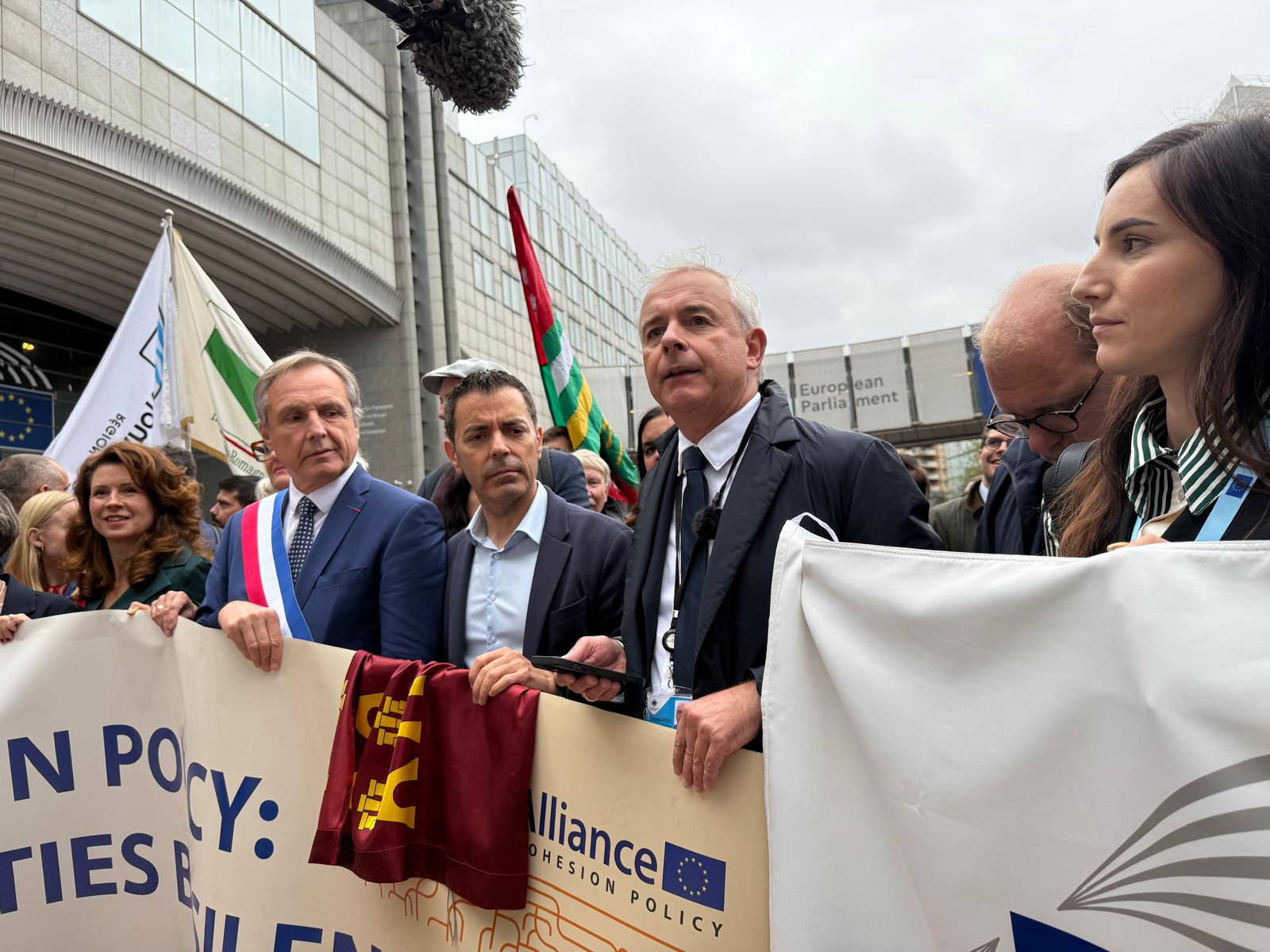
On 15 October, elected representatives from across Europe gathered in front of the European Parliament to call on EU institutions to give local and regional governments full partnership rights in the future Cohesion Policy, and to resist its nationalisation and centralisation.

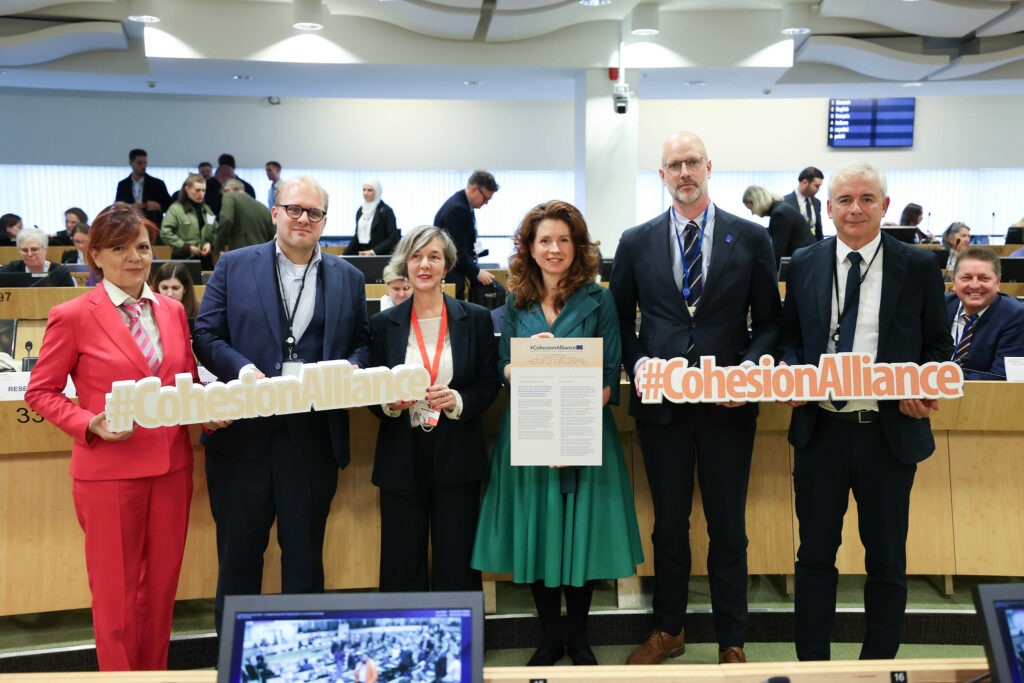
In a symbolic action joined by Members of the European Parliament (MEPs), the European Committee of the Regions and Europe’s territorial associations, the #CohesionAlliance partners adopted a seven-point call rejecting the European Commission’s current proposal .

“Bundling Cohesion Policy with policies on agriculture, defence or migration,” the statement warned, “would force local and regional authorities to compete for funds at the national level.” Such a shift, participants stressed, risks moving decision-making power away from regions and cities — the level where the EU’s goals are actually delivered.

“Competitiveness and cohesion are two sides of the same coin,” said Christoph Schnaudigel, CEMR Co-President and President of the County of Karlsruhe, Germany. “Businesses in our cities need infrastructure, housing, schools, and fibre networks. Cohesion is part of the Treaties — we need competitiveness and cohesion together. Otherwise, the money will disappear before reaching local communities. The European Commission must talk to us. You can’t know what territories need from Brussels or Berlin — we know it at the local level.”, he added.

Cities at the centre of Europe’s priorities

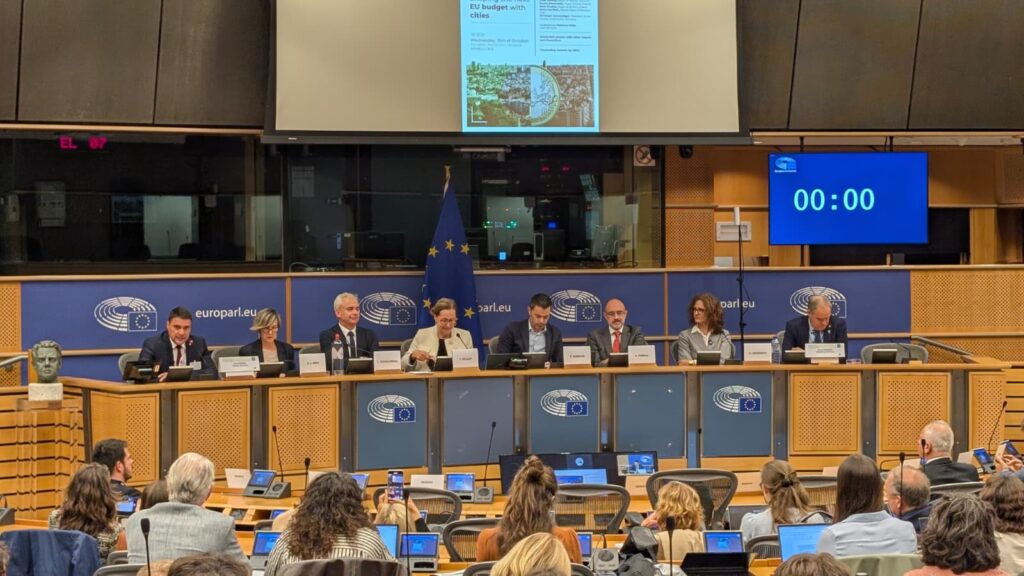
Later the same day, local leaders gathered again in the European Parliament for a debate titled Shaping the Next EU Budget with Cities, convened by the European Urban Forum in cooperation with the Local Alliance.

The message from city leaders, MEPs and European institutions was united: Europe’s priorities — from the green transition to digital transformation — cannot succeed without empowering cities and regions. As CEMR’s Christoph Schnaudigel put it: “You don’t know what the needs are from Brussels. We do — from the local level.”

Pascal Smet, Member of the Brussels-Capital Parliament and the European Committee of the Regions, warned that the proposed setup risks creating “a Europe of nation states”.

Other leaders, such as Peter Dermol, Mayor of Velenja (Slovenia), underlined the dangers of losing citizens’ trust if Europe fails to deliver on its promises in regions undergoing industrial transitions.

From Germany, Eckart Würzner, Mayor of Heidelberg, stressed that “cities are defenders of democracy” and that without adequate resources, “we will stand up” to protect the local dimension of Europe’s future.

Anna Lisa Boni, Deputy Mayor of Bologna (Italy), urged the EU to use the forthcoming Agenda for Cities as “a lighthouse” to ensure the next Multiannual Financial Framework (MFF) strengthens, rather than weakens, the role of local governments.

CEMR’s key asks on the next EU budget

CEMR is already working on an intense advocacy campaign to shape the current EU budget proposal made by the European Commission.

As stated in the document, ‘EU budget 2028-2034: Main changes, challenges and opportunities for local and regional governments’, CEMR has key asks on this topic:

  • Ensuring effective multilevel governance and meaningful partnership in the next MFF
  • Placing cohesion and territorial balance at the core of the next eu budget
  • Guaranteeing fair access to EU funding for local governments across all EU programmes 
  • Enhancing support for local governments in EU enlargement and accession of candidate countries
  • Developing a dedicated EU programme to reinforce local democracy

These proposals echo the sentiment voiced by local leaders throughout the European Week: Europe’s strength lies in its territories. Cohesion and competitiveness can only coexist through real partnership between all levels of government.

For more information, contact:

Final call for the EU budget

MFF - Position paper News 2025

Local and regional governments’ final call to EU institutions for a real involvement in the design of the EU budget 


The future of the EU budget is at a crossroads. As the European Commission launches consultations on the post-2027 Multiannual Financial Framework (MFF), local and regional governments across Europe, represented by CEMR, are calling for a fundamental change: an EU budget that is inclusive, decentralised, and truly aligned with the needs of cities, municipalities, and regions.  

This requires that future national plans and investment priorities in each Member State are not imposed from the top-down, but shaped through meaningful consultations with local and regional governments, just as the Partnership Principle ensures in Cohesion Policy. Only in this way can EU investments be fit for purpose and truly serve the people it is intended to benefit. 

CEMR’s newly released position paper on the post-2027 MFF sets out a clear vision for a reformed EU budget that strengthens multi-level governance and empowers local and regional governments as essential partners for effective spending of the EU budget on the ground. With growing social and economic inequalities, the need to accelerate climate adaptation, and increasing geopolitical instability, Europe cannot afford to sideline local and regional governments—the very actors that implement over 70% of EU policies on the ground. 

National plans must include mandatory consultations to local and regional governments 

The roadmap on the next MFF confirmed the European Commission’s ambition to establish single national plans for reforms and investments based on priorities defined at European level. The European Commission mentions the Recovery and Resilience Facility (RRF) as a good example of an instrument linking investments and reforms and points out that two thirds of the EU budget (Cohesion Policy funds and the Common Agricultural Policy) could in the future be implemented according to the RRF approach. In this context, CEMR issues a final warning to the European Commission: the RRF model failed to ensure effective multi-level governance. CEMR found that, since consultation with local and regional governments was not mandatory, it simply did not occur in most of the Member States.  

The European Commission must ensure that national plans and the definition of investment priorities in each Member State are developed through meaningful consultations with local and regional governments, similar to the Partnership Principle in Cohesion Policy. This is the only way to guarantee that EU investments are fit for purpose and meet the real needs of the population.  

The EU is more than its institutions and the 27 states—it belongs to its people, municipalities, cities, and regions. Decisions based solely on macroeconomic trends risk disconnecting it from citizens” — Gunn Marit Helgesen, CEMR President. 

CEMR key priorities for the post-2027 EU budget 

CEMR’s position paper, backed by national associations of local and regional governments across Europe, contains concrete proposals to reform the post-2027 EU budget and enhance its effectiveness: 

  • Empowering municipalities, cities and regions not only as implementers but also as planners 
    The Partnership Principle should be made mandatory across all EU-funded programmes to ensure that the funds effectively reflect the actual needs of local and regional governments. 
  • Decentralising the Cohesion Policy 
    Strengthening the capacity of local and regional governments to manage EU funds will ensure that investments address real local needs and promote balanced territorial development. 
  • Diversifying EU instruments as part of the ambitious policy agenda for cities 
    From shared management funds to increased direct funding, it would allow EU investment to reach local and regional authorities of all sizes, from all types of territories, both urban and rural.   
  • Simplifying and easing EU funding mechanisms  
    to reduce administrative burdens for both Managing Authorities and beneficiaries. CEMR proposals for simplification include: a single set of rules for beneficiaries across the different funds; flexibility in thematic concentration to allow place-based definition of priorities, hence accelerating funds disbursement; and a labelling of auditing processes as compliant with EU rules to avoid multiplication of auditing.
  • Enhancing synergies among EU funds. 
    The next MFF must improve coordination between different EU funding instruments to maximise impact at the territorial level. 

Take part in the public consultation 

Local and regional governments must not be sidelined in shaping the post-2027 EU budget. The European Commission’s consultation must not be reduced to a bureaucratic exercise or a mere checkbox. Consultations alone are not enough. The next EU budget regulations must include a mandatory requirement to involve local and regional governments in defining the investments that will meet the real needs of the population. 

Use this public consultation —open until May 7 2025— to demand a real seat at the table and a budget that truly serves our communities. A stronger, more inclusive Europe starts from the ground up. Speak up before it’s too late. 

Read the full CEMR position paper here

Contribute to the public consultation on the future EU budget here: https://ec.europa.eu/commission/presscorner/detail/en/ip_25_486 

For more information, contact: 

X Budgeting – power of subnational finance

Participatory Budget - Youth

Municipalities and regions explore new approaches to budgeting, from participatory and priority-based models to green and SDG-oriented practices


Municipalities, cities and regions across Europe are at the forefront of delivering essential services, from housing and health to climate action and mobility. Yet, they face increasing financial pressures, recovering from the pandemic’s “scissor effect” of higher costs and lower revenues, and coping with inflation. In this context, how budgets are designed and allocated has become a powerful political tool.

To explore this potential, the Council of European Municipalities and Regions (CEMR) organised a training event on 23 May titled “X-budgeting – the power of subnational finance.” The session brought together experts and practitioners to share knowledge on innovative approaches to local and regional finance.

“X-budgeting” refers to a range of methods that go beyond simple accounting, transforming budgets into instruments for shaping policy and engaging citizens. These include:

  • Priority-based budgeting, aligning spending with political or community priorities rather than repeating last year’s allocations.
  • Process-based budgeting, such as participatory models that involve residents directly in decisions.
  • Green and SDG budgeting, aligning local finances with climate goals and the Sustainable Development Agenda.

Each approach offers opportunities, from fostering transparency and boosting trust to mobilising investment for sustainability, but also poses challenges, such as methodological complexity, resource needs and the demand for strong political support.

By experimenting with new forms of budgeting, municipalities and regions can make financial choices that not only keep services running but also reflect citizens’ voices and accelerate progress towards long-term goals.

Read the study here

For more information, contact:

Future of EU cohesion policy

MFF - Position paper News 2025

Rethinking EU budget design to empower local and regional governments post-2027 


The Council of European Municipalities and Regions (CEMR) highlights the critical role of local and regional governments in shaping Europe’s future Cohesion Policy and the next Multiannual Financial Framework (MFF). Municipalities, cities and regions are at the frontline of delivering essential services, from transport to education and climate adaptation, while also being major drivers of public investment. Yet, the upcoming EU budget debates risk sidelining their role, particularly with the disappearance of the Treaty objective for Territorial Cohesion. 

CEMR calls for a strong, ambitious Cohesion Policy that maintains at least one-third of the EU budget and embeds key principles such as partnership, multi-level governance, and place-based development. Simplification is a top priority: fewer funds, a single set of rules for beneficiaries, and reduced administrative burdens would make EU resources more accessible and effective. Importantly, local and regional governments must be clearly recognised as beneficiaries and implementing partners to ensure funds reach citizens directly. 

A place-based and integrated territorial approach should be at the core of future instruments, designed bottom-up with local authorities defining priorities. CEMR stresses that Cohesion funds must not be redirected towards large corporations without strategic planning, but rather reinforce local and regional capacity for innovation, sustainability, and economic growth. 

For the post-2027 EU budget, the message is clear: no successful European project without local and regional governments at its heart. Territorial cohesion, simplified rules, and genuine partnership are essential to delivering a fair, sustainable, and effective Cohesion Policy. 

Read the position paper here 

For more information, contact: