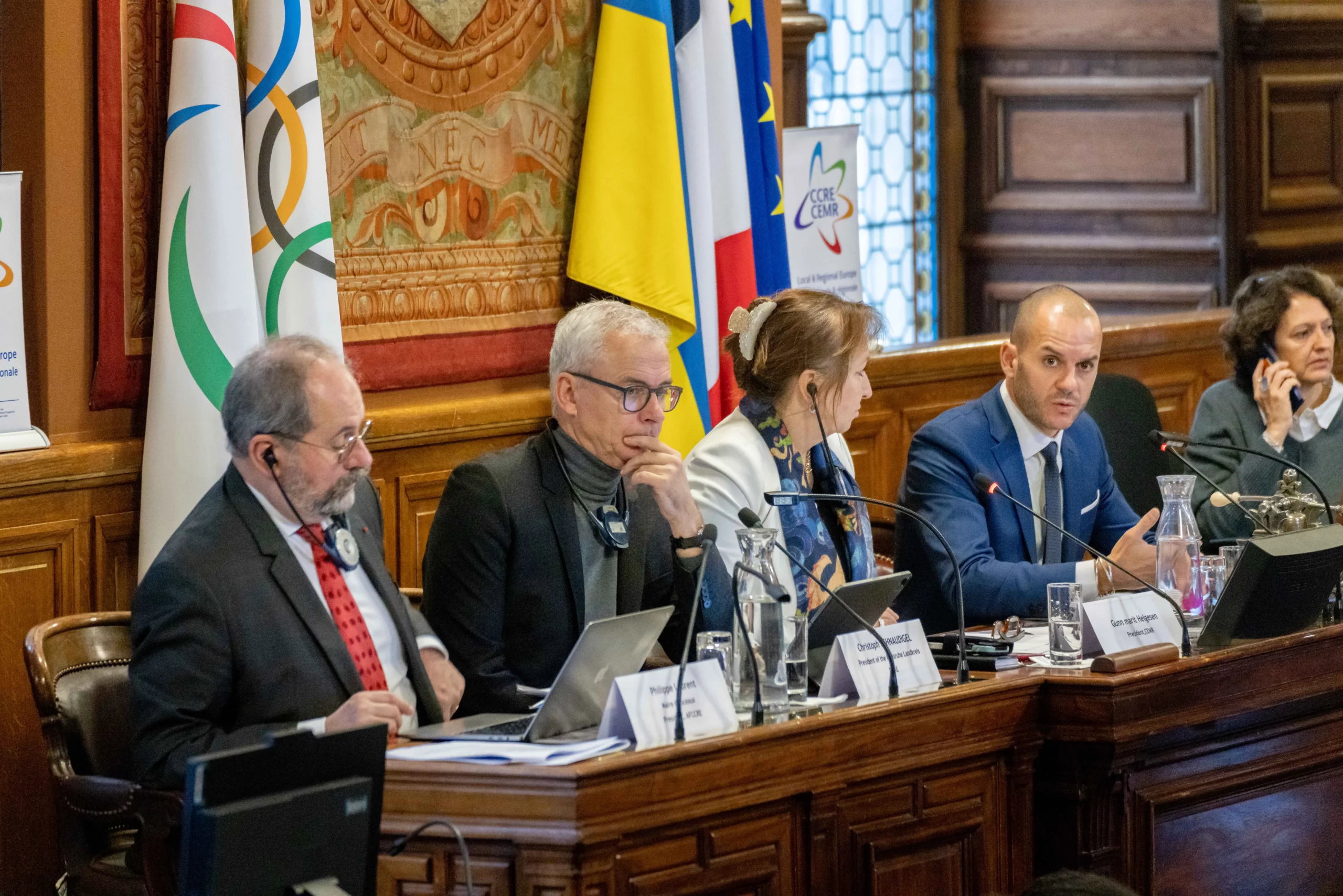
CEMR Retreat

Youth Matters - News 2022

4th CEMR retreat: a wrap-up of our debates and activities


Dedicated to a “Fresh start for a resilient Europe,” EU officials and local leaders from across the continent gathered virtually during the event to discuss the way forward beyond the COVID crisis, as well as the place of cities and regions in the Conference on the Future of Europe. This was an opportunity to spell out our vision of an inclusive, sustainable and resilient Europe over the course of political debates and to better organise our own work through several practical workshops.

Reaching decarbonised and resilient societies

Local elected officials discussed how to reach decarbonised and resilient societies, notably to identify challenges and messages for the upcoming COP26 climate conference in Glasgow. The wide-ranging discussion covered the appropriateness of EU legislation for achieving local climate transitions, the best financial measures for this goal, decarbonisation beyond Europe’s borders and the role of future generations.

Ronan Dantec, CEMR spokesperson on climate, French senator and municipal councillor for Nantes, highlighted how European cities signatories to the Covenant of Mayors had reduced their carbon emissions by 30% between 1990 and 2020, significantly more than the European average. “Europe and local governments are still global leaders in terms of decarbonisation, even if we can always do better”, he said.

The speakers notably discussed measures at both European and local level which can be taken now to both fight against and adapt to climate change. EU legislation should favour local public procurement and investment energy efficient housing. Local governments can also take many direct actions, such as the expansion of bike lanes, the banning of gravel gardens or the development of green façades covering buildings with plants. Whatever the area, there is no shortage of actions that be taken!

First meeting of CEMR national associations’ presidents

Our network held the first meeting of the presidents of our national associations together with CEMR President Stefano Bonaccini. The presidents exchanged on our associations’ crucial role during the COVID pandemic, the actions they took and their priorities and perspectives going forward for a sustainable recovery and resilience. Check out our social media thread of the presidents’ exchanges.

Advocacy, knowledge sharing, communication: three practical workshops

Last but not least, we held three interactive workshops to orient and better organise our activities as a network. These covered our associations’ tools for national and European advocacy, our associations’ knowledge-sharing activities and cooperation on communication. Taken together, these sessions explored how to create more synergies within our network and strengthen our collective voice.

Job opening

Call for Proposals - News 2023

Call for applications for the recruitment of CEMR’s Secretary General (2022 onwards)


CEMR has opened a call for the position of Secretary General whose current mandate will end in January 2022. For more information on the position and how to apply, please consult the recruitment pack. Applications must be sent to recruitment.sg[a]ccre-cemr.org by 3 October 18:00.

Policy Committee

Meeting - News section

Local leaders gather for a busy political agenda


Europe’s local leaders met on Friday (18 June) to take stock of CEMR’s activities and orient its political work. There was a busy agenda as the Policy Committee dealt with a wide range of issues.

CEMR’s highest decision-making body discussed action on migration and integration, and adopted positions on rural development and the European Commission’s 8th Environmental Action Plan. The elected officials also discussed the evolution of human rights, gender equality and local democracy in Europe, culminating in the adoption of a declaration in support of municipalities signing the Charter for Equality, regardless of the national situation.

The leaders also discussed CEMR’s participation to the Conference on the Future of Europe – a great event debating how to reform the European Union – in collaboration with the European Movement International (EMI). This would notably involve the organisation of local citizen dialogues, with several CEMR members having expressed an interest in organising such events.

The next Policy Committee meeting is planned for January 2022.

COVID-19’s impact on local cultural activities

The meeting kicked off with two simultaneous debates during breakout sessions, one on COVID-19’s impact on local cultural activities and the other on our long-term vision on rural development.

Local leaders and experts on cultural policy discussed the state of the cultural sector, which has been devastated by the COVID-19 pandemic. Catherine Magnant, deputy director in the European Commission’s Directorate-General for Education, Youth, Sport and Culture, provided an overview of the sector and of EU support measures.

The cultural sector makes up 4% of EU GDP and employs 8 million people but many institutions have seen a collapse in revenue as visitorship plumetted. Cinemas, museums and music venues all saw revenue losses of 70-80%.

This is a personal tragedy for the artists and a problem for the economy, at a time during the pandemic where culture is essential to our mental health and well-being“, said Magnant. “So it is very important that we try to help this sector recover.

The EU took a number of measures to support the industry. Employment contracts could now be made flexible. Funding is being provided with the Creative Europe programme being boosted by 60% (now worth €2.44 billion for the 2021-2027 period) and cultural funding also being provided within other EU programmes.

The session’s moderator, Flo Clucas (councillor for Cheltenham, United Kingdom), and the participants all agreed that the cultural sector represents more than just an economic industry, but is also a way of making the most of each territory’s heritage and of bringing people together at a time when the pandemic has sharply isolated people.

Long-term vision on rural development

Ahead of the publication of European Commission’s long-term vision for rural areas, local and regional leaders discussed the impact of COVID-19 on rural and remote areas. While rural areas were initially spared during the pandemic, they were often less prepared to deal with the disease due to comparative lack of infrastructure and healthcare services. At the same time, rapid digitalisation of daily life may offer new opportunities the countryside.

Lord Mayor of Sala Carola Gunnarsson described how the COVID crisis and teleworking had changed the situation for rural areas in Sweden. Many people had moved out of the capital Stockholm, a novel development, thanks to teleworking. People move to the countryside for the lower cost of living, contact with nature and higher quality of life. This gives new opportunities to revitalise rural areas by taking advantage of their assets.

Mayor of Soria and CEMR Vice-President Carlos Martínez Mínguez emphasised the importance of providing equal opportunities and equal access to public services, notably through public investment. Europe’s recovery and resilience plan represent an opportunity not to be missed, as lack of action in this area has led to public alienation in the form of rising euroscepticism. He proposed that we move to a new governance model in which local and regional governments take more responsibility for these policies and have more influence among national and international players.

Many members of the Policy Committee joined the debate to share similar challenges as well as shed light on the specificities of rural areas and urban-rural linkages in each country. Most of the interventions mentioned access to quality broadband and mobility opportunities as key issues, also pointing to the major role of national and European high-speed road and train networks in shaping territories. These issues will be at the heart of the session CEMR organises during the European Week of Cities and Regions.

For further information in this topic, check out CEMR’s long-term vision for rural areas: “Making ‘no one left behind’ a reality”.

CEMR – 70 years

Brussels - Image

Celebrating 70 years of local and regional Europe


500 mayors, regional and local leaders, and EU officials from 50 countries are gathering on 28 January 2021 to celebrate the 70th anniversary of the Council of European Municipalities and Regions (CEMR). 

The attendants – including the Mayors of Paris, Lisbon and Gdansk, the EU commissioner for environment, MEPs and many more – will also reflect on the role of local and regional governments in the transformative decades to come.

Today, the Council of European Municipalities and Regions looks back on a proud history representing and federating local and regional Europe”, said Stefano Bonaccini, President of CEMR and of the Emilia-Romagna Region. 

From the first steps promoting town twinning and local democracy to later work on territorial development and regional representation at EU level, CEMR and our member associations have time and again been trendsetters for Europe”, added President Bonaccini. “In our current context, marked by the pandemic, climate change and other major challenges, municipalities and regions are again playing a critical role.

We have steadily expanded in every respect over the years”, said CEMR Secretary General Frédéric Vallier. “CEMR has grown to embrace 60 associations covering 41 countries, making it by far Europe’s broadest local government organisation.

Vallier added: “So too we have increased our areas of action, to include issues such as rights, gender equality, territorial development, public services, international cooperation and climate change, thanks to our highly professional and devoted staff and members. That is why we can look to the future with confidence: local and regional Europe is ready for the great changes of this momentous century!

A few of CEMR’s achievements

• Defence of local democracy and self-governance: The adoption of the European Charter of Municipal Liberties in Versailles in October 1953 affirmed the conditions for municipalities’ genuine administrative and financial self-government. The text notably served as a basis for the European Charter of Local Self-Government, which has been ratified by all 47 states of the Council of Europe.

• The recognition of local and regional governments as an integral part of Europe’s model of governance, notably with the creation of EU Committee of the Regions and the Council of Europe’s Congress of Local and Regional Authorities.

• Launch of the European Charter for Equality of Women and Men in Local Life in 2006: this political document aims to secure firm commitments from towns and regions to take concrete measures to promote gender equality in their territories. Over 1,850 signatories have thus committed to taking action.

• Participating in the creation and operation of the Covenant of Mayors for Climate and Energy in 2008: the Covenant’s signatory territories commit to reducing CO2 emissions by at least 40% by 2030 and to increase the use of renewable energy.

• Creation of PLATFORMA, the network of 34 local and regional governments and their associations engaged in international development, working on further growing the practice of decentralised cooperation.

CEMR in mourning

Valéry Giscard d’Estaing - News 2020

CEMR pays tribute to Valéry Giscard d’Estaing


CEMR pays tribute to Valéry Giscard d’Estaing, key architect of the European project and strong advocate for local democracy.

“Valéry Giscard d’Estaing’s presidency of the Council of European Municipalities and Regions was marked by his commitment to fight for the recognition of local and regional governments as integral parts of governance. We owe him article 4(2) of the Lisbon Treaty protecting local self-government, which he had inserted into the draft constitution while he served as president of the Convention on the Future of Europe.”

Stefano Bonaccini, President of CEMR and of the Emilia-Romagna Region
Frédéric Vallier, CEMR Secretary General

National associations in Europe

Discover how national associations unite and represent Europe’s 100,000 towns and regions 


Europe is home to approximately 100,000 municipalities, provinces and regions, each embedded in its national political system yet also interconnected across borders. But who represents them? Who ensures their voices are heard by national and European institutions? 

To answer these questions, the Council of European Municipalities and Regions (CEMR) has published a new study delving into the vital but often overlooked world of national associations of local and regional governments. 

Since its creation in 1951, CEMR has championed local democracy, subsidiarity and citizen participation. At the heart of this mission are its member associations, 60 in total from 41 European countries, who work every day to represent the interests of towns and regions. 

Based on a survey conducted among 58 member associations, the publication sheds light on the structure, function and political weight of these associations, also known as LRGAs (Local and Regional Government Associations). 

Organised into five chapters, the report explores: 

  1. Who they represent – the types and numbers of municipalities and regions linked to each association. 
  1. How they are structured – their legal status, governance, staffing and membership models (voluntary or mandatory). 
  1. What they do – including advocacy with national authorities, knowledge sharing, training for elected officials, and support for policy implementation. 
  1. Their legislative influence – assessing how and when they are consulted in national law-making. 
  1. Their European and international role – detailing their involvement in CEMR, the EU institutions and global agendas such as the UN’s Sustainable Development Goals. 

The second part of the study offers a country-by-country overview of all member associations, providing a practical “identity card” for each organisation. 

This study offers a rare and valuable insight into the backbone of local democracy in Europe: the national associations that bring together municipalities and regions, giving them a common voice. Though often under-recognised, these associations play a vital role in shaping effective governance, ensuring policies are informed by local realities and that decisions taken at higher levels reflect citizens’ everyday needs. 

Strengthening the structure, recognition and influence of these associations is more than a technical issue, it’s a democratic imperative. From local services to national reforms and European cooperation, their contribution is essential for building resilient, inclusive and well-governed communities across the continent. 

Read the study here 

For more information, contact: 

CEMR rules of procedure

Leaders Summit - Oslo News

Ensuring transparent, balanced, and effective governance within CEMR


The Council of European Municipalities and Regions (CEMR) operates through a structured and transparent governance framework designed to ensure fair representation, accountability, and effective decision-making across its network. The Rules of Procedure set out how the organisation functions, from membership and institutional structures to decision-making processes and financial management.

CEMR membership is open to national associations of local and regional governments that meet defined criteria. Clear procedures guide applications, cooperation between members within the same country, and the handling of fees, ensuring both inclusiveness and organisational coherence.

The organisation is governed by key statutory bodies, including the Policy Committee, Executive Bureau, and Financial Management Committee. These bodies are responsible for political direction, operational oversight, and financial supervision. Particular attention is given to balanced representation, especially gender equality, reflecting CEMR’s commitment to inclusivity and the principles of the European Charter for Equality of Women and Men in Local Life.

Decision-making processes are designed to be democratic and transparent. Meetings are convened with advance notice, voting procedures are clearly defined, and mechanisms are in place to ensure accountability, including rules on quorum, proxy voting, and financial compliance.

CEMR’s functioning is further supported by committees, expert groups, and spokespersons who contribute to policy development and represent the organisation externally. The Secretary General plays a central role in managing the Secretariat, implementing strategic priorities, and ensuring the smooth running of daily operations.

Financial governance is ensured through structured fee systems, oversight by the Financial Management Committee, and regular auditing. At the same time, cooperation with European and international organisations strengthens CEMR’s role in promoting local and regional self-government globally.

Overall, the Rules of Procedure provide a solid foundation for CEMR’s work, ensuring that the organisation remains democratic, representative, and effective in supporting local and regional governments across Europe.

For more information, contact: