

COP31 Town Hall: CEMR webinar

COP 31 Town Hall

From COP commitments to local action: key messages from the CEMR-PLATFORMA Town Hall COP

1,081 words
5–7 minutes

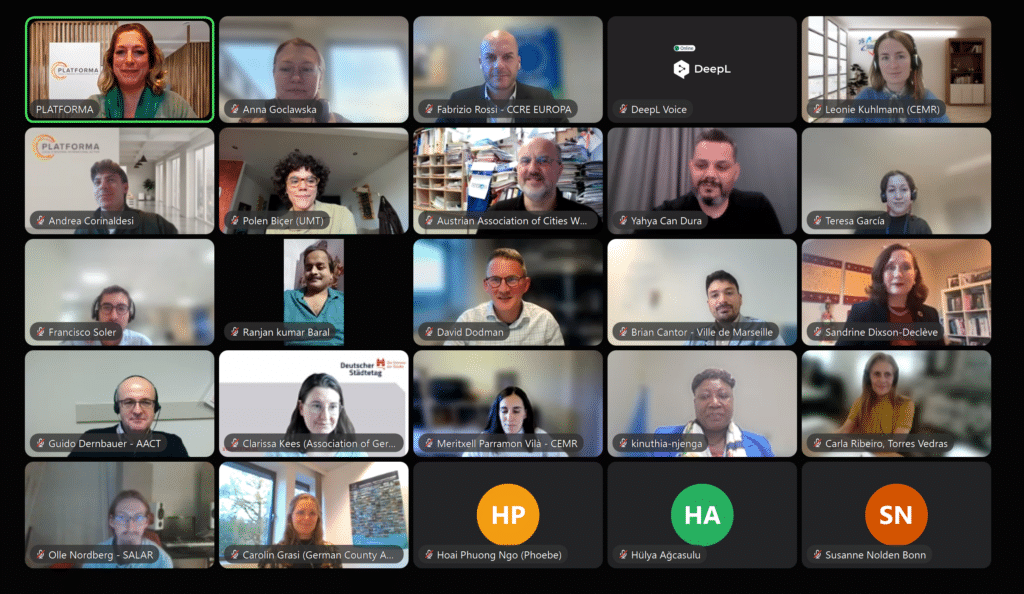
On 18 November 2026, CEMR and PLATFORMA held their second Town Hall COP, an online public webinar titled “Resilient cities for a changing climate: from COP commitments to local action”. Organised alongside COP31 in Antalya, Türkiye (9–20 November), the webinar focused on multilevel governance, adaptation, resilience and science as tools to fight climate change.

The Town Hall COP is a global initiative that helps local and regional governments connect their communities to national and international climate processes, with outcomes feeding into countries’ Nationally Determined Contributions.

An implementation COP, with a seat at the table still to be won

Opening the session, CEMR Secretary-General Fabrizio Rossi stressed that local and regional governments must be recognised as strategic partners in delivering climate ambition as the next cycle of climate commitments and future global stocktakes approach. The solutions are already known, he noted; the challenge is to unlock the enabling conditions to deliver them at scale: adequate climate finance, effective multilevel governance, access to innovation and technology, stronger institutional capacity and international cooperation.

Sandrine Dixson-Declève, Commissioner of the WHO Pan-European Commission on Climate and Health, set the scene by underlining that 2030 is “something really concrete,” within immediate reach. She called for explicit recognition of multilevel governance as essential to the climate transition and insisted that the transition must be fair. Local and regional governments, she stressed, are now in “the implementation and action game”, which means engaging with the actors who actually deliver change. She also raised hard questions about the architecture of the process: how to limit the influence of those blocking progress, such as the fossil fuel sector, how to move beyond consensus voting, and how to include towns, cities, regions and citizens in the feedback loop, alongside science through the Intergovernmental Panel on Climate Change (IPCC).

Cecilia Kinuthia-Njenga, Director for Intergovernmental Support, Collective Progress at the UNFCCC, offered a view from inside the negotiations. Governments have communicated more than 165 climate plans, she said, so “who delivers them?” is the question. Recognition of local and regional governments is growing, but “on a practical level not much has changed so far.” She identified three issues: the central role of national governments in implementation; the fact that cities and subnational authorities are named among non-party stakeholders contributing to progress, which amounts to recognition without a mandate; and calls for inclusive, multilevel and cooperative action. She also pointed to the gap between this and what local and regional governments have requested over recent COPs, including a common position endorsed by 80 networks and carried by the LGMA Constituency.

Adaptation and resilience: responsibilities need resources

Teresa García Perez, Policy Officer in the Environment Committee of the European Committee of the Regions and co-lead of the LGMA working group on adaptation, recalled that the Global Goal on Adaptation, set in Paris in 2015, still carries little influence. Discussions on indicators and on who provides the finance continue, and she considers the current draft weak because it does not address the role of subnational governments. The preamble should recognise local and regional governments, she said, and the second Global Stocktake should include both them and the scientific community.

Leonie Kuhlmann, Policy Officer on Climate and Energy at CEMR, turned to the EU level. The EU Climate Resilience Framework, she said, “gets the direction right”, with a common, preventive and territorial approach to adaptation, a scientific reference, and the inclusion of local and regional governments and nature-based solutions. Its main weakness is the gap between stronger planning and accountability requirements and the means available for local delivery. “Responsibilities assigned to local and regional governments must be matched by adequate powers, capacity and resources,” she said, adding that “cities and regions are where climate risks hit first. They must also be where resilience is built.”
What the science says about cities

David Dodman, Director of the Institute for Housing and Urban Development Studies (IHS) and a Coordinating Lead Author in the IPCC’s 5th to 7th assessments, highlighted the importance of cities in climate action: 195 governments have approved an IPCC Special Report on Climate Change and Cities in the 7th assessment cycle, due in 2027. Delay, he warned, risks an unprecedented, damaged world, whereas acting now can limit overshoot of 1.5°C, and our choices determine whether that overshoot lasts decades or millennia. Adaptation and mitigation are both urgent, mutually reinforcing and interdependent.

He described three challenges to be tackled in parallel: immediate response (addressing impacts and reducing emissions), coping and containment (managing risks and limiting peak warming), and long-term resilience (scaling adaptation and sustaining decline).

Youth and municipal perspectives

In the debate, Adam Ó Ceallaigh of the Irish Youth Delegation described how young people are working to match their actions to the promises of the Irish Presidency of COP, with phasing out fossil fuels at the top of the agenda. Young people in Ireland have pushed for the transition roadmap and are working to organise citizens’ assemblies to bring in young voices. He noted that Ireland is fortunate to have such a programme, while many countries have no equivalent.

Yahya Can Dura, Director of the Foreign Relations Department at the Union of Municipalities of Türkiye (UMT), welcomed the stronger voice of local and regional governments and shared findings from a survey of Turkish municipalities: finance was raised in 63% of responses, a lack of specialist staff in 41% and coordination with central government in 35%. The core idea of UMT’s position paper, he explained, is that local governments are not merely implementers but partners from the preparation of decisions to their financing and monitoring. New tasks must not be handed to municipalities without resources and capacity, and access to finance must not push them into unsustainable debt or exchange-rate risk.

Beyond COP31

Finally, closing the session, Boris Tonhauser, Director of PLATFORMA, highlighted the growing recognition of science and evidence-based policymaking. Climate governance, he said, does not begin or end at the COP: the road to the next round of national climate commitments, the next Global Stocktake and the post-2030 Agenda for Sustainable Development will require even stronger partnerships between local, regional, national and international actors.

The message from the Town Hall COP was consistent across speakers: recognition of local and regional governments is growing, but it must now translate into mandates, finance and capacity.

CEMR and PLATFORMA will continue to carry this message into the final days of COP31 and the processes that follow.

Watch the recording: https://youtu.be/22ArGbj7BEY

For more information, contact:

Call for proposals: RFSC project

Call for proposals: RFSC website and online tool

205 words
1–2 minutes

The Council of European Municipalities and Regions (CEMR) is seeking proposals from web agencies and independent developers to carry out a technical audit, hosting review, maintenance and technical support for the Reference Framework for Sustainable Cities (RFSC) website and online tool.

The assignment covers both the RFSC website, developed in WordPress, and the RFSC online tool, developed in a customised programming environment. The selected contractor will assess the current state of both platforms, identify technical issues and vulnerabilities, propose solutions and pricing packages, and support the long-term sustainability of these digital services.

What are we looking for?

We are looking for agencies or developers with proven experience in:

  • WordPress maintenance and support;
  • Website hosting and domain management;
  • Cybersecurity, backups and recovery solutions;
  • Technical audits and troubleshooting;
  • GDPR compliance and website governance.

The work will include a technical audit, recommendations for improvements, proposed maintenance and hosting solutions, and the implementation of agreed services.

How to apply

Interested applicants should submit a proposal including their profile, relevant experience, methodology, references and financial proposal.

Deadline: 27 November 2026
Email: communications@ccre-cemr.org
Subject: “Call for proposals – RFSC website and online tool”

Download the Terms of Reference: here

For more information, contact:

Local and subnational governments key messages for COP31

Cop 31 - Turkiye 2026

CEMR joins 80 networks and calls for COP31 to empower cities and regions as key drivers of global climate implementation

482 words
2–3 minutes

CEMR stands among the more than 80 networks of local and subnational governments that have endorsed the COP31 Position of the Local Governments and Municipal Authorities (LGMA) Constituency, the formally recognised voice of local, regional and subnational governments in the United Nations Framework Convention on Climate Change (UNFCCC) process.

Together, they represent tens of thousands of governments worldwide and share the same messages: the Paris Agreement will only be delivered through the engagement of all levels of government. They call for COP31 to empower cities, regions and states as key drivers of global climate implementation.

COP31 opens in Antalya (Türkiye) on 9 November, under new scientific reports that the planet is set to cross 1.5°C above pre-industrial levels within the next few years. The outcomes of COP will determine how high the peak goes, how long it lasts and who delivers the return trajectory to 1.5°C.

LGMA six calls

The COP 31 Position sets out six calls:

  1. Achieving an energy transition outcome that accelerates subnational delivery to return to the 1.5°C pathway;
  2. Prioritising an ambitious outcome on just transition to ensure national outcomes are rooted in local needs and realities and deliver tangible benefits that reach workers and communities at the local level;
  3. Institutionalising multilevel climate finance architectures that reach the subnational level, through country platforms, public development banks and funded project preparation;
  4. Continuing to uphold the key role of independent science in the COP process, including the forthcoming Intergovernmental Panel on Climate Change (IPCC) Special Report on Climate Change and Cities;
  5. Creating a single formal space for Parties and subnational governments to address the barriers to multilevel action;
  6. Accelerating the implementation of the Global Goal on Adaptation and National Adaptation Plans through integrated local action.

A Guidance for Negotiators accompanies the Position with proposed negotiating text on ten priority topics.

This LGMA Position serves as the basis for our interventions and advocacy leading up to and at COP31. It is integrated into the LGMA longer-term advocacy strategy towards COP32 and COP33.

Local leaders at COP31

A dozen local leaders representing CEMR members and PLATFORMA partners are heading to COP to defend the voice of local and regional governments in climate action.

Among others, they will attend several high-level events led by UCLG and the Global Task Force of local and regional governments, as well as by the LGMA.

On 12 November, CEMR and PLATFORMA are organising a side event on UCLG’s pavilion “From COP to 2030 and Beyond: Local and Regional Governments Building the Future of Climate Governance”.

CEMR and PLATFORMA are also organising a Town Hall COP online event on 18 November (15.00-15h30 CET) on “Resilient cities for a changing climate: from COP commitments to local action”.

Watch the video by Gary Robinson, CEMR spokesperson on environment, Councillor of Shetland Islands Council (COSLA).

For more information, contact:

75 years of CEMR

75 years CEMR event

Building Europe from the ground up: CEMR marks 75 years of empowering towns, cities and regions across the continent

1,210 words
5–8 minutes

Seventy-five years after European mayors and local leaders came together in Geneva to lay the foundations of what would become the Council of European Municipalities and Regions (CEMR), the organisation marked its anniversary with a forward-looking discussion on one central question: are Europe’s governance systems equipped to address the challenges of the future?

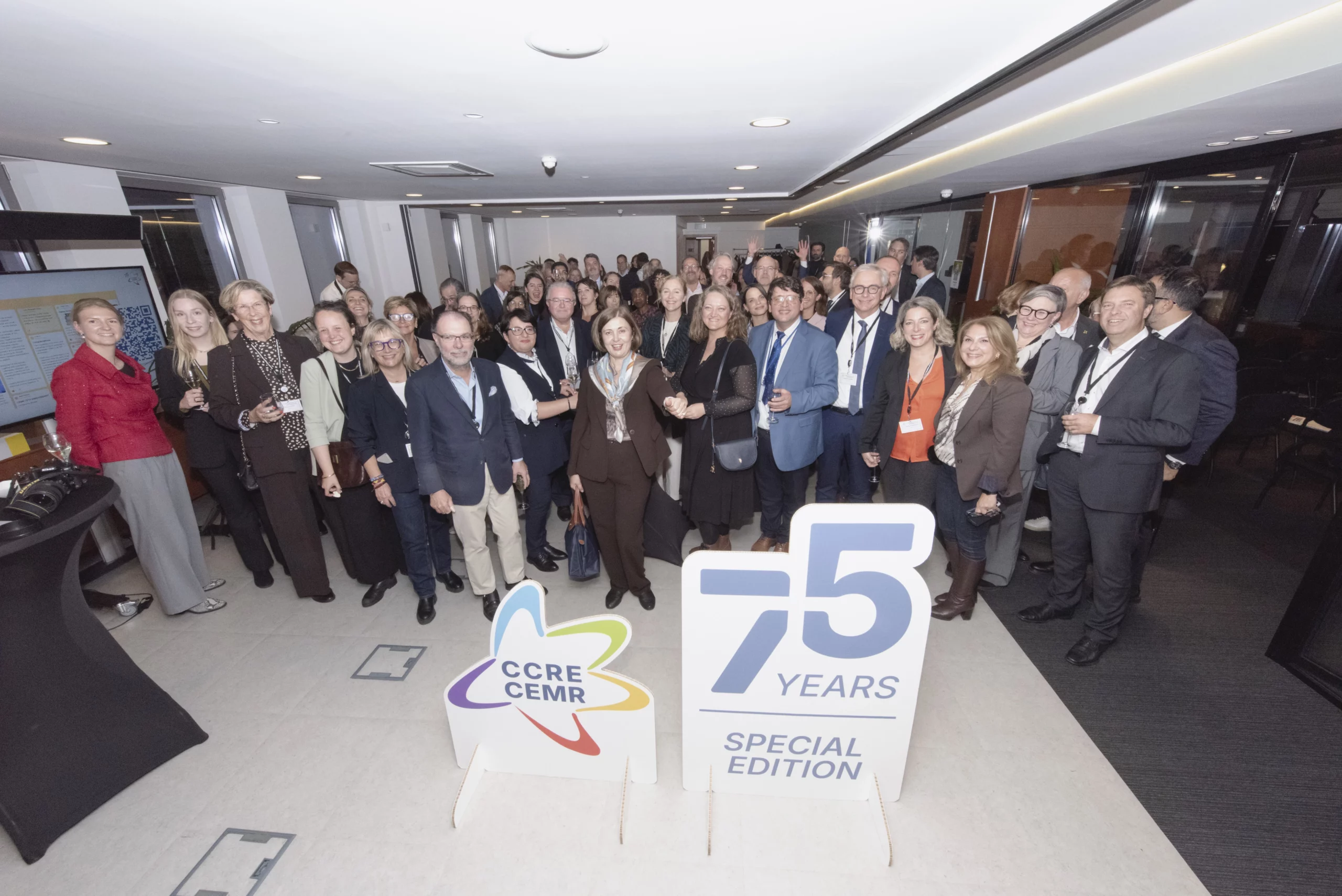
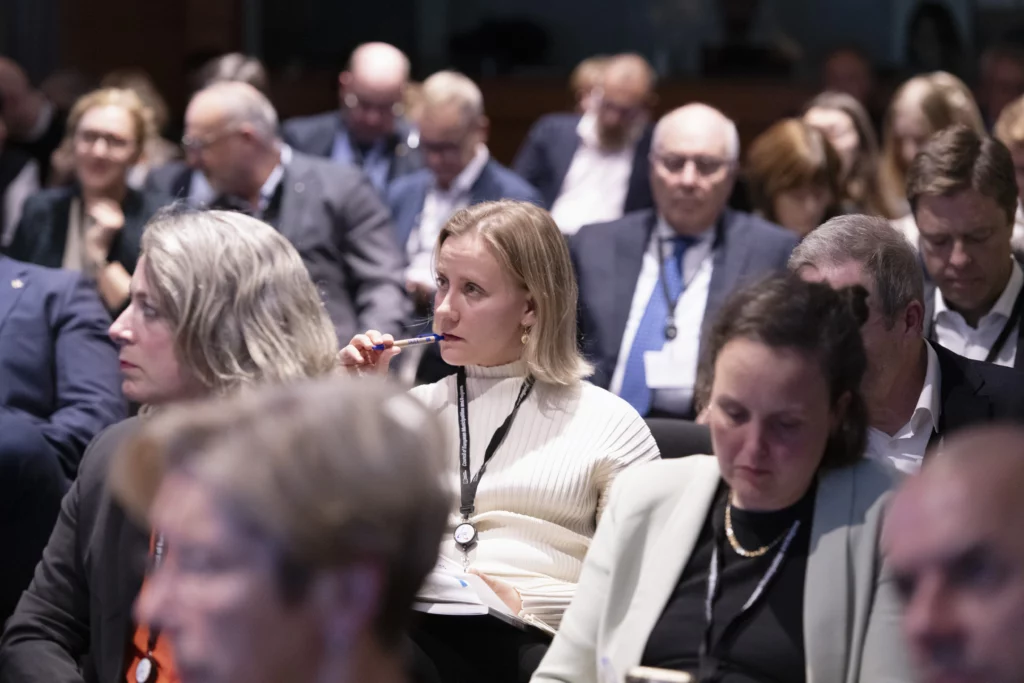
Bringing together more than 100 European, national, regional and local leaders, as well as experts and other stakeholders, the anniversary event combined a reflection on CEMR’s historic contribution to European integration with a debate on how local and regional governments can be empowered to respond to increasingly complex challenges, from competitiveness and demographic change to the housing crisis.

Moderated by journalist Esther Herrera, the event also marked the launch of the TERRI Report 2026, CEMR’s flagship publication on territorial governance. This year’s edition focuses on housing and highlights a broader shift in Europe’s governance debate: the key challenge is no longer who is responsible, but who has the capacity to deliver.

4 November 2026 - CEMR 75 years and TERRI Report event
4 November 2026 – CEMR 75 years and TERRI Report event

Local governments at the heart of Europe’s future

Opening the event, CEMR President Christoph Schnaudigel recalled the origins of the organisation in the aftermath of the Second World War and emphasised the enduring importance of cooperation between levels of government.

Throughout the afternoon, speakers repeatedly returned to a common theme: Europe increasingly relies on local and regional governments to deliver solutions, yet too often these authorities are asked to do more without receiving the corresponding resources, capacity or influence in decision-making processes.

Karen Maguire, Head of the Regional Development and Multilevel Governance Division at the OECD, highlighted the growing pressures facing towns, cities and regions across the world. Local governments are not only managing a wider range of responsibilities, she argued, but are also confronting increasingly complex and interconnected challenges. From demographic change and housing shortages to climate adaptation and economic transformation, many municipalities, particularly smaller ones, struggle to mobilise the expertise and capacity required to respond effectively.

Karen Maguire, Head of the Regional Development and Multilevel Governance Division at the OECD - 75 years and TERRI Report event
* Karen Maguire, Head of the Regional Development and Multilevel Governance Division at the OECD at the CEMR 75 years and TERRI Report launch event, 4 November 2026

Governance reforms must strengthen capacity, not shift pressure

A recurring message from local leaders was that governance reforms should aim to strengthen local governments rather than simply transfer responsibilities between levels of administration.

Participants stressed that local and regional governments need sufficient financial autonomy, administrative capacity and qualified staff if they are to successfully deliver on European priorities. These concerns closely reflect one of the TERRI Report’s 2026 key conclusions: governance capacity is becoming one of Europe’s most important public policy challenges.

The discussion also highlighted the importance of intermunicipal cooperation, particularly for smaller towns. Examples from Flanders, Austria and Moldova demonstrated how cooperation across administrative boundaries can help local governments deliver services more effectively and address challenges that exceed the capacity of individual municipalities.

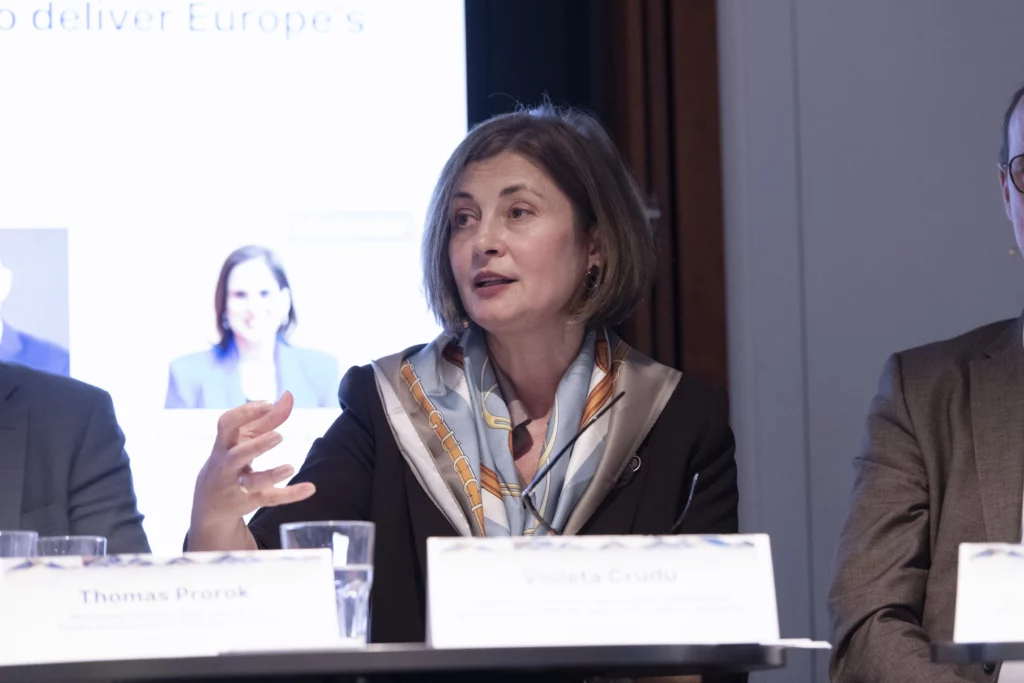
Sharing Moldova’s experience, Violeta Crudu, Mayor of Chisnau municipality and President of the Network of Women Mayors of the Congress of Local Authorities (CALM), explained how cooperation between municipalities has helped address difficult issues such as waste management, illustrating the practical benefits of working together at the territorial level.

Violeta Crudu, Mayor from Chisnau municipality and President of the Network of Women Mayors of the Congress of Local Authorities at the CEMR 75 years and TERRI Report launch event
* Violeta Crudu, Mayor from Chisnau municipality and President of the Network of Women Mayors of the Congress of Local Authorities at the CEMR 75 years and TERRI Report launch event, 4 November 2026

A stronger local role in the next EU budget

One of the most anticipated discussions focused on the future of the EU budget and the proposed National and Regional Partnership Plans (NRPPs).

Declan Costello from the European Commission’s SG REFORM outlined the Commission’s objective of simplifying funding structures, reducing administrative burdens and creating a more integrated approach to investment and reform. He argued that the proposed framework could offer greater flexibility and improve the effectiveness of public spending for all the regions across Europe. “The Commission has proposed a quite practical approach for the next EU budget and although it will be up to each Member State if they want to have regional chapters, we are open to engaging in direct negotiations with regional authorities in a flexible way”, he stated.

Local government representatives voiced clear concerns regarding the next EU budget.

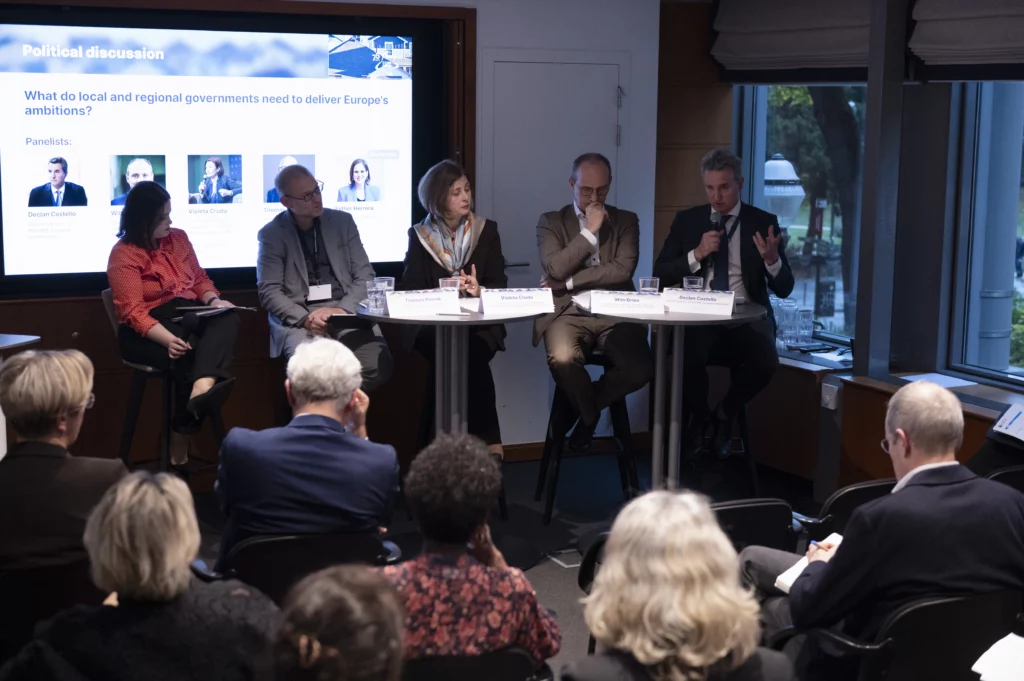
Wim Dries, Mayor of Genk (Belgium) and President of the Association of Flemish Cities and Municipalities (VVSG), delivered a direct message on behalf of local and regional government associations across Europe, arguing that towns, cities and regions must be involved in shaping the priorities of the next EU budget and have meaningful access to competitiveness funding. Several speakers warned that without strong local involvement, Europe risks missing opportunities to maximise the impact of investment on the ground.

CEMR 75 years and TERRI Report launch event - Speakers
* CEMR 75 years and TERRI Report launch event – Speakers

Housing as a test governance

The second part of the event focused on housing, the central theme of the new TERRI Report.

Speakers agreed that housing has moved beyond being a purely local issue and has become a concern across Europe. Affordability pressures, demographic change and social inequalities are affecting territories of all sizes, from major cities to rural areas.

According to the TERRI Report 2026, housing provides one of the clearest examples of the gap that can emerge between political ambition and delivery capacity. While towns, cities and regions are increasingly expected to address affordability pressures and housing shortages, many of the key policy levers remain at national level. Across Europe, different housing systems are facing remarkably similar constraints, including financing difficulties, planning pressures and limited administrative capacity.

Christian Lamouline, Mayor of Brechem-Saint-Agathe (Belgium) and President of Brulocalis, described the growing pressures on housing affordability in Brussels and stressed the importance of combining housing policy with transport, public services, education and urban planning. Creating liveable communities, he argued, requires a coordinated approach rather than isolated policy interventions.

For Francesco Amodeo from the European Commission’s Task Force on Housing, housing illustrates why multilevel governance matters. While responsibilities are distributed across different levels of government, citizens experience the consequences regardless of which authority formally holds competence. He stressed that Europe’s response must involve all relevant actors, from local and regional governments to the construction sector, housing cooperatives and financial institutions.

Several speakers pointed to the need for long-term solutions that extend beyond political cycles and electoral mandates. One of TERRI’s Report 2026 key messages is that housing cannot be considered in isolation. Housing markets are increasingly interconnected with labour mobility, transport systems, demographic change, climate objectives and territorial development. As a result, effective solutions depend on coordination across sectors and levels of government, reinforcing the wider message that multilevel governance remains essential to addressing Europe’s most pressing challenges.

CEMR 75 years anniversary and TERRI Report event - 4 November 2026
* CEMR 75 years anniversary and TERRI Report event – 4 November 2026

Looking ahead

As the event concluded, participants reflected on the lessons that local democracy can draw from the past 75 years.

Whether discussing housing, competitiveness, territorial cohesion or public administration reform, the same conclusion emerged: effective governance depends on trust, cooperation and strong partnerships across levels of government.

Seventy-five years after its creation, CEMR’s founding conviction remains unchanged: Europe’s future will continue to be built from the ground up through strong local democracy, effective multilevel governance and empowered local and regional governments.

For more information, contact:

Peer exchange on EU Enlargement

LORAI project event

Local voices shaping European choices: CEMR hosts its first peer exchange on enlargement

1,548 words
7–10 minutes

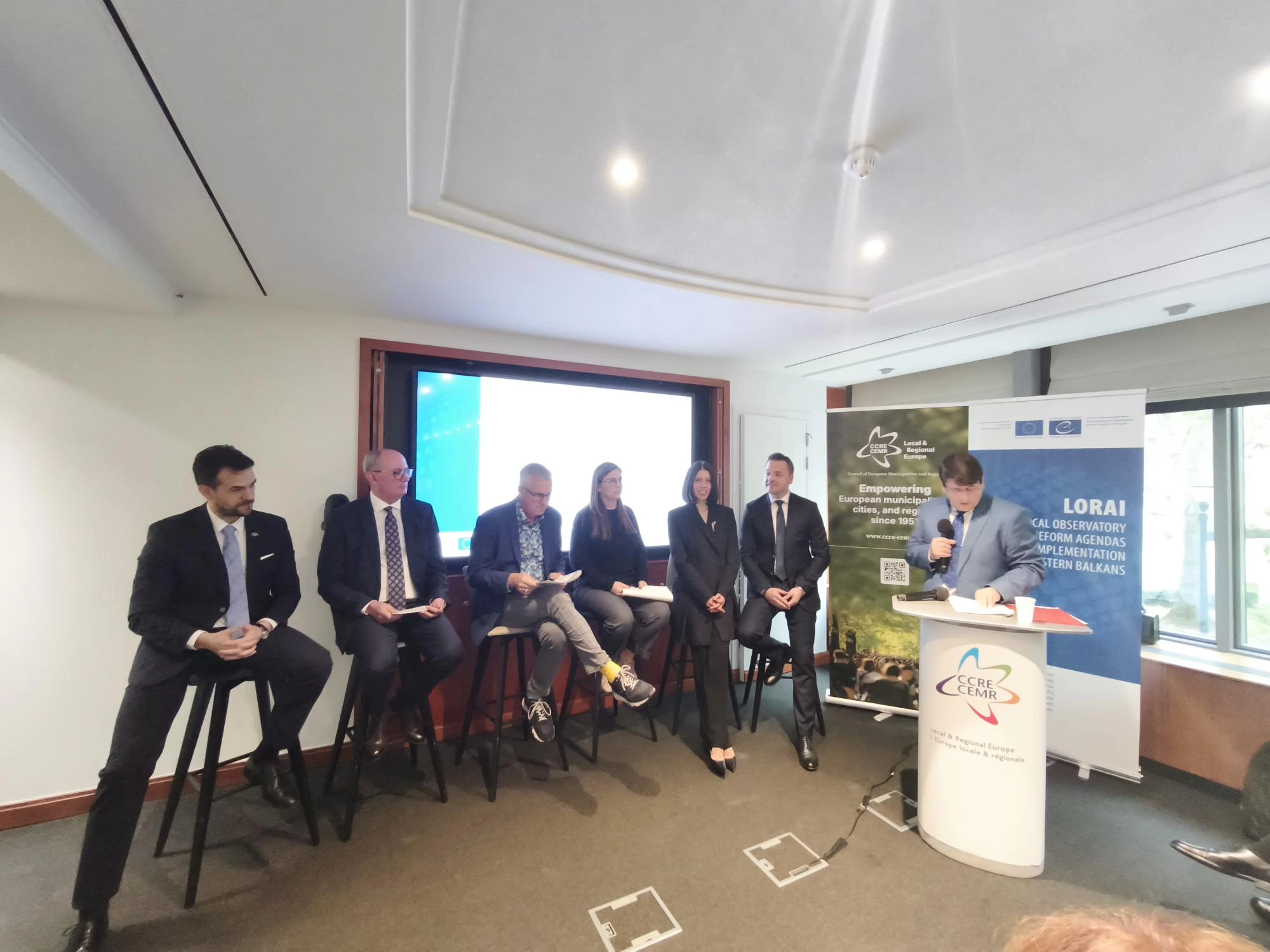
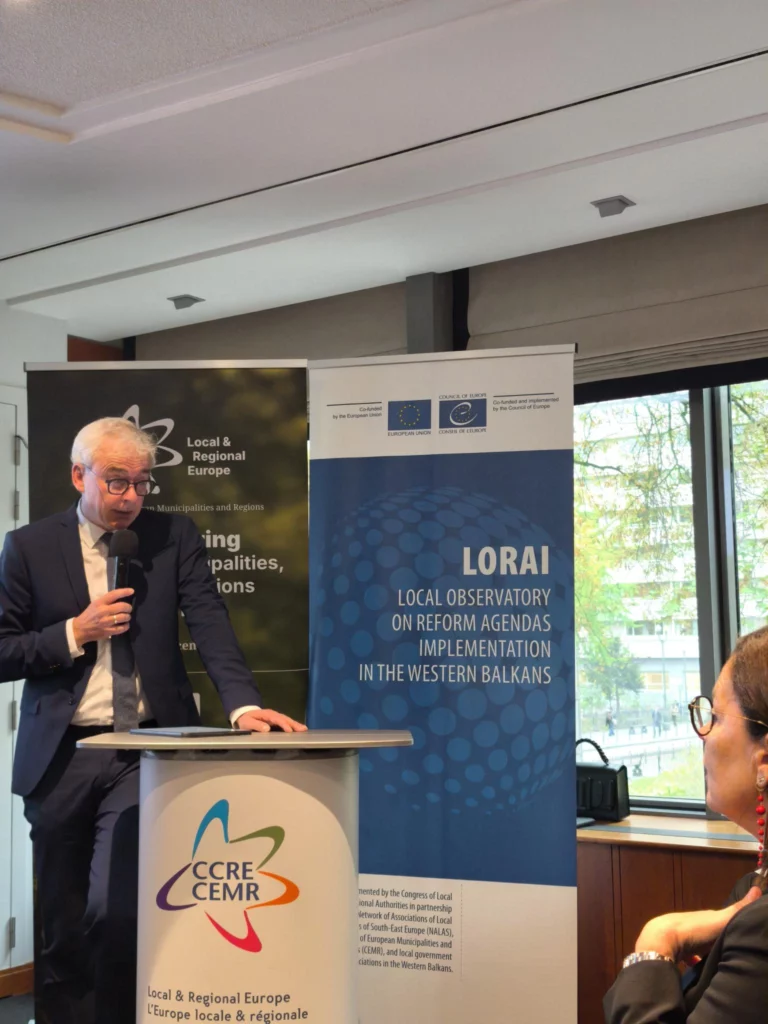
On 4 November 2026, the Council of European Municipalities and Regions (CEMR) brought together mayors, local government associations, national and EU officials in Brussels for a Peer Exchange on Enlargement, “Local voices shaping European choices”. The event took place at CEMR’s office and was organised under the programme Local Observatory on Reform Agendas Implementation (LORAI).  

The event was organised by CEMR under the EU–Council of Europe joint programme LORAI – Local Observatory on Reform Agendas Implementation in the Western Balkans, which aims to strengthen local authorities’ role and capacity to contribute to the implementation and monitoring of Reform Agendas under the EU’s Reform and Growth Facility, a key element in the region’s progress towards EU accession.  

Why local governments matter for enlargement 

Enlargement has regained strong political momentum, driven by geopolitical change, security concerns and hybrid threats. Yet a faster accession process also raises questions: Are candidate countries ready? Can they absorb EU funds effectively? Can reforms be sustained over the long term, leaving no one behind? 

CEMR’s answer is that the road to the European Union does not run only through national capitals. It also runs through towns, cities and regions, where reforms become visible in people’s everyday lives, from public services and infrastructure to local democracy.  

A programme built around local delivery 

CEMR Secretary-General, Fabrizio Rossi, opened the event with the words: “When we speak about a larger Europe, we speak about a Europe in which every community, every municipality and every country can find its place, contribute its strengths and share common values. The sustainability of enlargement depends on creating opportunities for all Europeans to sit at the same table.” 

Gunn Marit Helgesen, the President of the Congress of the Council of Europe, amplified that ”to join the EU, candidate countries must meet certain standards, but too often between these criteria we forget the fundamental truth that democracy is built from the bottom up, not the other way around.” She added that”democracy cannot be rebuilt without citizens’ trust.” 

Christoph Schnaudigel, CEMR President and President of the County of Karlsruhe (Germany), emphasised that “the road to the European Union does not pass only through national capitals. It also runs through cities, towns and regions. Municipalities are not only implementing reforms; they help make them meaningful and visible in people’s everyday lives.” 

Finally, Valentina Superti, Director of the Western Balkans Sector DG ENEST of the European Commission, said that “LRGs have an important role to play in this EU enlargement and geopolitical efforts; to implement EU policies effectively, they need to be equipped with the right administrative and financial capacities and have ownership”.  

The introduction to LORAI programme before the first panel was led by Dušan Raičević, Mayor of Bar, Montenegro, amplified that “to make reforms more inclusive and responsive to citizens’ needs, the citizens need to take active participation in the process. By investing in stronger local institutions, we invest in a stronger Montenegro and a stronger Western Balkans”.  

He recognised that ”for Montenegro, the EU accession is a strategic priority and an opportunity to strengthen democracy, support sustainable development and improve citizenship. ” 

Irina Sahakyan Vetter, Head of Unit, Institutional Partnerships, Congress of Local and Regional Authorities, explained the aim and role of the LORAI programme.  

The programme “is built on two pillars: two complementary areas of work. The first one is the monitoring and evidence gathering. It aims to improve information on the local impact of reform agenda implementation and strengthen local authorities’ participation in the monitoring processes”, she stressed.  

“Under this pillar, the program will develop a dashboard to monitor the local impact of the reforms, and we are in the process right now of developing the regional-level and beneficiary-specific indicators”, she added.  

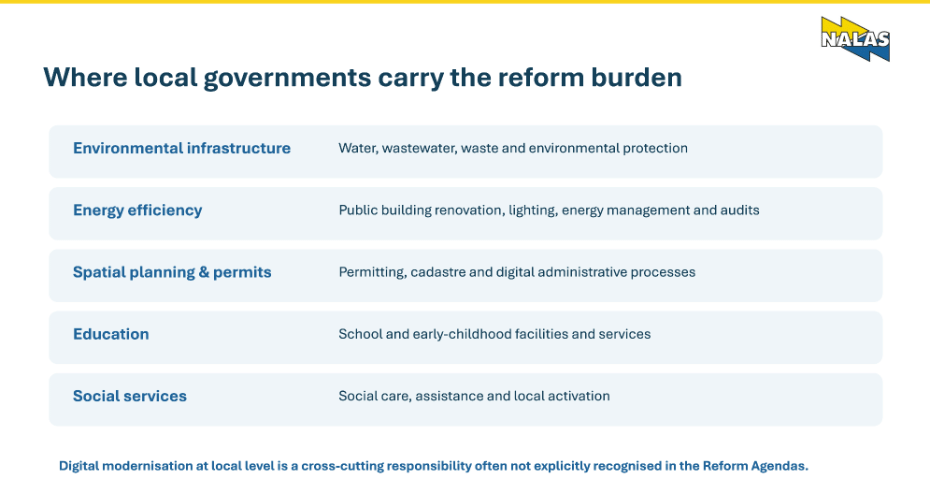
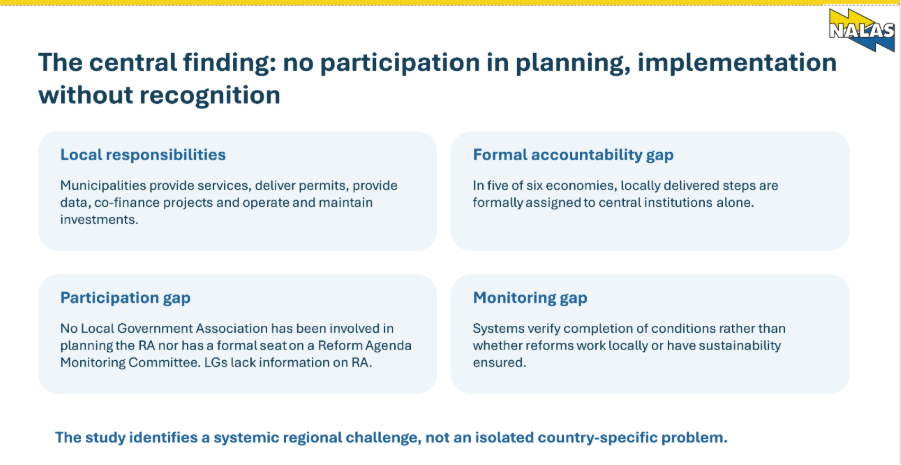
Finally, Jelena Janevska, the Programme Director of NALAS, presented a regional baseline study on Involvement of the Local Authorities in the Western Balkans Reform Agenda and Growth Facility.  

Green transition – the first challenge on the path to EU enlargement 

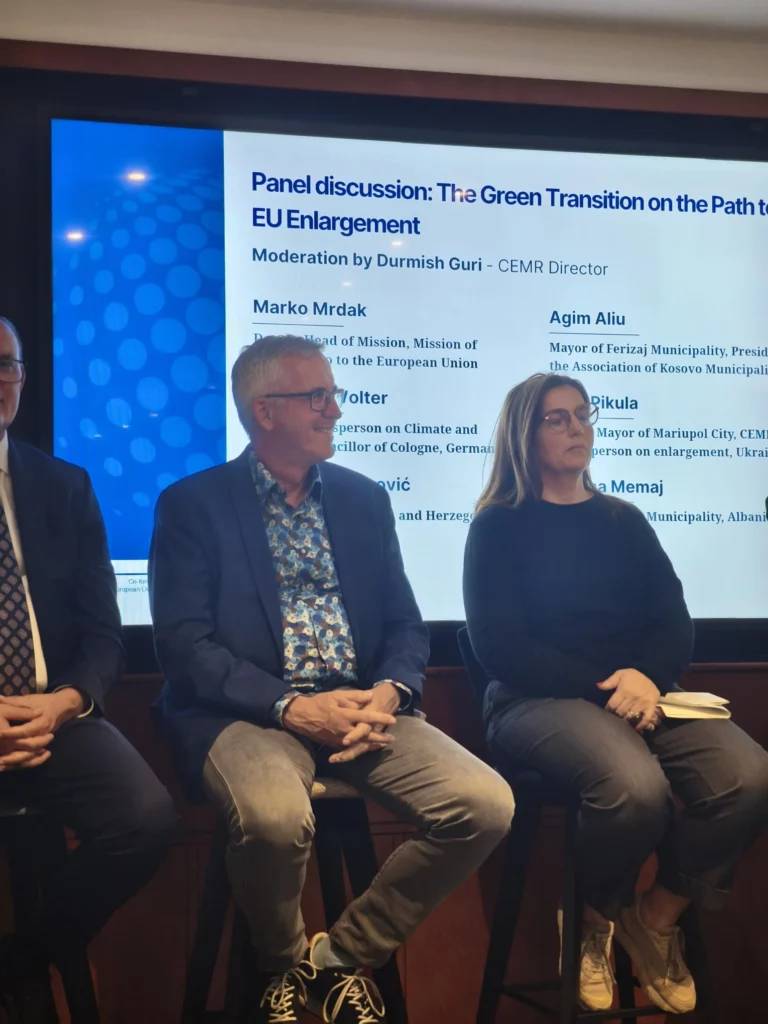
The first panel, the green transition on the path to EU enlargement, looked at how municipalities deliver policies at the heart of the EU Green Deal, from waste and water management to energy efficiency, sustainable mobility, spatial planning and climate adaptation, and what support they still need. The panel moderator, Durmish Guri, CEMR Projects Director, mentioned that “municipalities and regions are not only beneficiaries of the accession process, but essential partners in implementing the reforms needed for EU membership.” 

Marko Mrdak, Deputy Head of Mission of Montenegro to the EU, stressed that “because of the narrow deadlines, local and regional governments are not always consulted as they should be, but their role is important if we want an efficient implementation of the acquis Communautaire.” 

Agim Aliu, Mayor of Ferizaj Municipality, President of the Association of Kosovo Municipalities, added that Kosovo “has implemented a range of projects related to energy efficiency across the local and regional institutions.” 

Andreas Wolter, the CEMR Spokesperson on Climate and Energy and Councillor of Cologne, said that “local governments must be recognised not only as implementers, but as strategic partners in shaping Europe’s green transition. Municipalities and regions should be involved from the beginning in designing climate and energy policies, not only in implementing them.” 

Juliana Memaj, Mayor of Dimal, Albania, presented the case of her town, which “carried out interventions to protect the town from the flow of the Osum River, helping to prevent floods, protect the community, and increase resilience to climate risks.”  

“We have developed projects to improve the energy efficiency of buildings, with a total value of around 1 million euros, aiming to reduce energy consumption and improve public infrastructure”, she added.  

Milan Vukadinović, Mayor of Foča, Bosnia and Herzegovina, also followed with a regional example: “Our territory is home to Sutske National Park, the oldest national park in Bosnia and Herzegovina. Preserving these natural assets is not only a development priority for us, but also an obligation towards future generations.” 

Finally, Olha Pikula, Councillor of Mariupol, Ukraine and CEMR spokesperson on EU enlargement, ended a session saying that ”we are still managing to progress on the EU accession despite the ongoing war. The biggest challenge remains in the translation of the EU commitments on the ground.”  

She emphasised that Ukraine is using sustainable approaches. To do so, “we need three pillars; 

1. Interconnection between the state, regional and local levels. 

2. EU standards should be equal in every state but need to be tailored to every country. For instance, in Ukraine, not every community is ready now to implement, for instance, the EU Climate agenda. 

3. We need to have peer-to-peer learning, experience exchange, and the supervision of the projects.” 

Brain drain reduction – second challenge to the EU enlargement 

The second panel, Local economic development as a tool to reduce brain drain, looked at how municipalities can create conditions for people to stay, return and invest locally, in the context of demographic decline and the upcoming European Commission Right to Stay strategy.  

The debate was moderated by Marine Gaudron, CEMR Advisor on Territorial Cohesion and Local Finances, who emphasised that “competitiveness should be developed across all territories, not only in capital cities and metropolitan centres. Investments in connectivity, digitalisation, local infrastructure, entrepreneurship and skills are essential to ensure that all communities can benefit from growth and development.” 

Inga Vismantienė, Vice Mayor of Akmenė, Lithuania, emphasised that “people do not stay in the region simply because they were born there. They stay because they see the opportunities there. The future cannot be built by stopping people from leaving but rather by giving people opportunities to develop. ” 

Edi Majstorović, Association of Towns and Municipalities of Serbia (SCTM), stressed that “the new generation has a different understanding of the quality of life. They want a meaningful life; that’s why they don’t want to stay in smaller municipalities. Our major driver is creating new workplaces for 10 years and building the infrastructure, and we did it, and we had results.” 

Irina Luncasu, Congress of Local Authorities from Moldova (CALM) expert from Moldova, shared the discovery that “have acknowledged that our diaspora can be transformed into the biggest partner of Moldova. We managed to get them involved in the local economic development.” 

Finally, Erna Merdić, Mayor of Zavidovići from Bosnia and Herzegovina, stressed that ”at least 80% of the perception of the cities and how the state is successful and how government and public services are successful is through the local level.” 

What comes next 

The meeting closed with an outlook on LORAI activities. CEMR will help local officials turn reforms into investment roadmaps that can feed into the next Multiannual Financial Framework (MFF), through MFF Labs, country workshops starting with Albania in December 2026 and continuing in Montenegro, North Macedonia, Serbia, Bosnia and Herzegovina and Kosovo*. 

The next peer exchange on enlargement will be held at the CEMR Congress in Cluj-Napoca, Romania, on 7–9 June 2027. 

This document was produced with the financial assistance of the European Union and the Council of Europe. The views expressed herein can in no way be taken to represent the official opinion of the European Union or the Council of Europe.  

* This designation is without prejudice to positions on status and is in line with UNSCR 1244/1999 and the ICJ Opinion on the Kosovo Declaration of Independence. 

For more information, contact:

CEMR TERRI Report 2026

Terri Report 2026 - Housing

TERRI 2026 report looks at how Europe’s territorial governance is changing and why it matters

644 words
3–4 minutes

The Council of European Municipalities and Regions (CEMR) has published the TERRI 2026 Report, its latest assessment of territorial governance and reform trends. Drawing on evidence from CEMR member associations, the report examines developments in territorial organisation, governance arrangements, local and regional responsibilities, inter-municipal cooperation, fiscal capacity and housing governance. The central finding of TERRI 2026 is that effective governance is no longer defined by how institutions are structured. This edition focused on housing challenges in Europe.

Governance change is happening in how systems work, not in their structures

Since the first TERRI report in 2021, the focus of reform has shifted away from redrawing boundaries and restructuring territories towards improving how governance works in practice. Across Europe, efforts are increasingly centred on strengthening administrative capacity, enhancing coordination between levels of government, and delivering better outcomes for citizens

Shared responsibilities and growing cooperation

The distribution of formal responsibilities has remained broadly stable across much of Europe, although respondents in several countries reported examples of recentralisation or growing national influence over local decision-making. Delivery, however, increasingly relies on shared arrangements between national, regional and local governments, so how responsibilities work in practice matters more than the centralised/decentralised divide.

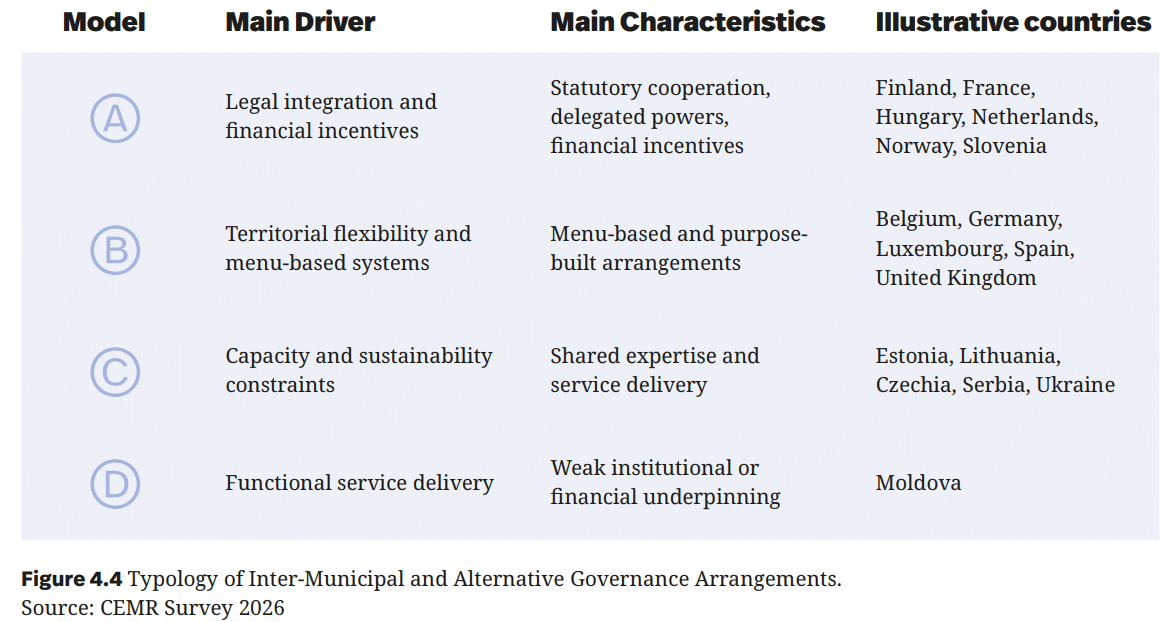
Cooperation is now mainstream: more than four-fifths of responding countries reported inter-municipal or alternative arrangements, increasingly covering areas such as spatial planning, economic development, social services, investment coordination and resilience preparation.

Capacity and financing remain critical challenges

Respondents to CEMR’s survey repeatedly pointed to administrative expertise, workforce capability and organisational resources as key determining factors for implementation. Performance depends as much on delivery capability as on institutional design. Fiscal pressures remain a key challenge, with many respondents highlighting the difficulty of balancing growing responsibilities with adequate resources, investment needs, and predictable long-term funding.

[on page 46 in PDF]

Housing: a test case for territorial governance

Housing is putting governance systems across Europe to the test. Affordability pressures, housing shortages, ageing stock and sustainability requirements are testing the ability of governments at all levels to respond effectively. The report finds that no single governance model guarantees better outcomes; success depends on how governance arrangements, financing, local flexibility and implementation capacity work together.

 CEMR sets six policy messages

  1. Align responsibilities with resources. New or expanded responsibilities should come with sufficient, predictable funding: funding follows function.
  2. Put governance capacity at the centre of reform. Invest in skills, expertise, and institutional capability as a core part of reform.
  3. Promote multi-level governance based on partnership. Support European, national, regional and local governments in working together while respecting local autonomy, rather than pursuing centralisation or decentralisation for its own sake.
  4. Strengthen place-based approaches. Give local and regional governments the flexibility to adapt policies to local circumstances rather than imposing uniform solutions.
  5. Strengthen long-term capacity and fiscal sustainability. Support multi-annual financing, long-term investment planning, and greater fiscal predictability.
  6. Recognise housing as a strategic governance issue. Rather than promoting one model, strengthen the conditions for success: clear responsibilities, predictable financing, local flexibility, implementation capability and coordination across levels of government.

Towards better-functioning decentralisation

The report concludes that Europe does not need a single model of territorial governance. The challenge is not more or less decentralisation, but ensuring that arrangements support effective local self-government, policy delivery and democratic accountability. This also matters for the Sustainable Development Goals, many of which depend on local and regional governments turning objectives into results.

Successful policy outcomes depend on all tiers of government working together through governance arrangements that are capable, coordinated and responsive to territorial needs.

TERRI 2026 provides a timely snapshot of how these challenges are evolving across Europe, and CEMR will continue to work with its members and partners to ensure that local and regional perspectives help shape the governance solutions of tomorrow.

For more information, contact: