European cohesion 

European cohesion - News 2023

Promoting European cohesion at the local level: The Emperor Maximilian Prize Application is calling Young Europeans


The Emperor Maximilian Prize celebrates outstanding achievements from all sectors in the field of European cohesion. This year’s edition focuses on youth, beacon projects that inspire young people to shape their own future. Candidates for the 2023 edition are invited to submit their application by 20 April.

The Emperor Maximilian Prize is open to citizens from the 27 member countries of the EU and/or the 46 member countries of the Council of Europe. Their initiatives should contribute to strengthening European cohesion and implement local best practices that are transferable to other communities. Candidates are invited to submit their project by 20 April 2023 on the online platform.

The jury is composed of representatives from five institutions, among which the Council of European Municipalities and Regions (CEMR). Fabrizio Rossi, the Secretary General of the Council of European Municipalities and Regions commented: “We are honoured to have been a part of this event since 1999 as it is both a celebration and a reinforcement of endeavours towards a deeper European integration”.

During the month of May, the jury will convene to assess the submitted projects and initiatives, on the basis of various criteria, including sustainability, creativity and visibility.

The winning project will receive the Emperor Maximilian Prize during a prestigious ceremony taking place in the city of Innsbruck in November. Winners will be awarded a cash prize worth €10,000 as a financial contribution to their exceptional initiative, a certificate, and a medallion of Emperor Maximilian I from 1509.
For more information on eligibility and selection criteria, consult the official “Guide for Applicants”.

About the Prize

The Emperor Maximilian Prize is a biannual European award. It was created in 1997 by the City of Innsbruck and the Region of the Tyrol in honour of the long-time mayor of Innsbruck, Alois Lugger. The prize aims to reward regional and local initiatives that embody the European unification process as outstanding examples of solidarity and sustainable efforts.

In 2021, the “#EuropagegenCovid19 / #EUmythbusters” project, which fought against disinformation about Covid with humorous and educational online content, was awarded for its contribution to European integration.

The 2023 edition’s expert jury will consist of representatives from the City of Innsbruck, the Region of the Tyrol, the University of Innsbruck, the European Committee of the Regions, the Congress of Local and Regional Authorities, the Assembly of European Regions, and the Council of European Municipalities and Regions.

Contact info

+43 512 5360 2357
kaisermaximilianpreis@innsbruck.gv.at

EU Enlargement

EU Enlargement - News

Towards a new EU strategy for enlargement


The EU needs to step up the involvement of local and regional authorities of EU Member States and candidate countries in the accession process, states a European Parliament’s report on the new EU strategy for enlargement. It was presented by MEP Tonino Picula at the plenary session in Strasbourg on 22 November. 

During the debate, the Croatian MEP emphasised that in the situation of the Russian invasion of Ukraine, expansion must gain new momentum, be predictable and believable, “as the single most effective EU instrument for securing peace, prosperity and fundamental values on the European continent.”

The rapporteur Mr Picula also added that each candidate for membership must be evaluated according to progress in reforms, especially when it comes to the rule of law, and the judiciary, and that EU support funds should be accessible to candidates for membership before they become full members of the Union.

Regarding Eastern Partnership countries, the Report welcomes the European Council’s exceptionally swift decision on the EU membership applications of Ukraine, the Republic of Moldova and Georgia and calls upon the Commission and the Council to continue to provide them with political and technical support, while stepping up the involvement of local and regional authorities in the accession process.

Similarly, it invites the authorities of the three countries to unambiguously demonstrate their political determination to realise the European aspirations of their people by making significant progress on substantial reforms to effectively fulfil the criteria for EU membership as soon as possible. Focus is in particular on the independence of the judiciary, the fight against corruption, democratic oversight, human rights and “de-oligarchisation”.

Finally, it is stressed that the facilitation of these countries’ transitions from the Eastern Partnership to the enlargement framework would require the switchover from the NDICI – Global Europe instrument to the Instrument for Pre-accession Assistance (IPA). However, such a transition should be accompanied by a sufficient increase in the overall budget of IPA III in order to retain funding for current IPA III beneficiaries.

CEMR projects overview  

CEMR’s externally funded projects foster cooperation, innovation, and sustainability across Europe 


Through its externally funded activities, the Council of European Municipalities and Regions (CEMR) brings local and regional leaders together to exchange ideas, test solutions, and build stronger communities. These projects are more than initiatives: they are platforms where municipalities and regions collaborate on Europe’s most pressing challenges, from climate action to equality, from digitalisation to democratic participation. 

Overview of Projects 
CEMR’s portfolio of externally funded projects reflects its commitment to innovation, sustainability, and inclusion: 

  • Reference Framework for Sustainable Cities (RFSC) – Supporting sustainable cities with a practical tool to plan and assess policies. 
  • IncluCities – Advancing migrant integration through peer learning among municipalities. 
  • Circular Cities and Regions Initiative (CCRI) – Driving circular economy solutions for cities and regions. 
  • Green City Accord – Helping European cities commit to ambitious environmental goals. 
  • Covenant of Mayors – Uniting local leaders in climate and energy action. 
  • PLATFORMA – Strengthening international partnerships and decentralised cooperation. 
  • Bridges of Trust – Building ties between Ukrainian and European municipalities. 
  • EPSU (Local Digital) – Supporting local administrations in navigating digital transitions. 
  • EPSU (Third-Party Violence) – Tackling violence against public service workers. 
  • Go.Li.EU – Promoting youth engagement and European citizenship. 

Together, these projects illustrate how CEMR channels external resources into meaningful action. By bridging local realities with European priorities, they not only empower municipalities and regions but also shape a more sustainable, inclusive, and resilient future for all. 

Read the study here 

For more information, contact: 

Territorial leaders in action at the COP 27

Climate - News Section

10 key points to prevent the inexorable march toward utter climate disaster


It’s now or never. We must gear up for climate action and advance the Sustainable Development Goals on the ground. This is the core message that PLAFTORMA and CEMR will bring to the COP27 taking place in Sharm El-Sheikh, Egypt.

In a joint position, PLATFORMA and CEMR put forward 10 key points for delegates and representatives from the UN, the EU and national governments who will sit around the COP27 negotiation table. Among the important points raised in the position are the need for a supportive regulatory and governance framework to implement subnational climate action, and the need for sustainable subnational financing.

Read the position paper

For more information, contact:

International Partnership

International Partnership - News 2022

Local government leaders renew their partnerships with the EU to boost international development


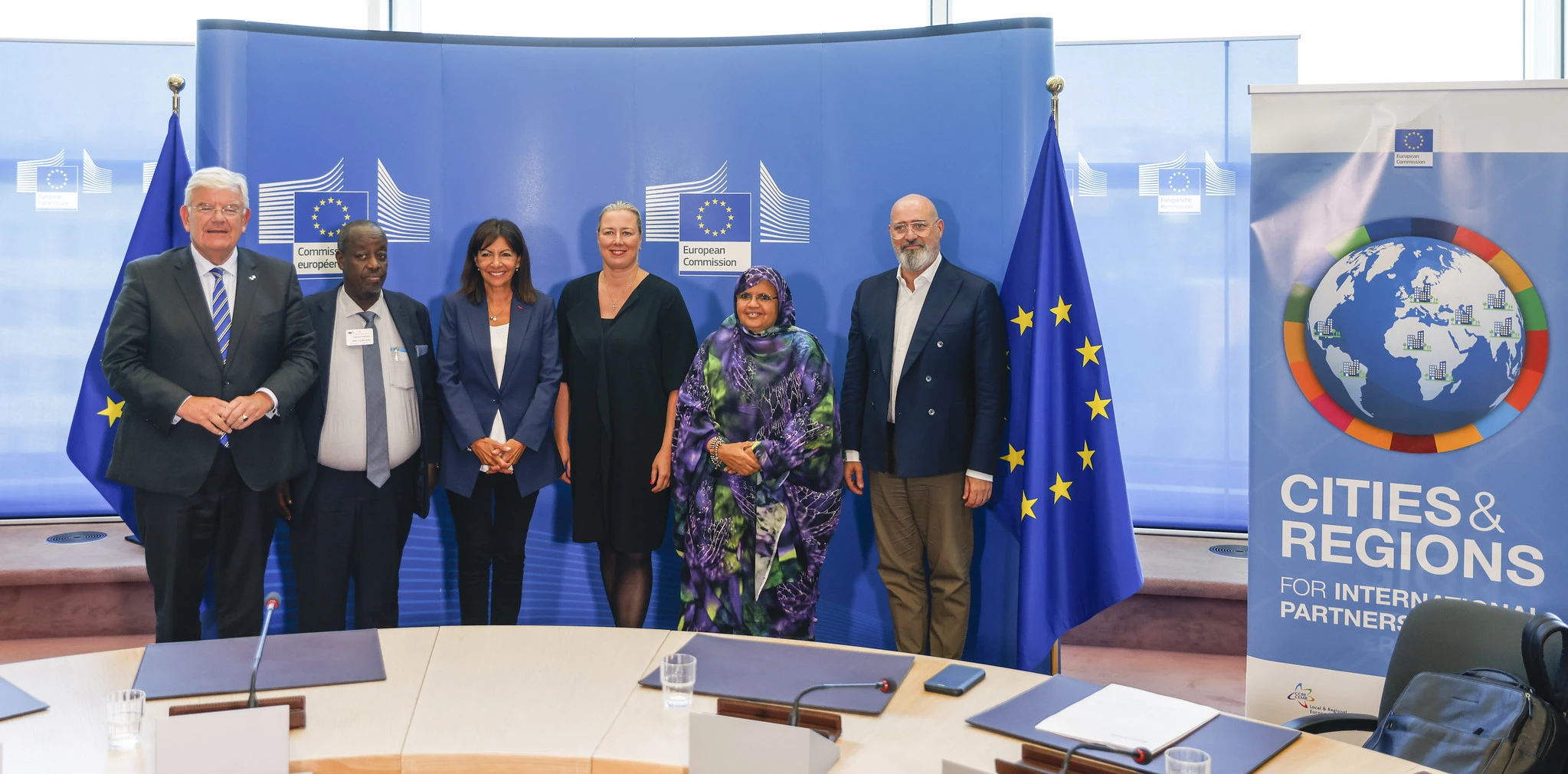
The presidents of the five largest associations of local and regional governments met yesterday (September 12, 2022) in Brussels with Jutta Urpilainen, European Commissioner for International Partnerships, to renew their partnership with the European Union on international development.

The five local government leaders present were:

  • Anne Hidalgo, Mayor of Paris (France), President of the International Association of Francophone Mayors (AIMF)
  • Stefano Bonaccini, President of the Emilia-Romagna Region (Italy) and President of the Council of European Municipalities and Regions (CEMR) & PLATFORMA
  • Innocent Uwimana, President of the Rwanda Association of Local Government Authorities (RALGA) and Board member of the Commonwealth Local Government Forum (CLGF)
  • Jan van Zanen, Mayor of The Hague (Netherlands), Chair of the Board of United Cities and Local Governments (UCLG)
  • Fatimetou Abdel Malick, President of the Regional Council of Nouakchott (Mauritania), President of United Cities and Local Governments – Africa (UCLG-A)

The five presidents signed new framework partnership agreements with the European Union for a period of four years. These agreements notably include financial support to local and regional government associations in designing policies aimed at promoting sustainable development at the international level, with a budget of €50 million under the NDICI-Global Europe financial program.

The agreements also strengthen the associations’ role in coordinating the voices of all development partners at the local level. Beyond aid to associations, development efforts by local governments will also be supported “on the ground” with €500 million, Commissioner Urpilainen said. These funds directly help cities and regions to tackle global challenges such as climate change, rising energy prices, gender equality, and democracy at the local level.

“We believe decentralised cooperation is essential to keep communication channels open and mutually enrich our practices,” said CEMR President Stefano Bonaccini. “The European Union can count on us to implement reforms that contribute to the democratisation of our territories and the revitalisation of our economies.”

The five associations “are committed to strengthening local governments in Europe and in third countries,” notably to implement the Sustainable Development Goals aimed at “making cities and human settlements inclusive, safe, resilient, and sustainable, and revitalising the global partnership for sustainable development.”

The first framework partnership agreements between these five associations and the European Union were signed seven years ago.

The presidents were accompanied by their associations’ respective secretaries-general and met other senior EU officials, including Koen Doens, Director-General of the European Commission’s Directorate-General for International Partnerships (DG INTPA).

See all the photos from the event
Watch the video recording of the ceremony
Watch the interview with the Presidents of the local government associations

Africities Summit

Calendar - Conference banner

Youngest Mayor of Portugal: “Young people should be seen as change leaders”


It is essential to better involve young people in politics and decision-making, according to João Fortes, the mayor of the Portuguese city of Mourão and the youngest mayor of Portugalduring the Africities Summit organised by UCLG Africa in Kisumu (Kenya).

The Summit, which took place from 16 to 20 May, gathered local governments and communities, civil society organisations, and development actors from across Africa, as well as many international players. The participants discussed the high stakes involved in the implementation of the UN’s 2030 Agenda. A day dedicated to youth issues highlighted the crucial role that the next generations play in the development of their territories.

Speaking on behalf of PLATFORMA and CEMR’s Committee of Young European Elected Representatives, João Fortes took part in different sessions dealing with sustainable development and challenges faced by young people.

The young elected mayor presented some of the policies being implemented at the European and local levels to move towards a more inclusive and sustainable social model. According to him, young people must be considered “change leaders” in this process.

João Fortes participated in three Africities sessions:

  • A meeting of the partners of the Covenant of Mayors in Sub-Saharan Africa (CoM SSA) on the issues related to sustainable development and climate change
  • The General Assembly of the Network of Young Elected Local Officials of Africa (YELO)
  • A “youth day”, notably dealing with urban policies aiming to better integrate young people

What role for young people in Africa and Europe’s mid-sized cities?

Whereas 2022 is the European Year of Youth, a Eurobarometer survey has found that a large segment of young Europeans consider that they are not sufficiently listened to by public authorities.

Young people face an increased risk of poverty, notably in the post-pandemic context, and there are reasons to fear the disengagement of young citizens from political life. To answer this, João Fortes stressed the need “to provide the conditions for young people to be genuinely involved in decision-making.”

The mayor of Mourão also highlighted several projects being undertaken in his municipality and in Portugal. Indeed, Portuguese youth are also being affected by the consequences of the health crisis and a difficult economic situation.

Mourão is taking numerous initiatives in these areas with the creation of a Local Assembly of Young People, a participatory budget, technical support for youth organisations, strengthened children’s access to medical and dental care, and the development of youth exchanges and volunteering opportunities.

The Summit was also an opportunity to bring together PLATFORMA and CEMR’s Committee of Young European Elected Representatives and YELO members. These two networks of African and European local leaders could soon undertake actions in cooperation to put into perspective the issues encountered in the development of their territories.

Check on Twitter with #Africities9

e-Academies

Online - News Section

From southeast Europe to central Asia: how NALAS is setting up an e-Academy in a Mongolian province


Local governments and their associations can lead international efforts to achieve sustainability. Consider the Network of Associations of Local Authorities of South-East Europe (NALAS) and its partnership with the Mongolian province of Darkhan-Uul.

With funding from the EU’s FRIENDSHIP project, NALAS is supporting the province and the efforts of its capital, Darkhan, to become a national model city for urban sustainability and livability, with a vision of becoming a “smart and green city” by 2032. But can this transition happen in practice?

One key aspect is knowledge and expertise. Since its set-up in 2004, NALAS has evolved over time into the main knowledge platform of local government affairs in south-east Europe. In particular, the NALAS e-Academy provides knowledge on topics relevant to local government professionals in the areas of investment planning, improving local services, energy efficiency, municipal finance, water management, gender equality and much more.

The idea then came of enabling Darkhan-Uul to create its own e-Academy to train its provincial and local officials. To achieve this, content and knowledge from the NALAS e-Academy will be transferred to the Mongolian province.

From reflection to reality
A Memorandum of Understanding was prepared, coordinated, and agreed upon between the project partners, including the School of Agroecology and Business, Mongolian University of Life Sciences. The document was signed during a NALAS study visit to Darkhan-Uul province in July.
In particular, the agreement aims to:

  1. Strengthen the capacities of municipal staff, elected representatives and relevant local stakeholders in governance.
  2. Transfer NALAS know-how in virtual capacity development.
  3. Contribute to the setup of an e-Academy at Darkhan-Uul Province Municipality.

The immediate next steps will be to include staff from Darkhan-Uul province and the School of Agroecology and Business in upcoming NALAS e-learning courses, identify together the courses to be transferred, include staff in developing online moderation and facilitation skills in a virtual environment and provide technical advice and support for the transfer and the initiation of activities.

During the study visit, the mayor of Darkhan City also invited NALAS to support the setting up of the Mongolian Association of Municipalities. Drawing from NALAS’ extensive experience in municipal network-building, the next steps will be defined during Darkhan-Uul officials’ upcoming visit to south-east Europe in October 2022.

Annual Report on SDG

SDG Report - News

Our annual report on the Sustainable Development Goals (SDG) goes digital


Available for the first time in an online format, PLATFORMA and CEMR have just published their fifth annual study on the localisation of the Sustainable Development Goals (SDGs). Released on the occasion of the UN High-Level Political Forum on Sustainable Development (HLPF) in New York, discover this innovative publication today at local-sdgs.eu

This study gathers the most recent information on how and to what extent associations and networks of local and regional governments have been involved in the localisation of the SDGs, both in Europe and with their global peers, and in particular during the COVID-19 pandemic. This year’s survey therefore included questions on the SDGs’ implementation since 2015 and the impact of the COVID-19 crisis. In the last two sections, there were also additional questions regarding Voluntary Subnational Reviews (VSR) and decentralised cooperation.

It gathers 63 answers from 28 European countries, 37 associations of local and regional governments and 18 municipalities and regions.

Main recommendations

Six main recommendations came out of this study, targeting EU institutions, national governments and local and regional governments and their national associations:

  1. The European Commission should report regularly on any progress made in achieving the Sustainable Development Goals (SDGs)  at the EU level and indicate how the different levels of governance have contributed to this process.
  2. We encourage associations of local and regional governments to actively take part in the Voluntary Subnational Reviews (VSR) process.
  3. Local and regional governments (LRGs) are calling for the firm recognition and inclusion by national governments of the role of LRGs and their associations in the monitoring and reporting of progress in the implementation of SDGs at the national level.
  4. European states and the EU need to strengthen their dialogue with the subnational levels and include them in any relevant high-level delegation meetings.
  5. Strengthen international cooperation to achieve the 2030 Agenda at the local and regional levels.
  6. There is still a need to localise and territorialise the SDGs through the deployment of appropriate funds and resources.

This study will be presented by a PLATFORMA-CEMR delegation at different events during the second week of the High-Level Political Forum on Sustainable Development (HLPF) taking place in New York between 5 and 15 July 2022.
This delegation is composed of:

  • Fabrizio Rossi, CEMR Secretary General
  • José Hila, Mayor of Palma de Mallorca (Spain, FEMP)
  • Hannah-Lea Braun, Member of Maichingen Council (Sindelfingen, Germany) and the CEMR Young Elected Officials Committee
  • Luis Salaya, Mayor of Cáceres (Spain, FEMP)
  • Valérie Dumontet, Vice-President of Aude Region (France, Cités Unies France)
  • Pilar Díaz, Mayor of Espluges de Llobregat, Deputy to the Presidency, Delegate for International Relations at the Diputació de Barcelona (Spain, Barcelona Provincial Deputation – DIBA)
  • Jan van Zanen, Mayor of The Hague (Netherlands, VNG International)

Directors, advisers and technicians from CEMR, the City of Paris, DIBA, FEMP, the Norwegian Association of Local and Regional Authorities (KS), UCLG and VNG International are also attending HLPF this year.

Annual report on SDGs goes digital

PLATFORMA - banner 3

Our annual report on the SDGs goes digital at the UN High-Level Political Forum on Sustainable Development (HLPF)


Available for the first time in an online format, PLATFORMA and CEMR have just published their fifth annual study on the localisation of the Sustainable Development Goals (SDGs). Released on the occasion of the UN High-Level Political Forum on Sustainable Development (HLPF) in New York, discover this innovative publication today on local-sdgs.eu

This study gathers the most recent information on how and to what extent associations and networks of local and regional governments have been involved in the localisation of the SDGs, both in Europe and with their global peers, and in particular during the COVID-19 pandemic. This year’s survey therefore, included questions on the SDGs’ implementation since 2015 and the impact of the COVID-19 crisis. In the last two sections, there were also additional questions regarding Voluntary Subnational Reviews (VSR) and decentralised cooperation.

It gathers 63 answers from 28 European countries, 37 associations of local and regional governments and 18 municipalities and regions.

Main recommendations

Six main recommendations came out of this study, targeting EU institutions, national governments and local and regional governments and their national associations:

  1. The European Commission should report regularly on any progress made in achieving the Sustainable Development Goals (SDGs) at the EU level and indicate how the different levels of governance have contributed to this process.
  2. We encourage associations of local and regional governments to actively take part in the Voluntary Subnational Reviews (VSR) process.
  3. Local and regional governments (LRGs) are calling for the firm recognition and inclusion by national governments of the role of LRGs and their associations in the monitoring and reporting of progress in the implementation of SDGs at the national level.
  4. European states and the EU need to strengthen their dialogue with the subnational levels and include them in any relevant high-level delegation meetings.
  5. Strengthen international cooperation to achieve the 2030 Agenda at the local and regional levels
  6. There is still a need to localise and territorialise the SDGs, through the deployment of appropriate funds and resources

This study will be presented by a PLATFORMA-CEMR delegation at different events during the second week of the High-Level Political Forum on Sustainable Development (HLPF) taking place in New York between 5 and 15 July 2022.

This delegation is composed of:

  • Fabrizio Rossi, CEMR Secretary General
  • José Hila, Mayor of Palma de Mallorca (Spain, FEMP)
  • Hannah-Lea Braun, Member of Maichingen Council (Sindelfingen, Germany) and the CEMR Young Elected Officials Committee
  • Luis Salaya, Mayor of Cáceres (Spain, FEMP)
  • Valérie Dumontet, Vice-President of Aude Region, (France, Cités Unies France)
  • Pilar Díaz, Mayor of Espluges de Llobregat, Deputy to the Presidency, Delegate for International Relations at the Diputació de Barcelona (Spain, Barcelona Provincial Council – DIBA)
  • Jan van Zanen, Mayor of The Hague (Netherlands, VNG International)

Directors, advisers and technicians from CEMR, the City of Paris, DIBA, FEMP, the Norwegian Association of Local and Regional Authorities (KS), UCLG and VNG International are also attending HLPF this year.

More

For more information, contact:

PLATFORMAwards

UCLG - News section

Applications are open until 15 July!


Get ready for the third edition of the PLATFORMAwards! This exceptional event rewards excellence in the field of decentralised cooperation.

Local or regional governments have until 15 July to submit their projects and partnerships online. This year our international panel of experts and elected representatives will judge the projects based on their contribution to achieving the Sustainable Development Goals (SDGs). 

If you win, we’ll make a short film promoting your cooperation partnership!

For more info on how to take part, please visit PLATFORMA‘s website.