Funding opportunities for Ukraine 

Ukraine's recovery - News

EU and Member State programmes supporting municipalities in Ukraine’s recovery and cooperation with European partners 


In the face of Russia’s invasion and its devastating social and economic consequences, European Union and Member State funding programmes have become lifelines for Ukrainian municipalities. These mechanisms provide not only financial support but also technical expertise and institutional backing, helping local authorities address urgent needs, rebuild services, and strengthen community resilience. 

This guide was developed by the Council of European Municipalities and Regions (CEMR), in cooperation with the U-LEAD with Europe Programme and CEMR’s National Associations, under the Bridges of Trust initiative. It brings together key funding opportunities available to both Ukrainian and European municipalities, offering a practical starting point for collaboration and joint recovery projects. 

The initiatives highlighted stem from training sessions organised with Ukrainian and European partners. These covered project design and development, EU funding instruments, and the implications of Ukraine’s EU accession process. By leveraging existing EU programmes, municipalities can reinforce partnerships, promote local growth, and deliver tangible benefits for their citizens. 

Recognising Ukraine’s strategic path towards EU membership, the European Commission has committed to extending funding mechanisms to Ukrainian municipalities, ensuring they can access resources alongside their European peers. In addition, the Ukraine Facility Programme (2024–2027) is being developed as a central financing instrument for recovery and development. 

To support applicants, the guide provides practical resources: 

  • CEMR’s Guide on 2021–2027 EU Funding, explaining how to use the Funding and Tender Portal and submit strong project proposals. 
  • The PLATFORMA Handbook for local leaders and civil servants, offering step-by-step guidance on preparing applications, managing partnerships, and implementing EU-funded projects. 

As a living document, this guide will continue to be updated with new funding streams and opportunities. It seeks not only to provide access to financial resources but also to strengthen trust and cooperation between Ukrainian and European municipalities, laying the foundations for a shared European future. 

Read the study here 

For more information, contact: 

Women in politics: European trends

Women - News Section

Launch of the women in politics study – Breaking the silence, ending the violence 


The Council of European Municipalities and Regions (CEMR) is proud to have launched its second groundbreaking study Women in Politics: Local and European Trends, which provides important data and insights into women’s representation in politics across Europe from 2019 to 2024. 

The study shines a light on both the progress and the persistent, systemic challenges, from underrepresentation in leadership to the rising issue of violence against women in politics – especially online abuse and cyberviolence. 

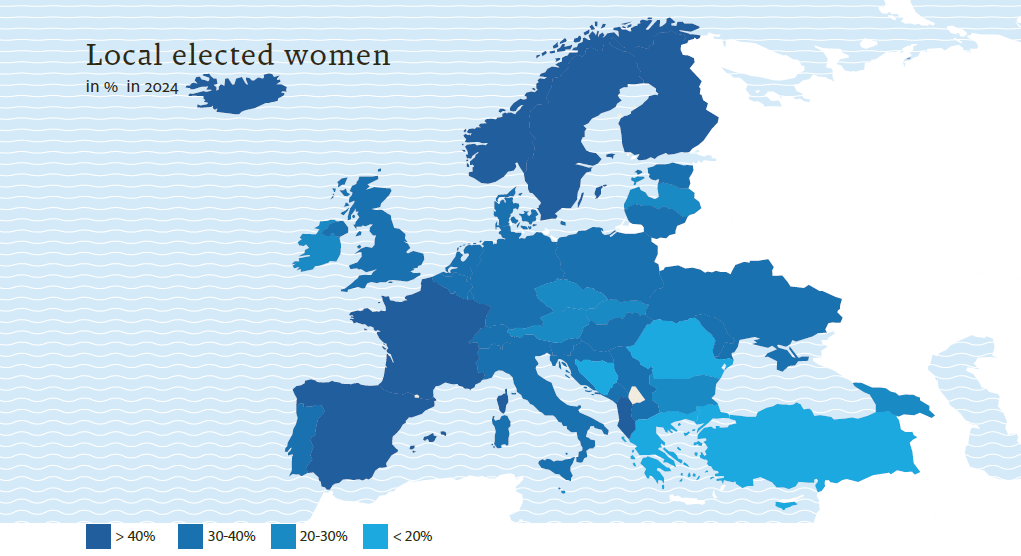
This study comes at a critical time. While representation in local councils has risen to above 40% in some European countries, leadership roles at all levels still show a troubling gender gap. At the national level, women’s representation in parliaments averages around 33%, with notable disparities among countries. In the European Parliament, women currently occupy 38.5% of the seats, which is the first decrease in the proportion of women Members of the European Parliament since 1979. 

Source: Women in Politics – Local and European Trends, page 14

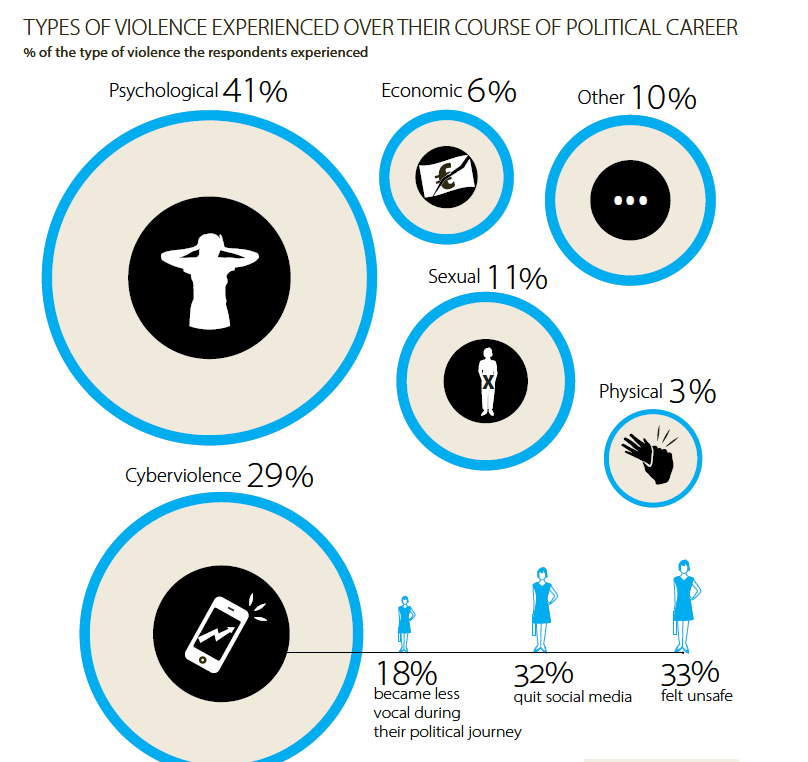
Violence against women in politics, both physical and digital, remains a major deterrent to women’s political participation. The data collected shows that 32% of respondents have experienced violence during their political career, and of those that suffered some type of violence 29% experienced cyberviolence. As highlighted by one of the speakers, Dr Marta Mazurek, Councillor from Poznan, on “recognising the serious consequences of cyberviolence” signalling that the responsibility to combat online harassment lies not only with national bodies but also with local authorities dedicated to fostering inclusive governance. 

Only 29% of those affected by violence had reported experiencing different types of violences, which may not only undermine their personal well-being but also their potential participation in politics. Angela Lowe, Senior Advisor at Women Political Leaders (WPL) emphasized that “the path towards a safe environment for women requires a collaborative effort,” underscoring the importance of working together across sectors to protect women in politics. 

Source: Women in Politics – Local and European Trends, page 87

The Women in Politics study collected data from across Europe, presenting the importance and need for reliable data on women’s political representation and experience to ensure informed policies and targeted actions. Robin Devroe, a researcher at the Vrije Universiteit Brussel (VUB), pointed to the broader impact of these challenges, noting that “these issues of gender-based violence contribute to a more global cycle of underrepresentation,” which weakens democratic structures and the inclusiveness of policymaking. Additionally, women from disadvantaged backgrounds—such as women of colour and LGBTQI+ women—are particularly vulnerable, facing unique and compounded challenges that further hinder their political participation. 

The study also underscored that lasting change will require widespread engagement from everyone within society and the need to shift our mindset of the current social and cultural norms and attitudes towards more inclusive equality, with Sari Rautio from Hämeenlinna City Council in Finland stressing that “all genders, all girls and boys should be interested in working on gender balance”. 

Read the Full Report 

For a deeper understanding of these findings and practical recommendations, the Women in Politics: Local and European Trends report is now available on the CEMR website. This study serves as a call to action for governments, communities, and advocates to work together in building a political landscape that champions gender equality and safeguards women’s participation across all levels of governance. 

For more information, contact:

X Budgeting – power of subnational finance

Participatory Budget - Youth

Municipalities and regions explore new approaches to budgeting, from participatory and priority-based models to green and SDG-oriented practices


Municipalities, cities and regions across Europe are at the forefront of delivering essential services, from housing and health to climate action and mobility. Yet, they face increasing financial pressures, recovering from the pandemic’s “scissor effect” of higher costs and lower revenues, and coping with inflation. In this context, how budgets are designed and allocated has become a powerful political tool.

To explore this potential, the Council of European Municipalities and Regions (CEMR) organised a training event on 23 May titled “X-budgeting – the power of subnational finance.” The session brought together experts and practitioners to share knowledge on innovative approaches to local and regional finance.

“X-budgeting” refers to a range of methods that go beyond simple accounting, transforming budgets into instruments for shaping policy and engaging citizens. These include:

  • Priority-based budgeting, aligning spending with political or community priorities rather than repeating last year’s allocations.
  • Process-based budgeting, such as participatory models that involve residents directly in decisions.
  • Green and SDG budgeting, aligning local finances with climate goals and the Sustainable Development Agenda.

Each approach offers opportunities, from fostering transparency and boosting trust to mobilising investment for sustainability, but also poses challenges, such as methodological complexity, resource needs and the demand for strong political support.

By experimenting with new forms of budgeting, municipalities and regions can make financial choices that not only keep services running but also reflect citizens’ voices and accelerate progress towards long-term goals.

Read the study here

For more information, contact:

Europe engagement in localising SDGs

Localising SDGs study - News

European Mayors strengthening their engagement at UN High-Level Political Forum


A delegation of European Mayors and councillors is heading to New York to defend the key role of local and regional governments in United Nations intergovernmental bodies during the upcoming High-Level Political Forum (HLPF) (8-17 July).

This year, HLPF will focus on “Reinforcing the 2030 Agenda and eradicating poverty in times of multiple crises” and is held under the auspices of the Economic and Social Council.

Once again, European Mayors and councillors will make they voice heard and present how the local level can deliver sustainable, resilient and innovative solutions.

Among them are:

  • Véronique Bertholle, Vice Mayor on European and International Relations, City of Strasbourg (France), PLATFORMA spokesperson
  • Francine Farrugia, Local Councillor in the locality of Siggiewi (Malta), member of CEMR-PLATFORMA Young Elected Officials Committee
  • Clare Hart, Vice-President Montpellier Métropole, President of Crisis and Rehabilitation Group, Cités Unies France
  • Gail Macgregor, Leader of Dumfries and Galloway Council, Scotland, UK (COSLA), Spokesperson for Environment and Economy, CEMR Spokesperson on SDGs
  • Nicole Unterseh, Mayor City of Bonn (Germany), Deutscher Städtetag

Mayors and councillors will actively participate in several meetings, including the Local2030 Coalition Special Event “Unlocking transformative change through the localisation of the six SDG transitions” on 10 June, during which Francine Farrugia will officially present the CEMR-PLATFORMA 2024 annual study on SDGs.

This year, the study European Territories Localise the SDGs – The time for impact is running out gathers 46 responses from associations of local and regional governments, representing 31 European countries.

In the Foreword, Tengiz Mtvarelishvili, Chair of Telavi City Council in Georgia, and PLATFORMA Spokesperson, warns about delays in implementing the 17 Sustainable Development Goals (SDGs). “But there’s hope: local and regional governments are on the front lines, closest to citizens, and uniquely positioned to find tailored solutions”, he says.

Eva Baños de Guisasola, PLATFORMA Advisor on SDGs, Global Agendas and Climate, and Federica Bordelot, CEMR Director of Policy and Impact, will moderate several sessions.

To strengthen the voice of local and regional governments, PLATFORMA and CEMR are joining forces with the Global Task Force of Local and Regional Governments (GTF) led by UCLG.

This year, HLPF will be followed by the UN Summit of the Future, also in New York on 22-23 September, where local and regional governments will gather during an Action weekend ahead of the meeting.

Discover the study:

Check the agenda of the Global Task Force of Local and Regional Governments (GTF)

For more information, contact:

Unfair recovery fund distribution

Post-COVID Recovery Fund: centralisation and unfair distribution of resources risk harming cohesion in Europe


A new CoR-CEMR consultation shows that the territorial allocation of funds from the Recovery and Resilience Facility is widely perceived as unbalanced on the ground.

On the eve of a crucial meeting of European heads of state and government focused on competitiveness, the European Committee of the Regions (CoR) and the Council of European Municipalities and Regions (CEMR) unveil the results of their third joint survey on the implementation of the post-pandemic Recovery and Resilience Facility (RFF), which is worth €648 billion.

While the implementation of the RRF is at the halfway point, regions and cities still feel left aside from National Recovery and Resilience Plans (NRRPs). A new consultation conducted jointly by CoR and CCRE-CEMR confirms the highly centralised management of the RRF by the Member States.

Key findings

  • The territorial allocation of RRF funds is broadly perceived as unfair. Nearly half of respondents rate territorial fairness as “poor or very poor” while only a few see it as “good or very good”. And the degree of ownership at local and regional level is also unsatisfactory with significantly more respondents seeing it as “poor or very poor” than “good or very good”.
  • The green and digital transitions stand out as the two objectives supported effectively by the NRRPs, according to respondents in the consultation.
  • Conversely, fully one-third of respondents state that NRRPs do “not at all” effectively contribute to enhancing territorial cohesion, despite this being the legal basis and general objective of the RRF.
  • The involvement of local and regional authorities remains inadequately weak in the various phases of preparation, implementation or monitoring of NRRPs. The specific provisions of REPowerEU to improve the involvement of LRAs do not seem to have yielded concrete results.
  • Almost all respondents encounter barriers to their involvement in the NRRP. The main barrier identified is the national government providing an inappropriate framework for involvement.
  • The share of respondents who consider limited capacity or expertise within their region or city to be a barrier is significantly higher than in the previous consultation. This is likely linked to the higher-than-expected administrative burden of the RRF.
  • Potential overlaps and lack of coordination with cohesion funds remain the highest risk perceived by local and regional governments in the implementation of the RRF.
  • While the overall impact of projects funded by the RRF is rated positively by respondents, they are rather divided regarding its synergies with other funds, its additionality and flexibility.

Christophe Rouillon (FR/PES), Mayor of Coulaines and CoR’s rapporteur on the Mid-term evaluation of the Recovery and Resilience Facility said: “The results of the joint consultation underscore that the RRF is not the silver bullet it was claimed to be. The RRF was the appropriate response in a multi-crises context and will probably have had a positive macroeconomic impact. However, the centralisation it brought about as well as the deficiencies of the performance-based mechanism cannot be extrapolated to the future Cohesion Policy post-2027 if we do not want to put at risk that this policy remains the most efficient EU policy for delivering fair transitions throughout all EU regions.

Kamila Bláhová, Vice-president for European Affairs, Union of Towns and Municipalities of SMOCR (CZ), stated: “The RRF and the national recovery plans of the Czech Republic have a huge potential to support the efforts of local and regional governments aimed at revitalizing the local economy and green infrastructure investments at the local level. However, the issue of administrative capacity and poor synergies between the RRF and other EU funds present significant challenges. It’s crucial to optimize how subnational governments can maximise the use of this substantial funding source and that we address any shortcomings as the RRF moves forward.

Background

The consultation was conducted between January and March 2024, collating the views and experiences of 36 organisations representative of a variety of subnational government levels across 22 EU Member States. The respondents were from Austria, Belgium, Bulgaria, Croatia, Cyprus, Czechia, Estonia, Finland, France, Germany, Ireland, Italy, Latvia, Lithuania, Luxembourg, the Netherlands, Poland, Portugal, Romania, Slovakia, Spain, and Sweden. The geographical composition of the respondents was not identical to that of previous consultations.  Responses received from individual local and regional governments were also taken into account.

Results of the previous CoR-CEMR joint consultations (January 2021 and April 2022)

Read the study here

Contacts:
Matteo Miglietta – CoR
Tel. (+32) 470 895382
Matteo.miglietta@cor.europa.eu

EU elections call to action

CEMR advocates for local and regional priorities in call to action ahead of 2024 EU elections


The Council of European Municipalities and Regions (CEMR) is gearing up for the upcoming European Parliament (EP) elections in 2024 by releasing its Call to Action, addressing the unprecedented challenges faced by Europe and the world.

In a time when national governments grapple with complex issues, such as climate change, the revision of its competition model and geopolitical shifts, CEMR and its national associations underscore their unwavering commitment to fundamental values such as democratic governance, human rights, subsidiarity, and sustainability. CEMR emphasises the critical role of local and regional autonomy in the face of re-centralisation trends and attempts to diminish power at the local level.

Fabrizio Rossi, Secretary General of CEMR, highlighted the significance of this Manifesto, stating, “Now, more than ever, it is imperative that local and regional governments actively participate in shaping policies that address the pressing challenges of our time. The upcoming EP elections provide a crucial opportunity for collaboration and co-creation with the new Members of the European Parliament (MEPs).”

CEMR EU Manifesto Four Key Advocacy Points

1. Active Subsidiarity and Multi-level Governance Cooperation:

Subnational governments are responsible for over 50% of public investment, and the involvement of LRGs in implementing EU legislation at the national level is at least 70%. CEMR emphasises the need for greater participation of LRGs at any level of decision-making to ensure the effective deployment of EU legislation, especially concerning the Green Deal package.

2. Systemic Approaches for Equitable, Inclusive, and Sustainable Societies:

LRGs are key enablers of the digital transition and, therefore, need sufficient public and private investment in digital services technologies, infrastructures, and skills to achieve this goal. CEMR urges the next European Parliament to be bold in promoting an enabling environment that supports the digital literacy of local public administrations.

3. Integrated Territorial Approach:

Urban and rural areas should be treated as mutually complementary assets, creating a reinforcing relationship that defines the concept of the urban-rural continuum. To accomplish this synergy, the upcoming EU co-legislators should advocate for appointing a dedicated Commissioner for Territorial Development within the next European Commission, scheduled to assume office in autumn 2024.

4. Open and Responsible Model of International Cooperation:

LRGs have attested to their commitment to fostering shared values and promoting openness within diverse communities through European partnerships, twinning arrangements, and city-to-city cooperation. This dedication extends to the context of EU enlargement. To amplify the impact of LRGs’ territorial diplomacy, it is imperative for EU policymakers to establish ongoing dialogues and involve local elected representatives in high-level meetings, including those convened by the United Nations and European institutions.

As the clock ticks down to the EP elections, CEMR encourages political parties to incorporate these priorities into their programs and candidate lists. CEMR believes that only through collaborative efforts with Europe’s future policymakers can meaningful outcomes be achieved on the ground.

For more information, contact:

Prague declaration in climate policy-making

Prague Declaration 2023 - News 2023

CEMR Policy Committee in Prague issues a Declaration Advocating Systematic Involvement of Local and Regional Governments (LRGs) in Climate Policy-Making


Policy Committee of the Council of European Municipalities and Regions (CEMR) is meeting in Prague on 6 and 7 December, and the first day of its deliberations culminated in the adoption of a landmark document titled “The Prague Declaration: More Trust in and Stronger Voice for Local and Regional Governments”. This significant political act underscores the pivotal role that local and regional governments (LRGs) play in confronting the formidable challenges facing our municipalities and regions.

“The Prague Declaration” sends a clear message about the imperative need for a stronger voice and a more vigorous partnership between the European Union, national governments, and LRGs. It calls for a more active involvement and consultation with LRGs throughout the entire policymaking process.

Fabrizio Rossi, CEMR Secretary General, expressed his gratitude, stating, “We extend our sincere appreciation to the Union of Towns and Municipalities of the Czech Republic SMO CR for their proactive role in initiating the Prague Declaration. This document reflects our shared commitment to effective governance, sustainability, and the well-being of our communities. Together, we are charting a course toward a more resilient and prosperous future.”

This declaration serves as a roadmap for empowering LRGs to effectively fulfil their responsibilities to citizens, highlighting their strategic role in the implementation of both European and national policies. Only in this way will it be possible to achieve the common goals of climate and social sustainability, preserve our planet for future generations, and ensure prosperity and well-being for the citizens of our towns and cities, municipalities, and regions.

CEMR welcomes media coverage and inquiries related to the Policy Committee meeting in Prague. For further information or to arrange interviews, please contact:

Martina Lehmannová
lehmannova@smocr.cz

CEMR is the broadest European association of local and regional governments that brings together one million democratically elected European politicians, in 60 member associations from 40 countries since 1951.

SMO ČR: The Union of Towns and Municipalities of the Czech Republic is a voluntary, apolitical, and nongovernmental organisation. The Union’s activity is primarily based on the efforts of mayors, lord mayors, and representatives who, beyond their duties, dedicate themselves to general self-government issues.

Analysis of twinning in Europe 

Twinning Report - News

CEMR survey highlights evolving practices, challenges and opportunities for town twinning in Europe 


Town twinning has long been recognised as a bridge between communities, fostering cultural exchange and mutual understanding. Since 1951, the Council of European Municipalities and Regions (CEMR) has championed this practice, helping municipalities and regions across Europe build partnerships that transcend borders. 

A new CEMR survey, with 315 responses from 27 European countries, reveals how twinning is adapting to today’s challenges. While cultural exchanges remain important, local and regional governments increasingly view twinning as a tool for practical cooperation, from joint projects and workshops to exchanges of best practices. Nearly 80% of respondents expressed their intent to further develop twinning activities, with national associations showing particularly high engagement. 

At the same time, the study identifies three persistent barriers: limited financial resources, shortages of staff, and gaps in knowledge or experience. Respondents highlighted the need for more structured support to help municipalities realise their ambitions. 

Looking to the future, municipalities and associations are especially interested in using twinning to: 

  • Build sustainable networks that go beyond one-off exchanges; 
  • Access and manage EU funding opportunities for joint projects in areas like economic development, agriculture, and new technologies; 
  • Strengthen local capacity through training and guidance

CEMR concludes that twinning remains a relevant and powerful practice, but unlocking its full potential requires a multifaceted approach: more funding, better information on financing opportunities, and dedicated training programmes to empower municipal staff. 

With its long-standing commitment to twinning, CEMR is uniquely placed to drive this renewed agenda, helping towns and regions use partnerships not only to connect communities, but also to advance shared European priorities, from innovation to the localisation of the Sustainable Development Goals

Read the study here 

For more information, contact: 

Study on SDGs localisation

Energy Behaviour Forum - image 1

Discover our new study on progress made by local governments in promoting the Global Goals


The Council of European Municipalities and Regions (CEMR) and PLATFORMA are releasing today (12 July) their annual study on the localisation of the Sustainable Development Goals (SDGs) at a United Nations special event in New York. The study is presented by CEMR President Gunn Marit Helgesen at the 6th Local and Regional Governments Forum on the 2030 Agenda, organised in the framework of the High-Level Political Forum (HLPF), the United Nations annual event on the SDGs.

The report collects data from 41 associations of local and regional governments from greater Europe and makes seven recommendations. As estimates show, 65% of the 169 targets underpinning the 17 SDGs cannot be achieved without the involvement of local and regional governments.

One more time, this report resonates as a strong call to national and European institutions to further recognise and include in their reports progress made by municipalities and regions in achieving the SDGs. More than ever, decentralised cooperation and partnerships are crucial instruments to achieve the 2030 Agenda at the local and regional levels.

“We are fast approaching the halfway point on the road to the 2030 Agenda and the implementation of the Sustainable Development Goals (SDGs), meaning there are only six summers left!” warns Gunn Marit Helgesen, CEMR President, in the foreword of the study.

The 6th Local and Regional Governments Forum on the 2030 Agenda is organised by UN DESA, the Global Taskforce of Local and Regional Governments (GTF), UN-Habitat, UNDP and Local 2030.

Mayors have a say

This year, the European delegation of local and regional governments is composed of several mayors and councillors:

  • Gunn Marit Helgesen, CEMR President and Councillor of Vestfold and Telemark, President of the Norwegian Association of Local and Regional Authorities (KS)
  • Magda Kostava, Member of Kutaisi Municipal Council, Georgia (NALAG), member of the CEMR Young elected officials committee
  • Wim Dries, VVSG President and Mayor of the City of Genk
  • Luisa Salgueiro, President of the National Association of Portuguese Municipalities (ANMP) and Mayor of Matosinhos, Portugal
  • Manueal Alvares, Councillor in the Municipality of Matosinhos, Portugal
  • Stephan Neher, Mayor, City of Rottenburg am Neckar, Germany
  • Anne-Marie Jean, Vice-President of Eurométropole de Strasbourg (CUF)
  • André Viola, Councillor, Department of Aude (AFCCRE)

Fabrizio Rossi, CEMR Secretary General, Emilia Saiz, UCLG Secretary General, Lucy Slack, CLGF Secretary General, Unai Tellería, Delegate of the Basque Government (Spain) in the United States, Leen Verbeek and Mathieu Mori, respectively President and Secretary General of the Congress of Local and Regional Authorities of the Congress of Europe are also attending HLPF and parallel dedicated to local and regional governments.

More information:

For more information, contact:

Inclusion starts locally

Inclusive Migration - News 2023

Key lessons from IncluCities to improve migrant integration through multilevel cooperation 


The IncluCities project, led by CEMR and funded by the EU’s AMIF programme, has shown how local and regional governments (LRGs) can lead inclusive migration policies when equipped with the right tools and support. Over three years, eight cities and six national associations worked together in a mentoring scheme to improve local integration strategies for third-country nationals. 

From needs assessments to action plans and training academies, IncluCities focused on real collaboration between cities and their associations, guided by CEMR. The project clearly demonstrated that peer exchange and coordinated support lead to more effective and sustainable policies. 

Turning Practice into Policy 

Based on the project experience, CEMR outlines seven key recommendations

  1. Adopt a Whole Community approach – Integration policies should benefit all residents, not just newcomers, and promote active local citizenship. 
  1. Promote inclusion over adaptation – Inclusion must be a two-way process involving the whole community, not just the integration of migrants. 
  1. Train entire ecosystems – Sustainable action requires collaboration across municipal services, civil society, and migrant communities. 
  1. Guarantee meaningful participation – Participation must be recognised as a basic right and embedded in local governance structures. 
  1. Support migrant women – Women play a key role in communities and should be at the centre of local inclusion efforts. 
  1. Improve multilevel governance – Stronger cooperation between EU, national, and local governments is vital, along with direct access to funding. 
  1. Create local support networks – Clustered partnerships help cities share knowledge and raise their voice in national discussions. 

Conclusion 

Local and regional governments are essential in managing integration, yet they remain underrepresented in EU policymaking. As the New Pact on Migration and Asylum moves forward, CEMR calls for the full inclusion of local voices in shaping migration policy, especially those of small and medium-sized cities, which are closest to the ground. 

Read the position paper here 

For more information, contact: