


TERRI 2026 report looks at how Europe’s territorial governance is changing and why it matters
The Council of European Municipalities and Regions (CEMR) has published the TERRI 2026 Report, its latest assessment of territorial governance and reform trends. Drawing on evidence from CEMR member associations, the report examines developments in territorial organisation, governance arrangements, local and regional responsibilities, inter-municipal cooperation, fiscal capacity and housing governance. The central finding of TERRI 2026 is that effective governance is no longer defined by how institutions are structured. This edition focused on housing challenges in Europe.
Governance change is happening in how systems work, not in their structures
Since the first TERRI report in 2021, the focus of reform has shifted away from redrawing boundaries and restructuring territories towards improving how governance works in practice. Across Europe, efforts are increasingly centred on strengthening administrative capacity, enhancing coordination between levels of government, and delivering better outcomes for citizens
Shared responsibilities and growing cooperation
The distribution of formal responsibilities has remained broadly stable across much of Europe, although respondents in several countries reported examples of recentralisation or growing national influence over local decision-making. Delivery, however, increasingly relies on shared arrangements between national, regional and local governments, so how responsibilities work in practice matters more than the centralised/decentralised divide.
Cooperation is now mainstream: more than four-fifths of responding countries reported inter-municipal or alternative arrangements, increasingly covering areas such as spatial planning, economic development, social services, investment coordination and resilience preparation.
Capacity and financing remain critical challenges
Respondents to CEMR’s survey repeatedly pointed to administrative expertise, workforce capability and organisational resources as key determining factors for implementation. Performance depends as much on delivery capability as on institutional design. Fiscal pressures remain a key challenge, with many respondents highlighting the difficulty of balancing growing responsibilities with adequate resources, investment needs, and predictable long-term funding.
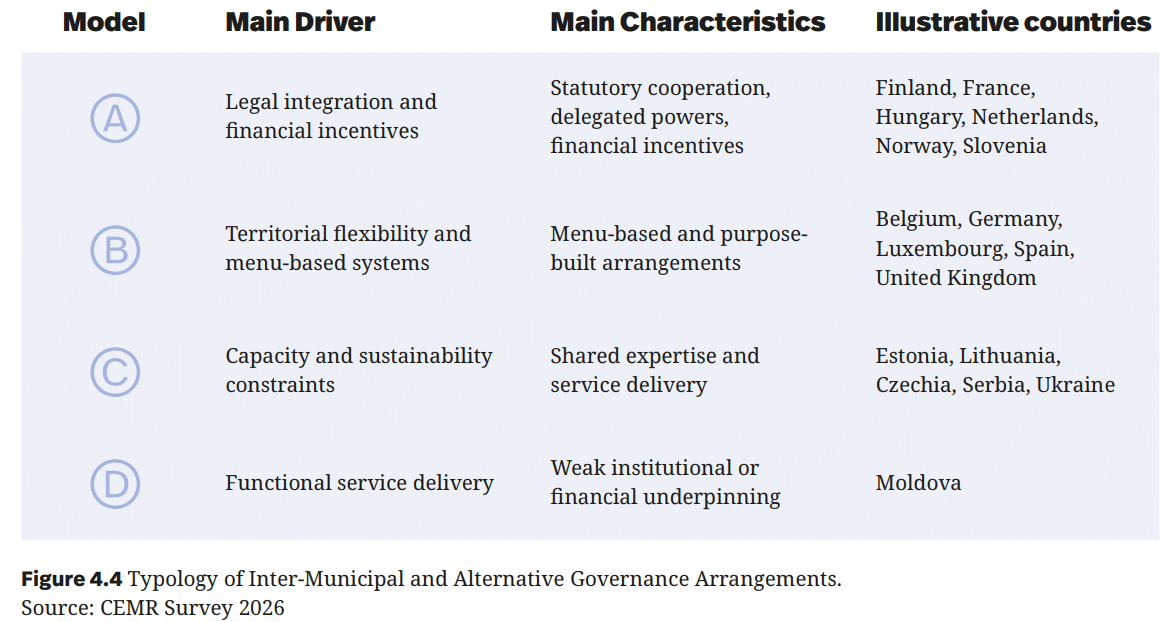
[on page 46 in PDF]
Housing: a test case for territorial governance
Housing is putting governance systems across Europe to the test. Affordability pressures, housing shortages, ageing stock and sustainability requirements are testing the ability of governments at all levels to respond effectively. The report finds that no single governance model guarantees better outcomes; success depends on how governance arrangements, financing, local flexibility and implementation capacity work together.
- Align responsibilities with resources. New or expanded responsibilities should come with sufficient, predictable funding: funding follows function.
- Put governance capacity at the centre of reform. Invest in skills, expertise, and institutional capability as a core part of reform.
- Promote multi-level governance based on partnership. Support European, national, regional and local governments in working together while respecting local autonomy, rather than pursuing centralisation or decentralisation for its own sake.
- Strengthen place-based approaches. Give local and regional governments the flexibility to adapt policies to local circumstances rather than imposing uniform solutions.
- Strengthen long-term capacity and fiscal sustainability. Support multi-annual financing, long-term investment planning, and greater fiscal predictability.
- Recognise housing as a strategic governance issue. Rather than promoting one model, strengthen the conditions for success: clear responsibilities, predictable financing, local flexibility, implementation capability and coordination across levels of government.
Towards better-functioning decentralisation
The report concludes that Europe does not need a single model of territorial governance. The challenge is not more or less decentralisation, but ensuring that arrangements support effective local self-government, policy delivery and democratic accountability. This also matters for the Sustainable Development Goals, many of which depend on local and regional governments turning objectives into results.
Successful policy outcomes depend on all tiers of government working together through governance arrangements that are capable, coordinated and responsive to territorial needs.
TERRI 2026 provides a timely snapshot of how these challenges are evolving across Europe, and CEMR will continue to work with its members and partners to ensure that local and regional perspectives help shape the governance solutions of tomorrow.
For more information, contact:
Senior Adviser, Governance, Gender Equality, Local Democracy